The end of this week’s Torah portion, Pinchas, outlines the offerings to brought to the Tabernacle and later to the Temple. It begins with the daily offerings, the weekly Shabbat offerings, and is then followed by the various festivals.
It is noteworthy that there was an offering presented by the priests every morning and every afternoon. Sacrifices were seen by the ancients as a way to connect with God; during a sacrifice, the boundary between life and death was crossed and that mysterious and powerful act was thought to bring God’s presence nearer. The Torah legislates that this does not happen only at special occasions or even just weekly, but rather every single day.
As a personal trainer, I can relate to this. In ancient times, the goal of sacrifice was to draw near to God. This could not be done in a haphazard way; it had to be done on a regular basis if there was any hope of achieving this aim. The same is true for almost any goal we set for ourselves. Whether in business, education or physical fitness, we need a regular program to help us get where we want to be.
I tell my clients that it is good that they see me on a (mostly) regular basis, but once or twice weekly may not be enough to lose the weight, tone up, build strength and endurance, etc. The effort needs to be daily, lest we miss a day…and another…and another.
Parashat Pinchas reminds us that this approach is valid not just in our earthly pursuits, but in our quest for the Divine as well.
Parashat Korach is considered by many to be the most revolting Torah portion there is. (See what I did there?) It is about the rebellion of Korach, Datan and Aviram against the leadership of Moses and Aaron as the Israelites began their wanderings in the wilderness on their way to the Promised Land.
At first read, the case brought by Korach and his followers seems like a legitimate challenge. They want to know who put Moses and Aaron above everyone else; after all, are not all the Israelites holy? Traditional commentaries have noted that their complaint was really a cover for a power grab. Whereas Moses felt a responsibility to God and the people, it appears that the rebels were more interested in elevating themselves. These are two very different views of leadership, and ultimately God makes it clear which one is preferable; Korach and his followers were swallowed whole into the earth.
On this post-Independence Day Shabbat, we reflect upon the history of our nation. Like at Passover, we recognize the value of the freedoms that we sometimes take for granted. We also consider those whose leadership—like Moses’—brought us through many challenging times. It has been the sacrifices of members of our Armed Forces that have helped to ensure our freedoms, but it has also been the service of duly elected officials that have labored on behalf of the people. Likewise, each of us has a responsibility to hold our officials to the standards set by our Constitution and our history; that is part of what we do to preserve this grand democratic experiment. Let us be wary, though, that we do so for the right reasons—not for a power grab, but rather to benefit all those with whom we share this great country.
There are some weeks when it seems as if everything going on in the world around us is disconcerting (to say the least). There is division, strife and suffering. One could say that the level of discourse is at an all-time low, but there isn’t a whole lot of discourse going on. There is a lot of talking “at,” and not a whole lot of talking “with.” It spreads a cloak of darkness across society.
Like a ray of sunshine on cloudy day, though, there are still acts of kindness that warm our hearts and remind us that there is a lot of good in the world. I am reminded of Oskar Schindler, who in the midst of all the atrocities during the Holocaust, saved hundreds of Jewish lives; of course, this was only one person and his actions were only a drop in the bucket compared to what could and should have been done. Even so, that drop in the bucket made a huge difference—especially to those on his famous list and their families.
Closer to home, there are friends and neighbors who are also helping to bring light into a dark world. They are talking “with” their fellow human beings. They are trying to lighten the burdens of those who suffer. It may seem like a drop in the bucket, but its significance is great.
On this Shabbat, I will be thinking about what I can do to “be the light” we need in this world. I am only one person; alone I cannot solve the challenges we face. The more who join the effort, however, the higher the odds we can redeem this very broken world.
For about 18 months now I have tried to build a meditation practice. I was first introduced to meditation at the Rabbinic Training Institute, a yearly program for rabbis sponsored by the Jewish Theological Seminary of America.
For a long time, I thought that meditation was a bunch of yoga/granola/tree-hugging hooey…until I tried it and learned a little more.
Meditation is not the only way that I try to calm my mind. I have been a regular davener (Yiddish for pray-er, ie, a praying person) for over 30 years, every day, three times a day. I will admit that not every prayer experience is what I hope it to be. Sometimes it seems like a chore, or I just rush through it, or I am anything but mindful–letting my mind wander in a thousand directions. Other times–especially when I am with a minyan (a group of 10 Jews)–I do feel spiritually connected, and allow myself to calm and simply be. Whether it is successful or not, it is significant that I take time out of every day to stop and try to connect with something outside of myself.
My favorite way to calm my mind is Shabbat–the seventh day, the day of rest. I feel like practically my whole week is aimed at Shabbat, preparing for it, waiting for it, missing it…. As an observant Jew, I try to have all the preparations ready before sunset so that I do not have to worry about cooking, cleaning, shopping, etc. It is a gift that God gave to us, and a gift that I give to myself each week. It is the one time during the week when I feel most present for myself and those around me.
And then there is meditation. Why is this so difficult? Why during the week is it nearly impossible for me to get my mind to settle? I find that many times I cannot seem to turn off the thoughts that rush into my mind, and then my thoughts run down the rabbit hole wherever it leads. Other times, I simply fall asleep.
I join a weekly Jewish meditation group on-line for 15 minutes of Torah teaching followed by 30 minutes of meditation; we sit in silence all of us, with our screens in front of us. Like my davening, there are times when it is great, and others where I feel like I “accomplished” nothing. I guess that is why it is called a “practice:” it is never perfect just a continual rehearsal to try to get there.
Speaking of practice, that is the same word used for Yoga. In the past, I have done a lot more yoga than I have since I moved; I hope to remedy this. Almost every time I practice yoga I do feel like my mind is calmed and I am totally present. Perhaps it is because it is so tactile, rather than simply a mind practice. It could also be the group setting (see my minyan comment above). Maybe the influence of others around me doing the same thing helps me to flow in the right direction. Maybe that is why the on-line meditation is so challenging.
Of course, the big question is: why is it important to calm one’s mind? We live in a world that now more than ever bombards us with information, distractions and demands. We often end up on that hamster treadmill, running and running, and getting nowhere and tired real fast.
None of us wants to live our lives this way, on a treadmill, never examining who we are, what we do, what interests us, what makes us passionate. On a regular basis, we need to calm ourselves and reconnect with the Source of All and with ourselves.
Not everyone will do this in the same way. Doing so, however, has great benefit. Not only does it helps us to ground ourselves in this big world, but it also has many health benefits.
Am I perfect at this? Is my prayer, my yoga, my meditation, my Shabbat everything I want it to be every time? Not by a long-shot; sometimes I am just that metaphorical dog asleep on the couch. In the meantime, I will continue to practice calming my mind, calming myself, and reconnecting with what is truly important in my life.
It is well known that going to the gym and starting to work out without some kind of warm-up is not the best idea. The same is true with relationships; when you meet someone, it is best not to propose marriage on the first date!
Now that Shavuot is in the rear-view mirror, I am feeling the same way about the high holidays that are just a few months away. (I know!?!?) While it is true that the month of Elul is really the time to gear up for the Ten Days of Repentance, summer gives us a bit of a longer runway.
If we think about it, when we are listening to your GPS and get off course, it is best to try to make a correction as soon as possible. The further we keep driving on the wrong path, the more difficult it will be to get back on track and to our final destination. Think back to the High Holidays last year. Do we remember the goals we set and the changes we wanted to make?
We should not wait until Elul to take this walk down memory lane. If we set our hearts, minds and souls to it, we can arrive at Elul already well back on track.
We often think of summer as a relaxing time. (It should be that too!) From a Jewish standpoint, however, it is time to orient ourselves to the task of meeting our goals and making the necessary changes.
So…enjoy the weather, let’s not forget what lies ahead as the days begin to shorten.
It has been interesting and emotional to watch as our nation and Europe marked the 75th Anniversary of the D-Day Invasion during WWII.
This heroic and painful endeavor turned the tide of the war in Europe and led to the eventual liberation of those on the continent who were under Nazi control. What we have learned since 1944 (and perhaps knew all along) is that liberation is not just a one-time event; just because the Nazi forces were pushed back and eventually surrendered does not mean that everything in Europe was rainbows and unicorns. There is a never-ending struggle to create, uphold and defend the institutions of freedom. There is also a recognition that freedom is not just for freedom’s sake; that liberty should be used for a higher goal to enrich the lives of those living under it, allowing for peace and justice to survive and thrive.
It is a meaningful coincidence that this milestone anniversary was celebrated just before the holiday of Shavuot. This holiday recalls the giving of the law at Mt. Sinai; that event is what the exodus from Egypt was all about. Freedom from Egypt was not just an exercise in liberty for the sake of running around the desert doing whatever we pleased. It was liberty in order to serve God and our fellow humans (rather than an earthly ruler like Pharaoh). Just as in Europe after the conclusion of WWII, this process is not over. It did not end when the sea closed in on the Egyptian Charioteers. It did not end when the Children of Israel received the Torah. It did not end when we entered the Promised Land. And it did not end when we went into exile. The work is never done.
The 75th Anniversary of D-Day and Shavuot are strong reminders to us that not only is the work of freedom never done, but that we must also remind ourselves for what purpose liberty has been won.
On Thursday I was at the JCC swimming pool. At the far end of the pool was a little girl (maybe 12-15 months) being held by her dad. She was crying (which is why I noticed her) and holding on to her daddy with all her might. And I had a flashback to my own days as a father of a young child.
I remember those days when my children (the youngest of whom is 19) would hold on to me in the pool. That firm grip from those little hands and arms reminded me of just how much my kids needed me. At the same time, it was heartwarming to know that not only did they need me, but I was able to give them exactly what they needed: a sense of safety and security. There is nothing in the world like that feeling.
Even though my kids are grown up now, I know that they still need me…but in different ways. I also recognize that at different times there are others who need me. There are members of the congregation who depend on me for guidance, and who know that at some time I may need to accompany them through a difficult time. There are clients of mine at the JCC who depend on me to help them reach their fitness goals in a safe and effective way; others rely on me help keep them active and independent in their older years. There are also those in society in general who count on me as a fellow citizen to do the right thing, to support the positive endeavors in which we are engaged, and to help them meet their needs.
It feels good to be needed, but it feels even better to be able to provide for those needs. This is a Jewish value to be sure, but more than that, we know it to be true in our hearts.
I don’t know if you saw the news article from the Washington Post on Wednesday, but there was a distressing article about the amount of trash washing up on remote islands these days. One beach alone, was littered with 414 million pieces of garbage—most of it plastic.
What are we doing to our planet? What are we doing to make it better?
The Torah itself wants us to take care of our home because it’s the only one we have. In the story of Adam and Eve in the Garden, God told Adam that the world was his to work and guard. This is not a coincidental use of words. From the very beginning, the Creator made clear that we are to make us of the planet, but we must also see to it that we do so in a responsible way. It needs to be healthy for generations to come.
Our weekly Torah portion, Behar, touches on this same theme. We are introduced to the laws of the Sabbatical Year and the Jubilee. During the Sabbatical Year, field were supposed to lie fallow and trees and bushes untended. Does this sound like modern crop rotation techniques today? The Torah tells us that this would occur once every seven year; it is still observed in a modified way in Israel to this day.
We may not be able to observe the Sabbatical Year in the USA (and in fact the mitzvah only applies in the Land of Israel), but there is much more we can do to care for the planet. Remember: reduce, re-use and recycle. Your Mother Earth will appreciate it…and so will coming generations!
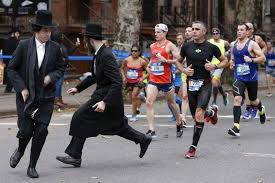
A few days ago at the Mandel JCC, a member who is a regular and long-time runner–who knows that I am a rabbi and a personal trainer–asked me (out of curiosity, I suppose), if running is permitted on Shabbat (the Sabbath).
This was not really the kind of question that I could answer on one foot (even though my left foot is still in a boot!), but I gave him the short answer, and promised to do a little more research. The short answer (so Jewish!) is: yes…and…no. It depends.
I started my “little more research” at my favorite Halachic (Jewish legal) source, Rabbi Googlowitz. A simple search on http://www.google.com revealed a surprisingly large number of web pages on this topic.
The long and the short of it…here is the issue. Traditionally, Shabbat is seen as being observed in two general ways: Shamor (guarding) and Zachor (remembering). These two broad categories come from the fact that the Aseret Hadibrot (The Ten Commandments) appear twice in the Torah–once in the Book of Exodus and once in the Book of Deuteronomy–in almost identical form. With regard to the observance of Shabbat (the 4th Commandment), one version uses the word Shamor and the other Zachor. Commentators said that the verses differ in order to instruct us that there are two aspects to making Shabbat holy and special. One is through guarding (observing the myriad laws about what can and cannot be done on the 7th day); the other is through remembering (doing the non-legal things that bring enjoyment to the day like having a festive meal, visiting friends, studying Torah, etc.) , often referred to as Oneg (literally, “joy”). The question becomes: is running simply exerting one’s body and therefore considered to be a violation of shamor–a kind of “work” with a productive purpose…or…is running an enjoyable activity in whose participation we can derive enjoyment, and therefore a kind of Zachor/Oneg? If the answer is the former, it is forbidden; if the answer is the latter, it is permitted. So…you are allowed to run, but only if it’s fun!
This is a very condensed version of the answer, but I was surprised to find that two pretty traditional websites: http://www.aish.com (Aish HaTorah) and http://www.ohr.edu (Ohr Sameach) said pretty much the same thing. Check them out for yourself to get the sources and the context.
By far the most comprehensive article I could find on the topic was written by my friend and colleague, Rabbi Jonathan Lubliner; it was endorsed overwhelmingly by the Committee on Jewish Law and Standards of the Rabbinical Assembly (the rabbinic association of the the Conservative Movement–which is ironically the name of one of the liberal/progressive branches of Judaism). He covers all kinds of exercises and the various circumstances and contexts in which athletic activities are permitted or not. Here is the web address: https://www.rabbinicalassembly.org/sites/default/files/public/halakhah/teshuvot/2011-2020/lubliner-recreation-sports-shabbat.pdf
My conclusion: like everything else having to do with exercise and athletic activity, if you’re not enjoying it…either you’re doing it wrong or perhaps you shouldn’t be doing it at all!
It has been a distressing week in the news—more than the usual. Between the tariffs/trade wars with China, the growing tensions between the US and Iran, and the most recent passage of the strictest reproductive rights legislation since before Roe v. Wade, there is a lot about which we should be concerned—no matter our political leanings.
Often, I feel like there are forces at work in the world much larger than I, and I wonder what power I have to influence these processes for good. Frequently, we sense that there is not a whole lot that we can do. As we say in modern parlance, “it is what it is.”
Of course, “it is what it is,” is not really a Jewish value. Our tradition has never taught us to just accept things the way they are—not even the very teachings of the Torah. Everything is up for interpretation, and it is possible to come up with more than one way of looking at a problem and its possible solutions. In contrast, to “it is what it is,” Judaism’s focus has been more on looking at “what is” and imagining how to make it “what ought to be.” This is why we have such a fine tradition of kvetching (complaining); it is not just kvetching for its own sake, but rather to stir us to action. We cannot just sit and stew about the state of our community, our nation, or our world. We must find ways—big and small—to make God’s creation closer to the image that the Divine intended.
What can we do—as individuals and as a community—to make a world filled with peace, justice, prosperity and love? I don’t know for sure, but surrendering to hopelessness is certainly not the solution.










 Kosher Fitness