
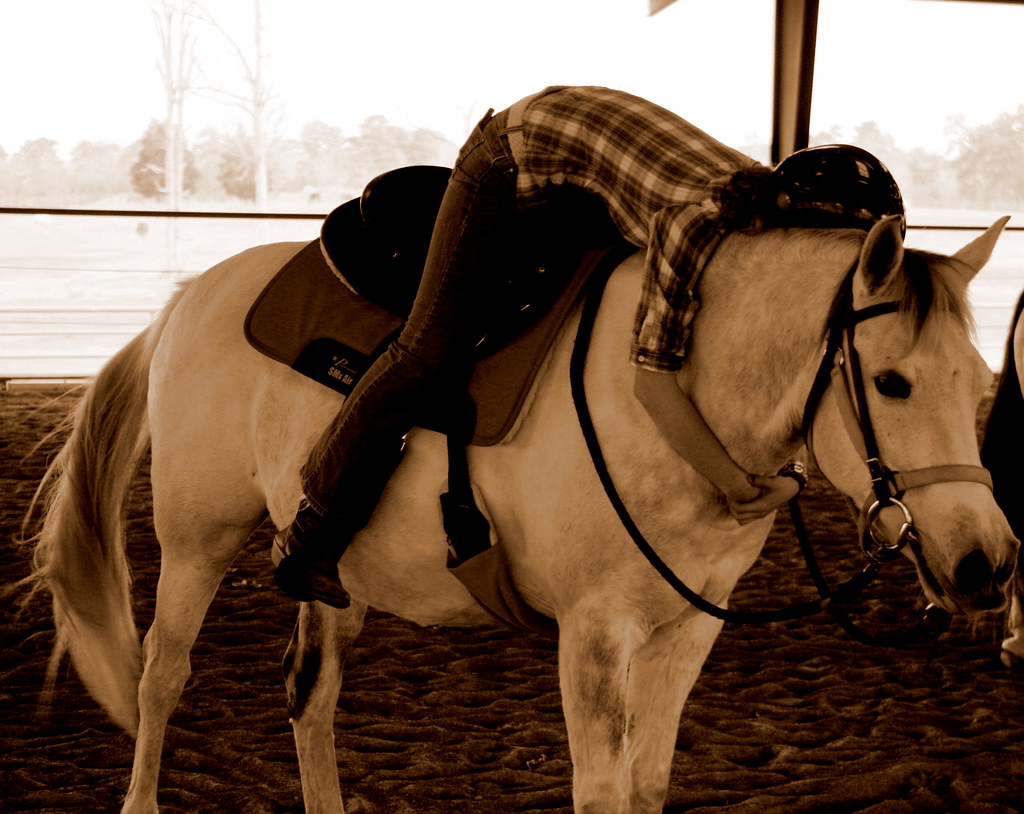
“Getting Back on the Horse”

Today was my first day without any physical restrictions after having a surgical procedure four weeks ago; luckily, I am fully recovered and the procedure was successful. This was not the case six weeks ago; I had actually undergone the same procedure in mid-November and was not given the clearest guidelines for what recovery should look like. As a result, the procedure was not successful and I had a second go-around at the end of December. The second time, before surgery I was told to plan on 7-10 days without strenuous activity, but at the 7-day mark the nurse practitioner told me since I was a “repeat offender,” I should count on four weeks instead! Not fun for a personal trainer and someone who likes to stay active. I did not, however, want to undergo the procedure a third time so I took an entire week off of work after surgery and did not exercise for three weeks afterwards–although walking was encouraged.

I did blog about my recovery from foot surgery a few years ago. In that post, I shared five important pieces of advice for “getting back on the horse.” 1. Listen to your doctor, but also listen to your body. (I knew within a few days that the procedure in November had not worked even when I was told to give it some more time.) 2. Go slow; after an absence from the gym, do not just jump in where you left off but ease back into it carefully. 3. Set goals and have a plan for how to get there; having this written out clearly will facilitate a safe return to exercise. 4. Do not get impatient or give up; everyone’s recovery time is different and it may take longer than expected or desired. 5. Do some research; the more you know about the recovery before the procedure, the more realistic you will be going into it.

This afternoon when I taught my on-line fitness class, I participated in the workout instead of just sitting in a chair and giving instructions. I planned a workout I knew I could handle and…so far, so good. Many people do ask, though, how much “damage” or regression occurs when we do not exercise…and how soon does it happen?

Cardiovascular capacity can be decreased within just a couple of weeks–even more quickly for those who are endurance athletes like long-distance runners or cyclists. Muscle strength that is recruited during resistance training begins to suffer after about 3-4 weeks. These are just estimates and the actual amount of time will vary due to the level of fitness before the break, how active a person remained during the break (bed-bound vs. walking), and the cause of the recess. Obviously, a person who has joint replacement may take much longer to recover fully as opposed to a person who has an appendectomy. Each person is different so, as noted above, listen to your body.

I am grateful to my doctor and the nurses for getting me hale and hearty. I am thankful that they were extra-demanding of me the second time around. It made the difference in a complete recovery–even if I was starting to get restless.

After a fitness break–due to health reasons, travel, etc.–it will take time to get back on that horse…but get back on that horse we must. The more we take care of ourselves, the less likely we will need to take those medical breaks in the first place.

More Adult Playgrounds

Two years ago, I blogged about an exciting trend in which municipalities are building public, outdoor fitness parks. They contain equipment designed to provide a workout for a wide range of abilities and age groups–except for kids.

The June 2023 issue of AARP Bulletin shared an update on this trend; AARP has been a key partner in providing grant money for these facilities. In 2019, AARP committed to build fitness parks in every state together with the organization FitLot. Currently there are 53 parks–with one in each state as will as the US Virgin Islands and Puerto Rico; in most communities classes and orientations are held at the parks.

This is very good news, but when I checked the nearest park to my home is an over 3-hour drive away. That means there is still a need for these kinds of facilities in much greater numbers. Contact FitLot and/or AARP to find out what it would take to get one in our community. In the meantime, there are more fitness parks that are not a part of this program. Check with your local municipality about availability where you live.

Keeping older adults active is key to remaining healthier and more independent. Fitness parks are another resource to help us all reach that goal.

Revisiting: To Shovel or Not to Shovel

Snow Shovelling - DSC 4903 ep

The past weekend saw record amounts of snowfall in some parts of the East Coast. The next few days call for possible records in parts of the Midwest.

A topic that comes up every now and again–and that I addressed in a blog two years ago–is how dangerous it might be to shovel snow from a health standpoint. We hear stories about people having heart attacks while shoveling, but what is the real story?

According the MetroHealth website (one of the hospital networks here in Cleveland): “Shoveling, even pushing a heavy snow blower, can cause sudden increase in blood pressure and heart rate, and the cold air can cause constriction of the blood vessel and decrease oxygen to the heart. All these work in concert to increase the work of the heart and trigger a potentially fatal heart attack.” What we have here is a kind of double-whammy. On the one hand, the physical exertion leads to elevated and respiratory rates, while on the other hand, the cold air may prevent the additional oxygen from reaching the heart where it is needed most.

For most folks in decent health, the risk still remains relatively low. In fact, according to an article from Harvard Medical School, only about 100 people die each year from shoveling snow. If, however, a person already has compromised heart or lung function or is elderly, there is definitely a risk factor here. See my last blog post on the likelihood of heart attacks from strenuos activity in general.

Each person knows their own body best. While there may be a low risk of a cardiac event, it is possible to develop issues with soreness of muscles or damage to tendons and ligaments as a result of shoveling. Perhaps most noteworthy is the danger of slipping on ice if such conditions exist. Younger adults may end up with only a bruise or a sprain, but older adults may have an increased risk of fractures, which can lead to further complications.

Weigh the pros and cons…and consider that paying the neighbor’s kid to shovel may not only help preserve your health, but also help a young entrepreneur on their way to self-sufficiency!