
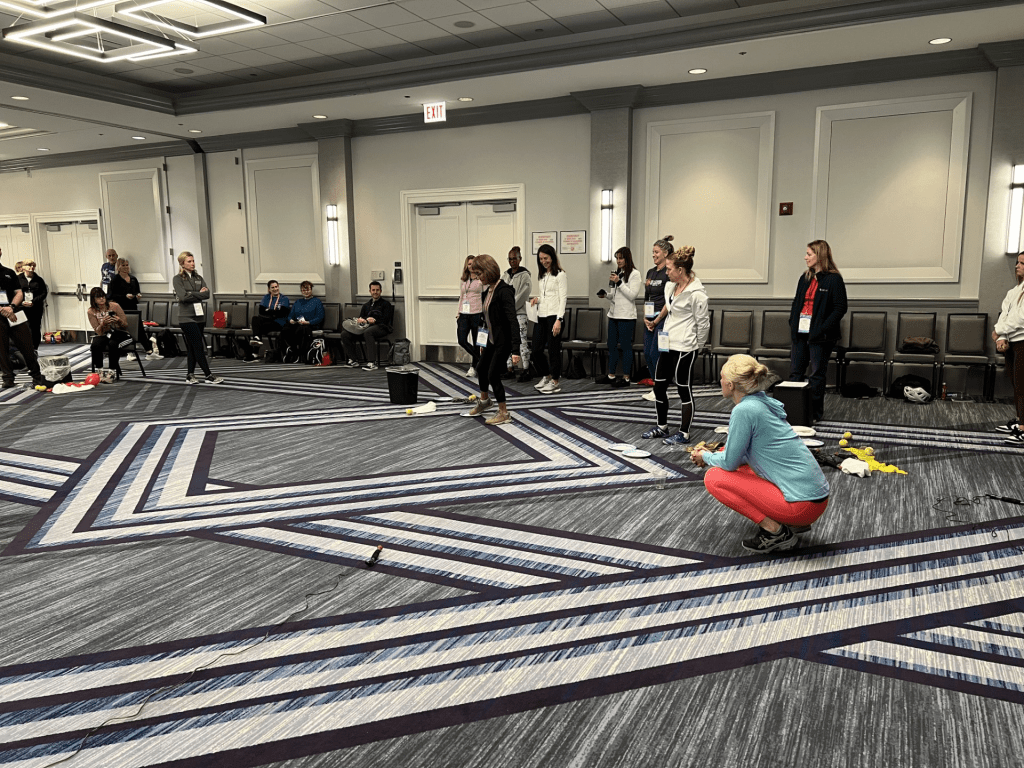
One of the biggest obstacles facing us at all ages is sedentarism; this is just a fancy word for “not moving.” It is definitely a 21st Century word. For many, the situation got worse since COVID; we used to walk around an office or visit customers, but now a lot of us are just sitting in front of computers. I certainly was more active at the gym when I barely sat down; now I spend about half of my day working with clients virtually sitting on my kiester.
At the recent IDEA & ACSM Health & Fitness Summit, I took a session with Judy Juvance-Heltzel and Stephanie Davis Dierenger (both of University of Akron) entitled “Promoting Life-Long Physical Activity: Strategies for All Ages.” The course was divided into two parts: 1. theory and strategies, and 2. brainstorming and presenting.
We are being encouraged to focus less on the word “fitness” and more on the word “movement.” People are often put off by the word “fitness;” they think that if they are not “fit” then the activity will not be for them. “Movement,” on the other hand, is something that almost all of us do and we should strive to do more. Of course, as trainers, we do not want to focus just on movement; the progression should be from movement to physical activity to exercise to fitness. It is the obligation of fitness professionals to move individuals from one level to the next.
The active part of the program (pictured above) required us to grab a bunch of objects that we can find at home and find ways to make them into “fitness equipment.” Tennis balls to staplers to trash cans to paper plates all became devices to get people moving at home. Why articles that are found at home? Many folks are turned off by the idea of going to a gym or cannot afford it. We were challenged to provide ways for people to move more using what they can find close at hand. It was a real throwback to the early days of the pandemic when very few people had exercise equipment at home and we were working out with canned goods, books, and cans of paint. The solutions worked for people at any age with any level of fitness!
It is not ideal for individuals to exercise only in this kind of ad hoc way, but it can be a start to more frequent movement which will lead to activity, etc. What I liked was that the course got us all thinking creatively. Sedentarism is a serious problem and if the old solutions worked the issue would be solved already. Using a little ingenuity, we can help to bring greater levels of fitness and awareness of activity to those who are mostly just sitting around–from children in front of their screens to older adults in front of the TV.
What have you got at home that you can use to exercise? Here is a hint: can you squat while picking up a full trash can?

 Kosher Fitness