
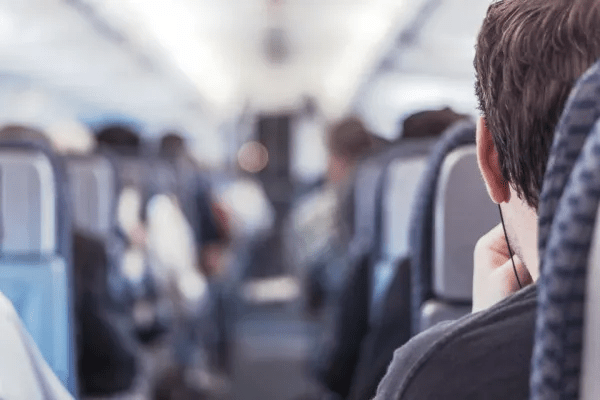
With November right around the corner, we enter into a heavy travel season: Thanksgiving, Hanukkah, Christmas and New Year’s. Travel will be brisk this year as the pandemic has been (mostly) tamed and folks are feeling more confident about taking longer trips to see loved ones.
Many of my clients do quite a bit of air travel–some of it long-haul–and they have asked me about the best exercises to do while on a long flight to prevent problems. The number one issue of concern is DVT (deep vein thrombosis); this is when a blood clot forms deep inside the body (very often in the legs) and it is more likely to occur when we sit for long periods of time. The clot can move throughout the body and cause serious health issues.
In-flight exercises–in addition to plenty of water–can help prevent DVT. What are the recommendations–especially given how tight space is on most airliners?
- If you are able to get up and walk around (after the “fasten seat belt” sign has been turned off!) that is a great idea. This is more difficult in narrow-body planes, but you can carefully stand in place and look to see if the aisles are crowded or if in-flight service is in progresss. If the coast is clear, take a stroll. On wide-body jets with two aisle, it may be possible to do a big lap around the plane. Do this as often as feasible.
- Exercises that can be done while seated include: ankle rotations (lift your foot of the floor and rotate your ankle); “quick feet” (running in place tapping either heels or toes quickly on the floor–alternating sides); calf raises (lifting heels up and then lowering them); leg extensions (straighten alternating legs so the foot comes off the floor); knee-ins (bring both knees or one at a time up to the chest and hold with hands); glute squeezes (clench those butt cheeks together); forward bends (lean forward as far as you can bringing your head down). Upper body exercises include shoulder rolls, elbow flexes (like a bicep curl without weights), and punches (don’t hit the back of the seat in front of you).
- There are also many stretches that can be done while seated–both dynamic (active) and isometric (holding a stretch still).
A simple internet search will turn up lots of exercises to keep moving during the flight. Just make sure that whatever you do is in compliance with crew member instructions–and be aware of those seated around you who might be affected (ie, poked in the eye) if you are not careful.
Finally, these exercises work on long car, bus, and train rides as well. If you are the driver, make sure to stop with regularity in order to walk around and do some of these exercises as well. It goes without saying (I hope) that you should find a safe place to do this like a parking lot in a gas or EV charging station, or a rest area. The side of the road is more dangerous than a DVT.
I hope these tips help. Bon voyage!
 Kosher Fitness