
Best Exercises for Osteoporosis

October 20 (yesterday) was World Osteoporosis Day. I blogged about Osteoporosis several years ago, but here is a quick refresher. It is a condition that weakens the bones and makes them more susceptible to injury and breakage. Although it mostly affects women, Osteoporosis can happen to men as well.

In my previous blog, I discussed the importance of weight training for those with this condition. As always, caution should be used in any exercise program and it is best to consult a medical professional before beginning. Although we have been accustomed to hearing that older people should not work with weights because they might hurt themselves or break a bone (which can happen), the opposite is the case with osteoporotic individuals. Putting controlled stress on the bones makes the stronger; working with weights does not just build muscle alone.

What are the best exercises to do for those with Osteoporosis?

According to the Cleveland Clinic, cardio exercises (that help to build heart and lung capacity) should have a weight-bearing element to them. Swimming and biking are not weight-bearing, so while they are good for the body, they will not strengthen bones. Walking, running, and dancing are examples of exercises that will affect the bone structure.

As for resistance training (using weights), the Cleveland Clinic suggests focusing on the parts of the body that are most likely to suffer a fracture: spine, hips, and wrists. As we age, many of us use lighter weights and do more reps (repetitions of the movement), but with Osteoporosis there must be enough weight/resistance to cause the bone to respond; this requires using heavier weights and doing less reps. It is important to work with a fitness or PT professional to determine the right weight, exercises, and number of reps to be most effective. Certain stretches are also important: back extensions, shoulder shrugs and rolls, knee raises, and flexing the ankle so that the toes come up toward the knees.

There are elements of diet and medications that can improve the condition, but certainly exercise is an important aspect of managing Osteoporosis. On World Osteoporosis Day, we raise awareness of the condition, the ways it can be treated, and the importance of continued research that will allow older adults to live longer, stronger, and healthier lives.
Just for the Women

This is my third report on the IDEA/ACSM Health and Fitness Summit in Chicago at the end of last month. The third session I attended was entitled “Everyday Strength for the Older Female Client;” the instructor was Keli Roberts. I was very interested in this class because approximately half of my clients are older women. Over the years I have learned a lot about the needs of older adults, so I was looking forward to finding out what particular issues women face as they age.

In all honesty, most of the class really applied to older adults of any gender. We talked about different categories of aging: chronological, functional, biological, psychological, and social. Each contributes to the overall picture of a person’s health and fitness, and helps to determine the needs of the client and how best to meet them as a personal trainer. The class was mostly aimed at group or small-group fitness strategies; nevertheless, there was a lot to be learned.

There are a number of issues that relate directly to women. Because women have often been caregivers, it may mean that they did not have the time or opportunity to take care of themselves in the past; the result is that there may not be a history of exercise and other healthy habits. How do we create new patterns of behavior? Women may also be less likely to avail themselves of health services or have access to them in the first place. Some women, then, may not even be aware of the health conditions particular to themselves. All this needs to be taken into account so that an exercise program can be successful.

Older women may experience heart disease, diabetes, obesity, stroke, cancer, anxiety, and other mental health challenges. These are mostly shared with men. Osteoporosis, however, is much more prevalent in women. Osteoporosis a medical condition in which the bones become brittle and fragile from loss of tissue, typically as a result of hormonal changes, or deficiency of calcium or vitamin D. Research has shown that women can benefit from resistance exercises that involve weight bearing and weight lifting. This can be done safely and effectively as long as all the other co-morbidities are taken into account.

I have already put some of my newfound knowledge into practice with my clients and my exercise class. Roberts made me more aware of areas of weakness for women and how to compensate for them. My main takeaway is that while all older adults share much in common when it comes to fitness, women have their own unique sets of circumstances that cannot be ignored. I will definitely be more aware in the future.

I’m in Parade Magazine!

Do you remember Parade magazine? It used to come inside over 700 Sunday newspapers. Its circulation was over 30 million and its readership was over 50 million. Recently, it went to an all on-line format and is ranked as the #3444 magazine on the web; it is still a recognizable name and a trusted source of information.

Which is why I felt honored to be asked to be interviewed for two different articles. The first is on osteoporosis and exercises for women over 50, and the second on the effects of doing 10 push-ups every day. When I was contacted by the magazine, I asked how they found me–especially since I am in the Cleveland area and they are headquartered in Nashville. Amazingly, it was a google search that led them to me. By the way, this is the way that most of my clients find me as well. This shows that since my business occupies a certain niche–exercise for older adults only–I have become somewhat of an expert on the topic. I sometimes have a sense of imposter syndrome, but then I realize that I have the certifications and over 5 years of experience in the field. My work with clients with a wide range of physical and cognitive abilities has pushed me to learn more and really focus in on new techniques and approaches.

My wife tells me I should write a book, and perhaps one day I will. For now, it just feels good to be recognized for the important work I am doing. Check out the links ahead to see the articles!

Osteoporosis and Weight Training

It has been a long-held perception that as we age we need to be more careful and not “overdo it.” While it is true that older adults should take appropriate caution with physical activities, research overhwelmingly shows that being active–including weight training–is associated with better health outcomes. Sometimes it happens in unexpected and surprising ways.

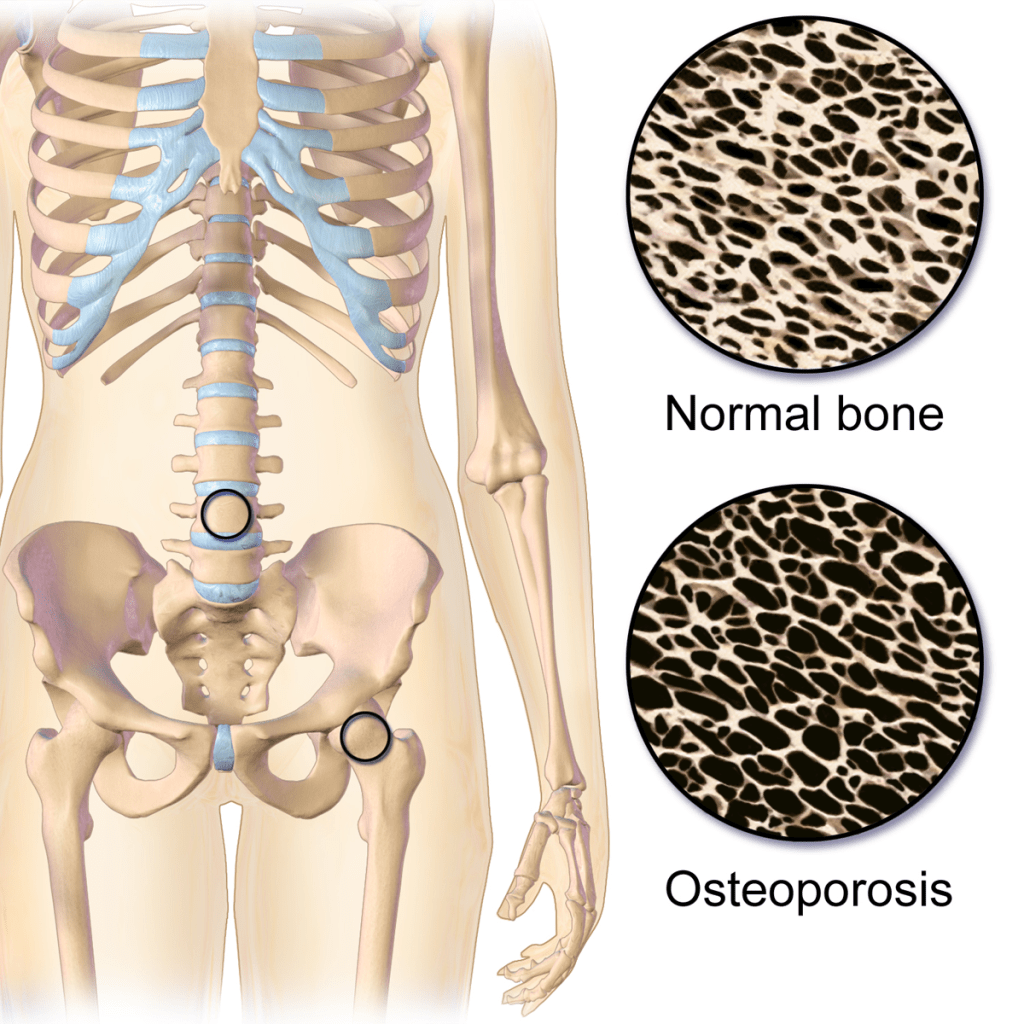
Osteoporosis is a condition in which bones bones become weak and brittle; this condition is especially prevalent in older women. Under normal circumstances the cells in our bodies are constantly dying and being regenerated; this includes our bones. Osteoporosis occurs when bone tissue is reabsorbed into our bodies at a faster rate than it is replaced. The bones (osteo) become porous (porosis) as shown in the picture above. They become especially susceptible to fracture.

How can it be treated? Proper diet and medications are effective, but so is weight training. Wait! What? We are going to ask people with brittle bones to lift dumbbells?!?! As a matter of fact, this is a great way to strengthen bones. Our bodies respond to stimuli according to the SAID principle. SAID stands for Specific Adaptation to Imposed Demands. What this means is that when we make our bodies act in a certain way, it will change physiologically to accomodate those new requirements. As an example, postal workers who have a walking route (as opposed to sitting in the mail truck) often have stronger legs and amazing calves. Likewise, folks whose work requires them to do heavy lifting of packages will develop larger arm, shoulder, and back muscles. Their bodies have adapted specifically to the demands opposed on them.

How does this work with Osteoporosis? When we train with weights, our bones get the message that they need to work harder and get stronger; the bones respond by creating new tissue at a faster rate. Lower body bones can also be strengthened by weight-bearing exercises like walking.

Is this dangerous? Like any physical activity, there are always risks. Those with Osteoporosis should be aware of their surroundings to avoid injuries and falls which can result in broken bones. They should also avoid high impact activities like jumping or those that require jerky or sudden movements. Otherwise, there are few restrictions with regard to just how heavy those weights can be.

It seems somewhat counterintuitive to put stress on brittle bones but, in fact, it is one of the best things to do for Osteoporosis. As always, consult a healthcare professional before embarking on any new fitness regimen, and let your fitness professional know of any conditions that might impact your health and safety. Otherwise, do not be afraid to pick up those weights; your bones will thank you!