
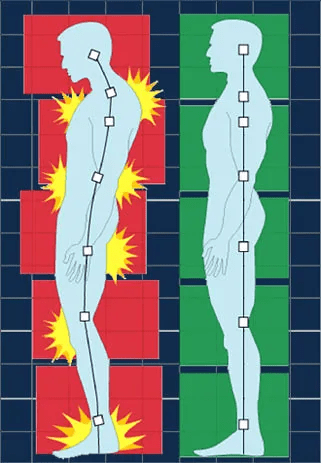
Did you see the article by Dr. Pamela Peeke about posture in the most recent issue of the AARP Magazine? I have blogged about the importance of posture for older adults in the past, but it bears some review.
Peeke’s article addresses six different ways that we can assess our posture, and work toward fixing it. Not only can it improve our appearance, but it can also relieve pain.
The first three are done in front of a mirror, but standing perpendicular to it (ie, with our side toward the mirror). Turn your head so you can see your reflection.
- Where are your ears? If they are not directly over your shoulders as they should be, scapular retractions and/or chin tucks can help.
- Where are your hips? If your hips tilt forward, tighten your abdominal muscles and push your hips forward so that they are directly beneath your shoulders.
- Where are your ankles? If your ears or hips are out of line, your ankles may not be in the right place–directly below your shoulders. Work on 1 & 2 above, and 3 should resolve itself.
Now, turn so that you are facing the mirror.
- Where are your shoulders? If one is higher than the other, try forward and reverse shoulder rolls. If one or both is rounded forward, stretch your chest muscles (which pull the shoulders forward) by clasping your hands behind your back and interlacing your fingers; now pull your hands up and away as far as you can from your back for 10 seconds and repeat throughout the day.
- Where are your feet? They should be shoulder-width apart, parallel, and with toes facing forward. If that is not the case, shuffle your feet until they are in the correct position; note the balanced feeling and strive to maintain it throughout the day.
- Where are your knees? If your knees are out of alignment, you can stand with toes pointing inward and heels slightly apart. Fold forward at the hips and let everything hang loose. This will help re-align the knees and stretch the hamstrings.
There are many reasons for poor posture. For serious issues that lead to pain or major misalignments, talk to a physician; physical therapy or other treatments may be necessary.
Remember, posture is not just about appearance. When we are out of alignment, it can cause a cascade of negative effects on the body. A little bit of work each day can go a long way.
 Kosher Fitness