Parashat Re’eh begins with a statement from God given through the prophet Moses. We are told that God has placed before us blessing and curse—and it is plain to see, in Hebrew, “Re’eh.”
There are instructions later in the Parasha that the Israelites, once they enter the Land of Israel, are to place a list of blessings on Mt. Gerizim and list of curses on Mt. Ebal. These two mountains overlook the town of Shechem (Nablus today). Gerizim is to this day covered in greenery, while Ebal is barren and rocky. It is easy to imagine that the Israelites looking at these two mountains would clearly see the difference between blessing and curse, between following the commandments and going after false gods. It is an amazing visual aid.
We are familiar with the phrase, “seeing is believing,” but that is only partially true. Sometimes we cannot accept something until we see it with our own eyes. Other times, our eyes can deceive us; we make judgments about what we see on the surface and miss what is going on behind it.
We know that life is never that simple. Unlike Gerizim and Ebal, life is not black and white (although sometimes it is!). Most of the time there are shades of gray…and other colors too. That is why it is so important to see—really see—in order to do our best to determine what courses of action will lead to blessings and which (God-forbid) will lead to curses.
I usually stay away from politics in the Thought for Shabbat, but it seems unavoidable this week. Israel and the Jewish community appear to have been dragged into a discussion where many feel we have no place. There have been charges against some Jews of disloyalty to both the United States and Israel. This is a familiar trope and one that should cause all of us concern—no matter what our political affiliation.
Sadly, the divisions that have deepened in US society seem to have reached the Jewish community as well. Israel was for many decades a bi-partisan issue; American Jews believed that no matter who controlled Congress or who sat in the White House, it was important for them to have good relations and strong connections with the Jewish State. Our current situation is a long-simmering departure from that.
What is worse is that this schism can potentially fracture communities, congregations and even families. Individuals and communities need to engage in serious study/workshops/seminars that help us learn to communicate with those whom we love but with whom we may have deep differences of opinion.
It is my hope that in what promises to be a tumultuous period ahead that we will remember our love for each other. What we share as a community and congregation is greater than what separates us. Let our words and actions be guided by the teachings of Aaron to “love peace, pursue peace and bring others closer to Torah.”
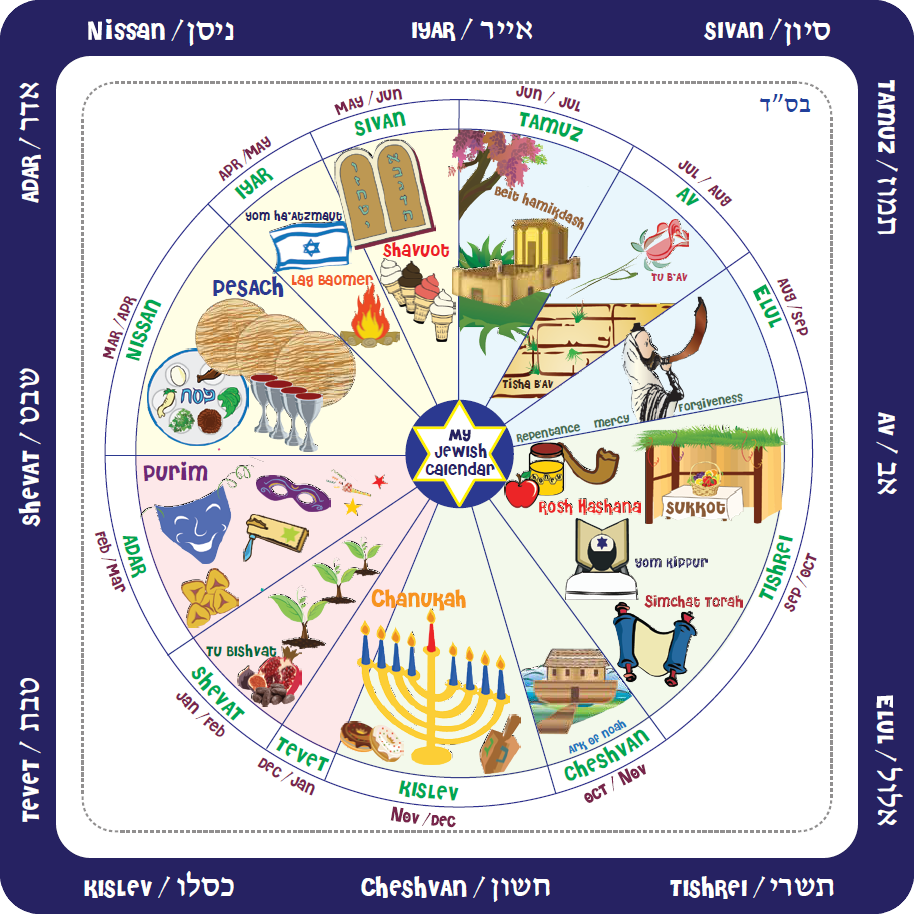
Today, not only are we about to begin Shabbat, but it is also Rosh Chodesh Av–the first day of the Hebrew month of Av. On the Hebrew calendar, every month begins when there is a new moon in the sky (even if it isn’t visible); it is a lunar calendar (as opposed to the Gregorian calendar which is solar). Even so, the Jewish calendar has a solar correction because the sun and the moon aren’t always lined up; there is a leap month every few years so that Passover always ends up in the spring, Rosh Hashanah in the fall, etc.
Judaism is especially attuned to the cycles of nature. We not only mark the cycles of the moon, but also the various seasons and harvests that accompany them. Prayer times are set by the pattern of sunrises and sunsets.
There is only one major observance that does not line up with any astronomical or natural cycles: Shabbat, the day of rest. It does not reflect anything going on in the cosmos; rather it is based on the biblical story of Creation. Even so, it is an important part (the most important!) of the cycles that make up Jewish life. The mega-cycle of the year on the Jewish calendar causes us to appreciate the world around us, to confront our responsibilities, and find our place in the world. Each holiday asks us to focus on what we need to do in the world. Passover focuses on freedom, Shavuot on responsibility, etc. All the cycles give us context for our lives so that we are not simply running on a treadmill from cradle to grave. The calendar encourages us to live in and appreciate the moment.
I cannot help but see a parallel to the world of physical fitness. Many of us have our regular cycle of upper body days, lower body days, group classes. We may even have a rotation of cardio equipment we use. For those who take this seriously, the cycles and patterns provide a sense of orderliness; they present a plan where it is possible to see progress–to look back on where we have been, where we are, and where we hope to go. These cycles can be quite effective.
In our society we often hear that we should not get “stuck in a rut.” We need to “break the cycle.” There is, however, a flip-side. We can use these patterns to help us organize our lives, set goals and even give our lives a sense of meaning.
On this new moon, I am reflecting on the bad things that happen in our world (that is a theme of the month of Av), and what I can do to prevent them. On this Shabbat (on which we conclude the Book of Numbers), I am thinking about closing one chapter and beginning another. I look to these cycles to help me find my place in the world and what I can do to reflect God’s presence in it.
The end of this week’s Torah portion, Pinchas, outlines the offerings to brought to the Tabernacle and later to the Temple. It begins with the daily offerings, the weekly Shabbat offerings, and is then followed by the various festivals.
It is noteworthy that there was an offering presented by the priests every morning and every afternoon. Sacrifices were seen by the ancients as a way to connect with God; during a sacrifice, the boundary between life and death was crossed and that mysterious and powerful act was thought to bring God’s presence nearer. The Torah legislates that this does not happen only at special occasions or even just weekly, but rather every single day.
As a personal trainer, I can relate to this. In ancient times, the goal of sacrifice was to draw near to God. This could not be done in a haphazard way; it had to be done on a regular basis if there was any hope of achieving this aim. The same is true for almost any goal we set for ourselves. Whether in business, education or physical fitness, we need a regular program to help us get where we want to be.
I tell my clients that it is good that they see me on a (mostly) regular basis, but once or twice weekly may not be enough to lose the weight, tone up, build strength and endurance, etc. The effort needs to be daily, lest we miss a day…and another…and another.
Parashat Pinchas reminds us that this approach is valid not just in our earthly pursuits, but in our quest for the Divine as well.
I write this Thought for Shabbat from the airport in Houston on my way back from a wonderful vacation with Michele.
We had the good fortune to travel to Alaska for a tour/cruise. It was a beautiful trip with great memories.
We went primarily to see the majesty of nature before it is altered beyond recognition by global climate change; unfortunately, so much damage has already been done and we saw and experienced it first hand. It renewed in me the need to act in ways that are sustainable and even help to reverse the damage that has been done.
Princess Cruises’ motto is “come back new.” I certainly feel refreshed, but I think I’m still me. What is new, is an appreciation of the enormity and beauty of God’s Creation—and the obligation that each of us has to “till it and tend it.”
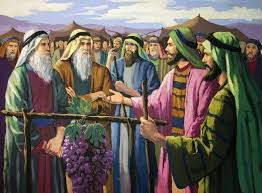
Shelach Lecha contains the well-known story of the scouts sent into the Land of Israel by Moses to check out the territory in preparation for the conquest. One scout was sent from each tribe. Although they all saw the same thing, not everyone agreed on what it all meant. Ten of the scouts were afraid and said that even though the land was everything that had been promised, it would be too difficult to conquer. The other two had faith that God—who had already wrought Ten Plagues on Egypt, split the sea, and fed them manna—would not fail them now. Unfortunately, the voices of the ten won out and the Children of Israel were made to wander in the wilderness for forty years until a new generation arose in its place.
Shelach Lecha can be a reminder to all of us about the proverbial “voices” in our heads. They can often be like the ten scouts, providing a million reasons why we cannot do this or that. They are the voices that traffic in fear, negativity and stagnation. They tell us we cannot get that new degree, lose that weight, find a new job, or even just be happy. How often do we listen to the other two voices? Do we look back and remind ourselves of the blessings that are a part of our lives? If we take the time to really listen to the voices of positivity in our heads and in our lives, we may not only find ourselves avoiding forty wasted years, but also find ourselves in the midst of a “land of promise.”
For about 18 months now I have tried to build a meditation practice. I was first introduced to meditation at the Rabbinic Training Institute, a yearly program for rabbis sponsored by the Jewish Theological Seminary of America.
For a long time, I thought that meditation was a bunch of yoga/granola/tree-hugging hooey…until I tried it and learned a little more.
Meditation is not the only way that I try to calm my mind. I have been a regular davener (Yiddish for pray-er, ie, a praying person) for over 30 years, every day, three times a day. I will admit that not every prayer experience is what I hope it to be. Sometimes it seems like a chore, or I just rush through it, or I am anything but mindful–letting my mind wander in a thousand directions. Other times–especially when I am with a minyan (a group of 10 Jews)–I do feel spiritually connected, and allow myself to calm and simply be. Whether it is successful or not, it is significant that I take time out of every day to stop and try to connect with something outside of myself.
My favorite way to calm my mind is Shabbat–the seventh day, the day of rest. I feel like practically my whole week is aimed at Shabbat, preparing for it, waiting for it, missing it…. As an observant Jew, I try to have all the preparations ready before sunset so that I do not have to worry about cooking, cleaning, shopping, etc. It is a gift that God gave to us, and a gift that I give to myself each week. It is the one time during the week when I feel most present for myself and those around me.
And then there is meditation. Why is this so difficult? Why during the week is it nearly impossible for me to get my mind to settle? I find that many times I cannot seem to turn off the thoughts that rush into my mind, and then my thoughts run down the rabbit hole wherever it leads. Other times, I simply fall asleep.
I join a weekly Jewish meditation group on-line for 15 minutes of Torah teaching followed by 30 minutes of meditation; we sit in silence all of us, with our screens in front of us. Like my davening, there are times when it is great, and others where I feel like I “accomplished” nothing. I guess that is why it is called a “practice:” it is never perfect just a continual rehearsal to try to get there.
Speaking of practice, that is the same word used for Yoga. In the past, I have done a lot more yoga than I have since I moved; I hope to remedy this. Almost every time I practice yoga I do feel like my mind is calmed and I am totally present. Perhaps it is because it is so tactile, rather than simply a mind practice. It could also be the group setting (see my minyan comment above). Maybe the influence of others around me doing the same thing helps me to flow in the right direction. Maybe that is why the on-line meditation is so challenging.
Of course, the big question is: why is it important to calm one’s mind? We live in a world that now more than ever bombards us with information, distractions and demands. We often end up on that hamster treadmill, running and running, and getting nowhere and tired real fast.
None of us wants to live our lives this way, on a treadmill, never examining who we are, what we do, what interests us, what makes us passionate. On a regular basis, we need to calm ourselves and reconnect with the Source of All and with ourselves.
Not everyone will do this in the same way. Doing so, however, has great benefit. Not only does it helps us to ground ourselves in this big world, but it also has many health benefits.
Am I perfect at this? Is my prayer, my yoga, my meditation, my Shabbat everything I want it to be every time? Not by a long-shot; sometimes I am just that metaphorical dog asleep on the couch. In the meantime, I will continue to practice calming my mind, calming myself, and reconnecting with what is truly important in my life.
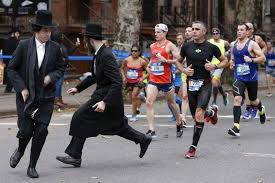
A few days ago at the Mandel JCC, a member who is a regular and long-time runner–who knows that I am a rabbi and a personal trainer–asked me (out of curiosity, I suppose), if running is permitted on Shabbat (the Sabbath).
This was not really the kind of question that I could answer on one foot (even though my left foot is still in a boot!), but I gave him the short answer, and promised to do a little more research. The short answer (so Jewish!) is: yes…and…no. It depends.
I started my “little more research” at my favorite Halachic (Jewish legal) source, Rabbi Googlowitz. A simple search on http://www.google.com revealed a surprisingly large number of web pages on this topic.
The long and the short of it…here is the issue. Traditionally, Shabbat is seen as being observed in two general ways: Shamor (guarding) and Zachor (remembering). These two broad categories come from the fact that the Aseret Hadibrot (The Ten Commandments) appear twice in the Torah–once in the Book of Exodus and once in the Book of Deuteronomy–in almost identical form. With regard to the observance of Shabbat (the 4th Commandment), one version uses the word Shamor and the other Zachor. Commentators said that the verses differ in order to instruct us that there are two aspects to making Shabbat holy and special. One is through guarding (observing the myriad laws about what can and cannot be done on the 7th day); the other is through remembering (doing the non-legal things that bring enjoyment to the day like having a festive meal, visiting friends, studying Torah, etc.) , often referred to as Oneg (literally, “joy”). The question becomes: is running simply exerting one’s body and therefore considered to be a violation of shamor–a kind of “work” with a productive purpose…or…is running an enjoyable activity in whose participation we can derive enjoyment, and therefore a kind of Zachor/Oneg? If the answer is the former, it is forbidden; if the answer is the latter, it is permitted. So…you are allowed to run, but only if it’s fun!
This is a very condensed version of the answer, but I was surprised to find that two pretty traditional websites: http://www.aish.com (Aish HaTorah) and http://www.ohr.edu (Ohr Sameach) said pretty much the same thing. Check them out for yourself to get the sources and the context.
By far the most comprehensive article I could find on the topic was written by my friend and colleague, Rabbi Jonathan Lubliner; it was endorsed overwhelmingly by the Committee on Jewish Law and Standards of the Rabbinical Assembly (the rabbinic association of the the Conservative Movement–which is ironically the name of one of the liberal/progressive branches of Judaism). He covers all kinds of exercises and the various circumstances and contexts in which athletic activities are permitted or not. Here is the web address: https://www.rabbinicalassembly.org/sites/default/files/public/halakhah/teshuvot/2011-2020/lubliner-recreation-sports-shabbat.pdf
My conclusion: like everything else having to do with exercise and athletic activity, if you’re not enjoying it…either you’re doing it wrong or perhaps you shouldn’t be doing it at all!
It is that time of the year when we in the Midwest are aware that there may be time when we will either get a notice on our phone, on TV, or hear the siren and we know that we will have to head to a safe area due to severe weather. It is a part of living in this part of the country, and it seems a small price to pay to avoid volcanoes, earthquakes and hurricanes.
This week, many Israelis were forced to seek shelter over and over but for a different reason; the threat was not severe weather but rather missiles launched from Gaza. Although this happened far away, I have many Facebook friends who live in Israel for whom this was a frightening reality. I do not know how one ever can get used to the mad dash to the shelters on a regular basis—sometimes after a long stretch of quiet.
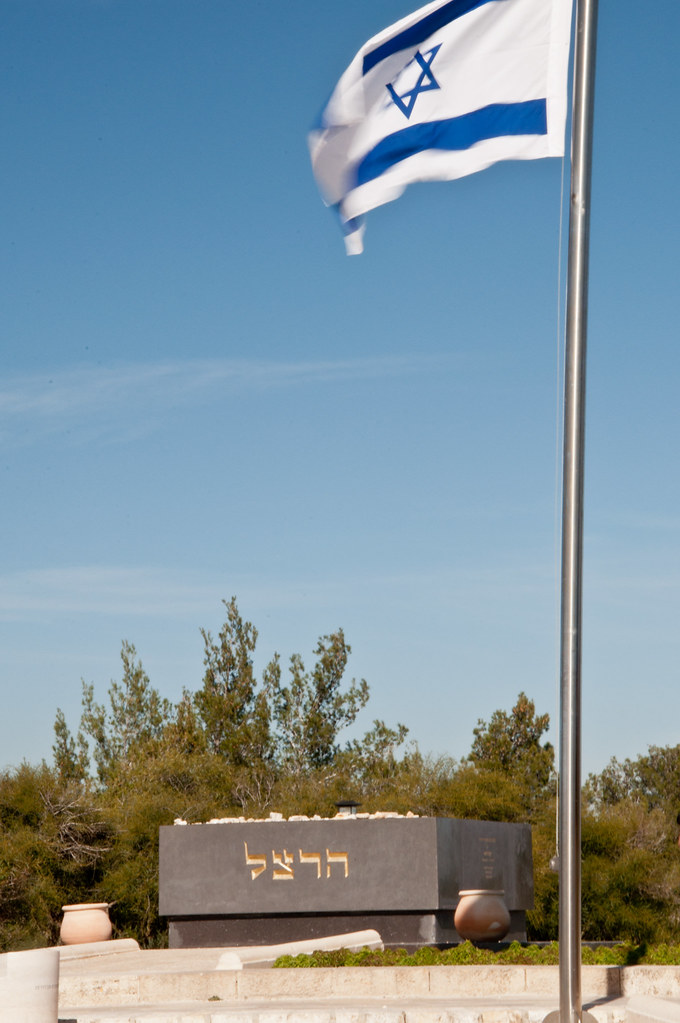
And then, yesterday (after Israeli Memorial Day on Wednesday), the celebrations began for Yom Ha’atzma’ut. Having been in Israel on Independence Day several times, I know how much fun it can be. It is a day to reflect on the many accomplishments of the Jewish State as well as the sacrifices that made it all possible.
How Israelis are able to regulate their emotions from fear of missiles to the elation of the reality of Eretz Yisrael under Jewish sovereignty again after nearly 2000 years? It takes a certain kind of special to do it, I guess.
This Shabbat let us give thanks for the many blessings that the State of Israel has brought. Let us also pray and work for the peace and well-being of all of Israel’s inhabitants. Next year, may there be no reason to fear…only reasons to celebrate!
My weekly musings that I share each week with Beth El – The Heights Synagogue…and now with you too!
This Shabbat is the first of many that is not a “special” Shabbat. The last two weeks were Passover, before that Shabbat Hagadol, and before that Hachodesh, Parah, etc.
Nevertheless, this Shabbat is significant to us today because it falls between two important dates on the Hebrew calendar: Yom Hashoah (Holocaust Remembrance) and Yom Hazikaron/Ha’atzma’ut (Israel Memorial Day and Independence Day—that are observed one day after the other). Their proximity on the calendar is coincidental; it is just the way it worked out in modern times. The 27th of Nissan was chosen by the Knesset in the early 1950s as the result of negotiations, putting it somewhere on the Jewish calendar between the day that the Warsaw Ghetto Uprising began and the day that the Nazis declared that the Ghetto had been completely liquidated. Yom Ha’atzma’ut, of course, was set on the anniversary of the establishment of the state, with Yom Hazikaron set the day before.
It always seemed to me that it was more than a coincidence that these two observances are so close to each other. Just as Yom Ha’atzma’ut follows Yom Hashoah, the establishment of the State of Israel followed the Holocaust. This understanding is somewhat simplistic, though.
Modern Zionism had been working on creating a Jewish State beginning in the 19th Century. Settlement and support of this venture began soon afterward and grew during the first part of the 20th Century. Many historians believe that Israel would have come into being eventually, but that the Holocaust (and the resultant world sympathy for the Jews displaced as result) sped up the process.
Each of these observances stands independently; one is not a result of the other even though they are somewhat connected. This Shabbat as we stand between these two dates, let us reflect one of the worst episodes in our history…as well as one of the most glorious. The path we follow on the calendar remind us of Passover’s message of redemption—even when it seems most unlikely.








 Kosher Fitness