
Vaping in the Gym

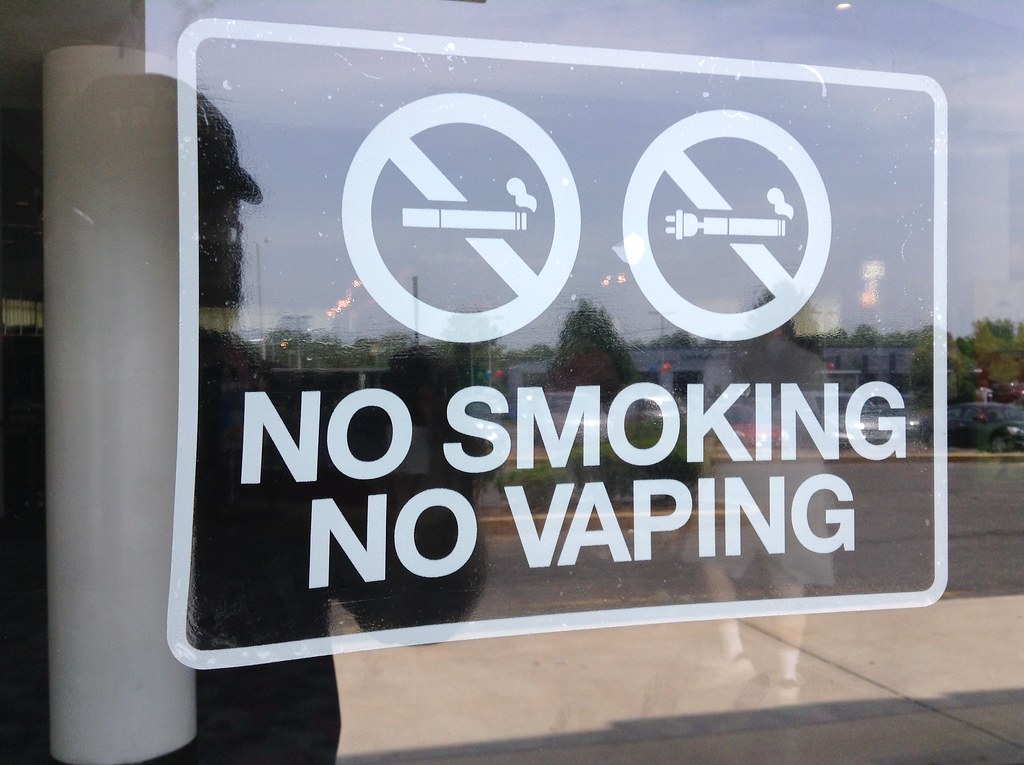
No Vaping

You read that right, “vaping in the gym.”

Yesterday evening, I went for a run on the indoor track that runs around the main gym, but up a level. When running on the track it is possible to look below and see kids playing on toys, adults playing Pickleball, and teens playing basketball. I could not believe my eyes when I saw–of all things!–three teenage boys vaping IN THE GYM on the side of the basketball court.

I work at the gym and, even though I was not in uniform, when I got around the track to where they were I stopped running and called down to them. “Excuse me, gentlemen!” They saw where the voice was coming from and I said “You can’t do that here.” One of them said, rather sheepishly, “I’m sorry.” I responded, “don’t be sorry–just don’t do it!”

The same boys were seen and reported by two members vaping again the Fitness Center. I would say that I was speechless when I heard this, but this is a blog so I’ve got to write about it.

I know this shouldn’t matter, but what really bugged me was that the boys were obviously Jewish teens. How did I know? They were dressed in clothing and “accessories” that clearly identified them as Jews–and observant ones at that. Ugh.

I know this isn’t fair. I find it horrifying when I see any young person (or any person for that matter) vaping or smoking. It is so clearly detrimental to one’s health. Do I need to quote articles and health journals? We’ve known for a while just how damaging and addictive it can be. It is also a very expensive “habit.” How people still vape and smoke is beyond me.

Why does it bother me that they were Jewish…and apparently observant? How does one follow the Jewish laws so closely–so much so that it dictates their dress, diet, social interactions, etc.–and at the same time destroy one’s own body–a potentially holy vessel given by God?

There may not be a commandment in the Torah that says Thou Shalt Not Vape, but Jewish law clearly mandates that we have an obligation to preserve our health so that we will live and be able to serve God and our fellow human beings. How can someone care so much about the food that goes into their body and ignore the noxious chemicals they inhale? It is a total disconnect.

It is important for all religious leaders to share the dangers of vaping and smoking. We also need to call out the cigarette and vape companies that market to teens and young adults. They know that if they can create an addict early, they will have a customer for life.

Vaping in the gym? Sadly, yes. We can do better. We owe it to the next generation to get the message out.

From a Tree-Hugger

Tree Row

An Improvised Ode to Trees

O Trees, how do I love thee?

I love thy fruits:  apples, pears, coconuts, and oranges.

I love thy leaves:  they provideth us with shade on hot summer days, their rustling sings to us on breezy days, and their color guard in fall is without parallel.

I love thy barks:  Root Beer…enough said.

I love thy roots:  they holdest together the soil and preventeth erosion.

I love thy branches:  they providest homes for the birds and iguanas, children climb them and create memories.

I love your boughs:  they are the stuff from which we build our homes, schools and shules.

I love thy pulp:  there is nothing like holding a paper book in one’s hand, and without thee there would be no toilet paper (only leaves–from you as well!).

I love your photosynthesis:  I do not know how thou dost it, but thank thee for thy oxygen-producing nature.

O Trees, how do I love thee?  Thy manifold beauty and purpose is beyond sufficient praise.  I will show thee my love by vowing to forever safeguard you.

This coming Sunday evening and Monday, we celebrate Tu Bishvat, the New Year for Trees.  It is a kind of “fiscal year” described in the Mishnah to help us observe the mitzvah of not eating tree produce during the first three years they bear fruit.  More recently, it has become a day to honor trees, plant trees, and work to preserve our environment.
We have messed up our planet.  I am not sure what can save us…but I think trees may have the answer…and they might be the answer.

Nothing to Fear but Fear Itself

President Franklin Delano Roosevelt

These words are a paraphrase of remarks made by Franklin Delano Roosevelt at his first presidential inauguration. Those were difficult times, recovering from the Great Depression and with a World War looming on the horizon. One could argue that back then there was a lot to actually fear.

Aside from how our anxieties affect us at work, school and in relationships, I regularly see how fear plays an outsized role in the realm of physical fitness.

I have worked with many clients with a variety of fears: fear of doing a certain exercise, fear of entering in a 5K, fear of looking foolish in the gym, fear of disappointing their trainer, etc. This can often be paralyzing. It can prevent us from engaging in the fitness activities that can help us to avoid the kinds of injuries and illnesses that we should legitimately fear.

I know that every time I have competed in a race (obstacle course, 1/2 marathon or triathlon), my overwhelming emotion beforehand is fear. I am afraid that I won’t finish the race, or that I might hurt myself, or that I will do so poorly that I will be a disappointment to myself or others. It is irrational since none of these have ever happened, but still it occurs.

As someone who has dealt with anxiety and even panic attacks, I know that this fear can prevent us from living a life of adventure, fulfillment and even love. There comes a time, though, when we have to take an informed and prepared leap of faith. I wouldn’t say that a person should conquer their fear of running a 5K by waking up one morning to do one; it requires preparation and training. The process of getting ready can help give us the confidence to overcome our anxieties.

We should be aware of the crippling role that fear can play in our lives. We must remind ourselves of how strong and courageous and deserving of good things we are. We must also work hard to reach our goals. Accept the fear. Stare it down…and then set it aside. The only thing we have to fear…is truly fear itself.

What Moves You to Act?

empathy

Parashat Bo–the Torah Portion read yesterday morning–contains the last of the 10 Plagues that God visited upon the Egyptians.  The last, the death of the first born of both human and beast, was the most devastating of all of them; it was the plague that finally convinced Pharaoh to let the Hebrews go.

Much interpretation has been written about the final plague.  It is clear that this plague personally touched Pharaoh and his family.  All the previous plagues may have affected the rest of the Egyptians, but Pharaoh’s powerful position may have prevented him from their full force.  With the death of the first born, not a house in Egypt did not experience the loss–including Pharaoh’s palace.

There is a recognizable truth in this.  We know that often we are not moved until something touches us directly.  We may hear about injustice or war or suffering, but we don’t do anything about it if we are not affected by it.  If it comes knocking at our door, however, we are the first to step up, complain, and act.Judaism teaches us that we cannot take this approach.  We must remember our experience as outsiders to feel what others feel and act accordingly.  This is called “having empathy.”  It is something that Pharaoh seemed to lack.  It is something that is often missing in our society as well.  It is found at every level; unless we are somehow inconvenienced or aggrieved we are silent.

The price for not acting is a high one.  When we do not stand up for others, when we do not feel what they feel…we cannot expect them to do the same for us.  Setting that aside, wee stand up for others because it is the right thing to do? It is our sacred duty to be empathic.  We know it means to suffer, and we should work to prevent others from having to experience it as well.

Know Your Numbers and…

Image result for numbers

Yesterday, I had the opportunity to hear a registered dietitian, Robin Rood, give a presentation about diets at the Mandel JCC to our Big Weight Loss Challenge participants. I was curious as to the content of the presentation since I had not been one of the organizers of the event, and discussing diets can be a tricky thing.

Robin went over a number of different diets, explaining what they are, the science behind them, as well as the pros and cons. This was informative for most of the crowd. There is a lot of talk out there about various diets and it is difficult to know what they are and which is the best.

What Robin emphasized to us from the beginning was that not every diet is right for everyone. It is important for us to know our numbers. By that she meant not just our weight, but our blood pressure and blood sugar. Knowing where there are imbalances in our systems should guide us to the diet that is most appropriate if we seek to trim our body fat percentage.

Numbers aren’t the only thing we need to consider. She cautioned us to also be aware of family medical history. If there is a history of diabetes or coronary disease, that will have bearing on which diets are even safe to try. Certain diets are risky for those with a history of eating disorders (like intermittent fasting). Having the history and the numbers can narrow down the choices quite a bit.

The overall message was that the most effective way to find a healthy way to eat is to know ourselves first. We need to know our numbers, our health history, and even our own emotions and shortcomings. We know what we are capable of doing and what will be too difficult.

Of course, diet is only part of maintaining a healthy lifestyle. Robin shared with us as well the importance of exercise, getting enough rest/sleep, and finding ways to de-stress.

Choosing a diet isn’t as easy as selecting what a certain celebrity is doing, or what you’ve heard about on the news, or even seen in a magazine. It is a personal decision….and how you choose will determine your success and your overall health too.

The Struggle is Real…difficult

Image result for ten plagues of egypt

Parashat Va-era contains the beginning of the process of our ancestor’s liberation from Egyptian slavery.  The end of the portion is comprised of the first plagues God visited on our oppressors.

Va-era and the following two portions are filled with miracles that accompany the Exodus from Egypt.  Modern readers often wonder if the events described really happened.  Did the Nile turn to blood?  Were there frogs everywhere, etc.?  And was it possible that these natural disasters only struck the Egyptians and not the Israelites?  Scholarly papers have been written that seek to explain the plagues from an epidemiological standpoint.  A few of them are rather convincing; there are plausible explanations for how it started and how one plague naturally followed after the other.

But do we really need to understand exactly how the plagues occurred?  Do we even need to believe that the stories contained in these Torah portions (or any others for that matter) really happened?

The miraculous nature of the story does not require historical or scientific verification.  Ultimately, what is most important is the underlying message:  the difficult path from oppression to liberation.  This story is not just about the Exodus from Egypt.  It is about the constant quest for justice and freedom in our world.  Bringing redemption to our world is never easy; it doesn’t occur overnight.  And there are times when we reach a milestone–where some wrong is righted or some injustice recognized–and feel that the moment is beyond just us.  There is something “miraculous” about it…or a sense that a higher source somehow intervened.There are those who take the story literally, but for those who don’t, there is still the valuable lesson about the work it will take to redeem our far from perfect world.

Shabbat Shalom!

Labels Stick (double-entendre)

Hello my name is...

I am re-posting a post from my brother, Joel, on LinkedIn. We grew up in a home where athleticism wasn’t really a thing. Don’t think my mom every worked out–aside from walking. My dad used to swim, but not real heavy duty. Now my sister, brother and I are all gym regulars.

I never thought of myself as an athlete until a few years ago when my doctor referred to me as “athletic.” My brother encapsulates a lot of what I felt growing up and what the change has meant to him.

Enjoy!

https://www.linkedin.com/pulse/really-im-athlete-joel-ungar/

The Difficult Climb Out

Image result for majdanek

Many years ago I had the opportunity to visit the Majdanek Concentration/Death Camp in Poland.  There is a huge sculpture that looks somewhat like a menorah that dominates the landscape.  As visitors get closer, they see that there is a long sloping path that goes under the menorah; the way out is a steep set of rock stairs.  The symbolism was to show how easy it was to slide into the situation that led to the Holocaust, and how difficult it was for those caught up in it to get out.

This week’s Torah portion reflects a similar idea.  The process by which the Children of Israel came into slavery in Egypt looks somewhat quick and easy; it occurs over the course of just a few verses.  The way out, however, took 400 years and a series of miraculous events.  Even then, by the end of the Torah, the Israelites still had not reached the Promised Land.  The contrast is striking.

Often in life we make decisions or take actions that are not well-thought out; we take the easy route instead of the right one.  Sometimes the repercussions are not really consequential.  Other times, though, we find ourselves entangled in webs from which we are not able to extract ourselves so easily.  Parashat Shemot–and the many parashiyot that follow it–remind us that what may seem inconsequential now may end up being quite significant further down the road.  It is up to us to see beyond the moment and think about the future.

Water…water…

Desert, Jordan

The Weight Loss Challenge where I work is now in full swing. Last night was the first group fitness class offered by one of the other coaches. It was a big group and notable that many had not brought water with them. This is not a formula for success.

We hear a lot about keeping hydrated. We are not like camels who are able to store water for long periods and long distances. We use water to nourish our bodies and we lose water through sweating which helps to keep us cool. We must continually replenish. So what are the rules for water consumption with exercise?

Generall speaking the following guidelines apply:

  • 2-3 cups of fluid 2 hours BEFORE the start of exercise
  • 1 cup of fluid every 10-20 minutes DURING exercise
  • 2-3 cups of fluid for every pound of body weight lost AFTER exercise

You’ll notice that I put “fluid” instead of “water.” Water is always excellent, but there are sports drinks that work as well. It is also better to drink something cool that something hot; this improves the speed of absorption. We also know that there are some liquids that actually accelerate dehydration: coffee and alcohol are two prime examples. This is not to say that you cannot have a glass of wine at dinner after exercising; just remember that this cannot be your primary form of hydration.

Dehydration is not pretty. It can lead to dizziness, loss of conscience, nausea and headaches. Bring a water bottle to the gym or to your class; this will help ensure that you are drinking enough.

Get your exercise on, but remember to get your hydration on as well!

When Values Clash…on Iran

Image result for confusion

This past week has been a very troubling one.  The killing of Soleimani has heightened tensions with Iran.  The circumstances of a Ukrainian airliner’s crash in Tehran are murky.  Iran has targeted US bases in Iraq.  It is a real morass.

There is little doubt that Soleimani was not a nice guy.  There is little doubt that the Iranian regime is problematic at best.  And yet, we worry about the possibility of an armed conflict and what it might mean for those who will have to fight it…as well as those who may get caught in the crossfire–including those in Israel.

I am reminded of my study of Talmud.  The Talmud’s style is to ask every question imaginable (even those you could not imagine!).  It debates each opinion and even itself.  It digs deeper and deeper until we may forget the original question.  Rabbis disagree with each other on issues of law and conduct.  It is full of “on the one hand…and on the other hand.”

What is happening in the Middle East now (as always) is more complicated than it seems.  Nothing is truly clear cut.  It is difficult to know what the US Administration’s motives are.  We cannot know what the Iranian regime is thinking. We do not know all the intelligence that is out there.  We tend to follow whatever news source confirms what we already think from our own political or emotional perspective.

It is not easy to know what to think for certain…which is why the last week has felt like a dive into the Talmud for me.  And why so many of us are so worried.

One thing that is clear from our tradition is that there are times when values may clash with each other.  Sometimes there are two options that both seem right, or that both seem wrong.  How do we know what to choose?  How do we know what to believe?  Judaism teaches us that when values come into conflict we must try to follow the example set by the students of Aaron the Priest:  we must love peace and pursue it.

There are times when war is necessary.  First, however, we must seek to avoid it all costs.  If there is a way to save a life, it must be a priority.  May our tradition guide us and our leaders through the rough waters ahead.

Shabbat Shalom!