I Only Know My Own Experience

Key

Yesterday I was invited to a meeting in Toledo, where I used to serve as a rabbi and was co-founder of “Erase the Hate,” a program aimed at building bridges and eliminated hatred and bigotry.

Long story short, one of the school districts in metro Toledo has been dealing with some issues of bigotry directed at students from other students. In one case, a Jewish girl (and there are very few in this district) had the image of her face superimposed on the face of a person in an historical photo of inmates in a Nazi Concentration Camp. It was shared on social media and was devastating. Those responsible were caught, but this occurred in a class that had already heard a Holocaust Survivor speak. How can we best address the hatred? How do we build empathy? The meeting’s goal was to figure out next steps and strategies.

One of those in attendance at the meeting shared that when she was asked to come to a previous meeting in the district, she met up with a local pastor beforehand. When she arrived at the church, she came to the door and was surprised to find that it was unlocked. When the pastor showed up, she asked how that could be? How do you leave the doors to your church unlocked? It was he who was surprised now. Of course the doors to the church are unlocked; they’re always open. She went on to explain to him that in the Jewish community, every building is in lock-down–many before the tragedy in Pittsburgh. There is hardly a Jewish institution without an armed guard, cameras, etc. It is a part of the Jewish reality in the US (and in large part in Israel and throughout the world) that doors are not open for those who wish to enter.

How many in the non-Jewish world know that this is our reality?

For that matter, I only know my own experience. I do not know what it is like to be an African-American male in this country being pulled over for a traffic stop. I do not know what it is like to be a woman passed over for a job that is given to a man who is less qualified. I do not know what it is like for many families of Hispanic origin to live in fear of possible deportation or separation from family. I do not know what it is like to come out to loved ones as GLBTQ, nor the special kind of harassment many in that community have to endure. I do know what it is like to live with a handicap or to be on the Austism Spectrum. I only know my own experience.

That does not mean that there is no hope. On the contrary, there is something holy and compelling about sharing our narratives. Too often we think we know what the other is all about. Too often we judge without really knowing.

At that meeting, our advice to the district administrator was two-pronged. First, pursue one of the many excellent programs out there that deal with diversity and how to deal with the inevitable issues that arise in a heterogeneous school setting. Second, invite members of minority groups (and even those in the majority) to share their stories. Every one of us has a story, an experience. They shape who we are–our hopes, dreams, fears and disappointments. When we hear the other, perhaps it will build empathy and a sense of connection. With time and with practice, maybe we can focus not on what makes the “other” other, but rather what it is that we share in common.

On the way to a funeral for a 25-year-old

Yesterday I performed the Mitzvah of Nichum Avelim–Hebrew for the commandment to comfort the bereaved. A family that played a significant role in one of my previous congregations lost a son and grandson who was active duty in the military. Although I only barely remember the young man (I left that community 17 years ago), I felt I needed to be there for the family; Jewish tradition says that we do not really have a choice but are commanded to be there for others.

On the way to the funeral I was listening to NPR and there was an hour-long discussion about suicide. (This was not the cause of death.) As a member of the clergy, there was not a whole lot that I had not heard before, but still it was a great segment and a good reminder.

Much of the program dealt with what to do when we hear/see/sense something wrong with a friend. What are we supposed to do? What should we say? In a number of different ways, they spoke about how one of the most important things we can do is let the other person know they are not alone, that there are others going through the same thing as well, and that there are places to get help. They all emphasized how significant it is for those who are having suicidal thoughts to feel connected to others.

They also talked about a kind of systemic change that needs to occur. We still place too much of a stigma on mental health. Our healthcare system does not always provide health insurance or treatment parity with physical illnesses. This means that open discussions about how friends, family, co-workers, etc., are doing do not take place often enough. We can begin to create change in our own families, places of work, school, by encouraging those conversations–checking in on others even when they don’t seem to be distressed. Sometimes those with mental illness are very good at disguising their distress, and all it takes is making the effort to connect.

I know that I will try this myself. The more we make conversations about mental health no different than those about physical health, the more likely we are to create situations in which those needed help will comfortable to seek it.

The funeral I attended was not a suicide, but was tragic nonetheless. I cannot imagine what the family is going through. I hope my presence made some difference. As we rethink mental illness, we can all make a difference.

This was not the segment, but still very helpful: https://www.npr.org/sections/health-shots/2019/04/20/707686101/reach-out-ways-to-help-a-loved-one-at-risk-of-suicide

Thought for Shabbat

Somerset Sunburst

There are some weeks when it seems as if everything going on in the world around us is disconcerting (to say the least).  There is division, strife and suffering.  One could say that the level of discourse is at an all-time low, but there isn’t a whole lot of discourse going on.  There is a lot of talking “at,” and not a whole lot of talking “with.”  It spreads a cloak of darkness across society.

Like a ray of sunshine on cloudy day, though, there are still acts of kindness that warm our hearts and remind us that there is a lot of good in the world.  I am reminded of Oskar Schindler, who in the midst of all the atrocities during the Holocaust, saved hundreds of Jewish lives; of course, this was only one person and his actions were only a drop in the bucket compared to what could and should have been done.  Even so, that drop in the bucket made a huge difference—especially to those on his famous list and their families.

Closer to home, there are friends and neighbors who are also helping to bring light into a dark world.  They are talking “with” their fellow human beings.  They are trying to lighten the burdens of those who suffer.  It may seem like a drop in the bucket, but its significance is great.

On this Shabbat, I will be thinking about what I can do to “be the light” we need in this world.  I am only one person; alone I cannot solve the challenges we face.  The more who join the effort, however, the higher the odds we can redeem this very broken world.

Shabbat Shalom!

Meditation and Trying to Calm my Mind

Vizsla Meditation

For about 18 months now I have tried to build a meditation practice. I was first introduced to meditation at the Rabbinic Training Institute, a yearly program for rabbis sponsored by the Jewish Theological Seminary of America.

For a long time, I thought that meditation was a bunch of yoga/granola/tree-hugging hooey…until I tried it and learned a little more.

Meditation is not the only way that I try to calm my mind. I have been a regular davener (Yiddish for pray-er, ie, a praying person) for over 30 years, every day, three times a day. I will admit that not every prayer experience is what I hope it to be. Sometimes it seems like a chore, or I just rush through it, or I am anything but mindful–letting my mind wander in a thousand directions. Other times–especially when I am with a minyan (a group of 10 Jews)–I do feel spiritually connected, and allow myself to calm and simply be. Whether it is successful or not, it is significant that I take time out of every day to stop and try to connect with something outside of myself.

My favorite way to calm my mind is Shabbat–the seventh day, the day of rest. I feel like practically my whole week is aimed at Shabbat, preparing for it, waiting for it, missing it…. As an observant Jew, I try to have all the preparations ready before sunset so that I do not have to worry about cooking, cleaning, shopping, etc. It is a gift that God gave to us, and a gift that I give to myself each week. It is the one time during the week when I feel most present for myself and those around me.

And then there is meditation. Why is this so difficult? Why during the week is it nearly impossible for me to get my mind to settle? I find that many times I cannot seem to turn off the thoughts that rush into my mind, and then my thoughts run down the rabbit hole wherever it leads. Other times, I simply fall asleep.

I join a weekly Jewish meditation group on-line for 15 minutes of Torah teaching followed by 30 minutes of meditation; we sit in silence all of us, with our screens in front of us. Like my davening, there are times when it is great, and others where I feel like I “accomplished” nothing. I guess that is why it is called a “practice:” it is never perfect just a continual rehearsal to try to get there.

Speaking of practice, that is the same word used for Yoga. In the past, I have done a lot more yoga than I have since I moved; I hope to remedy this. Almost every time I practice yoga I do feel like my mind is calmed and I am totally present. Perhaps it is because it is so tactile, rather than simply a mind practice. It could also be the group setting (see my minyan comment above). Maybe the influence of others around me doing the same thing helps me to flow in the right direction. Maybe that is why the on-line meditation is so challenging.

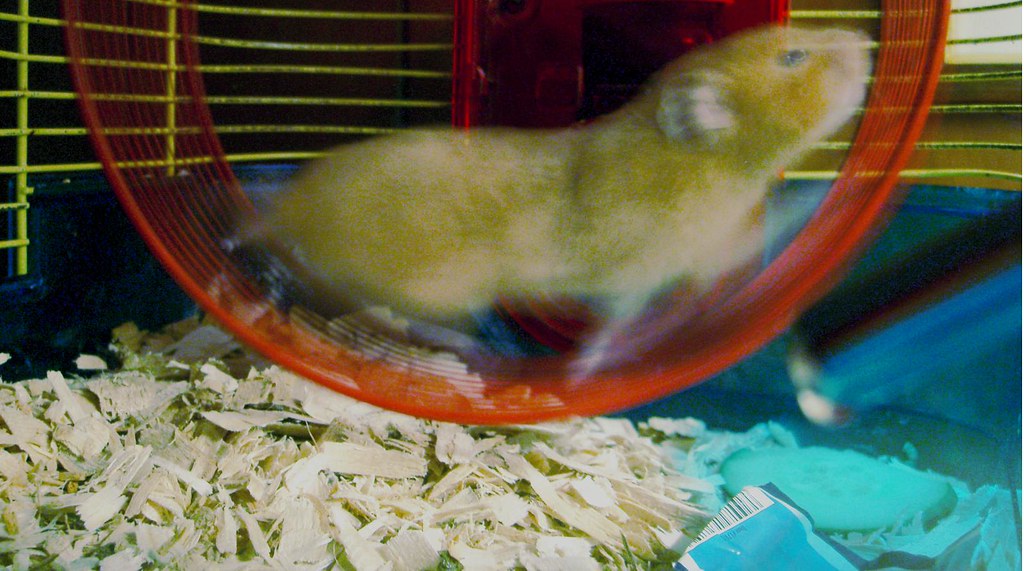
Of course, the big question is: why is it important to calm one’s mind? We live in a world that now more than ever bombards us with information, distractions and demands. We often end up on that hamster treadmill, running and running, and getting nowhere and tired real fast.

not a metaphor for your life

None of us wants to live our lives this way, on a treadmill, never examining who we are, what we do, what interests us, what makes us passionate. On a regular basis, we need to calm ourselves and reconnect with the Source of All and with ourselves.

Not everyone will do this in the same way. Doing so, however, has great benefit. Not only does it helps us to ground ourselves in this big world, but it also has many health benefits.

Am I perfect at this? Is my prayer, my yoga, my meditation, my Shabbat everything I want it to be every time? Not by a long-shot; sometimes I am just that metaphorical dog asleep on the couch. In the meantime, I will continue to practice calming my mind, calming myself, and reconnecting with what is truly important in my life.

What I Hadn’t Counted on After Surgery

Scales

It has been 9 weeks since my surgeries on my leg and foot. The recovery has been more arduous and painful than I expected. And I have learned a lot.

It is only since I began physical therapy exercises a couple of weeks ago that i finally began to see progress in my mobility and levels of pain. As a personal trainer, I am on my feet a lot; after a month of putting no weight on my foot, the shock of doing that again was dramatic. After having been off pain medications, I went back on again for a short time. I’m still taking Ibuprofen and Tylenol–although a lot less now. It has only been in the last week that I finally have been able to go through a large part of the day without pain.

To those of you doing PT…listen to the instructions and do what you are told! It makes a difference. PTs are amazing skilled health professionals and I am really impressed with their ability to spot (diagnose) issues and recommend the appropriate exercises. I even “borrow” some of them for clients who have similar complaints.

Here is what I really did not expect. I put on quite a bit of weight–about a 5% gain. This is due to a number of issues. I was forced to be sedentary. Medications (especially pain meds) messed with my system. I did not eat as I normally did since I was sitting around with little to do but…snack. My exercise regimen was interrupted.

I have been trying for over 6 weeks to get back to my pre-surgery weight and really been finding it difficult. I finally turned to a subscription weight-loss app. Too soon to say if I am making progress, but the tracking of calories is scary as hell and definitely showing me where I am making mistakes. I will let you know if it works.

It is noteworthy that weight gain is quite common after many different kinds of surgery. It is also notable that few doctors warn their patients that this is a possibility and to prepare for it–physically and emotionally. I wish I had known; not that it would necessarily have made a difference, but I believe that knowledge is power.

My big takeaway? With regard to both the pain and weight gain after surgery, patience is required. Others who have had foot surgery have told me to not give up hope or get anxious; it takes a while for recovery. This is true of nearly any surgery. I now see a pain-free light at the end of the tunnel, but it took me longer to get here than I thought it would. With regard to the weight, I am also learning that what took 8 weeks to come on will not come off in 8 days. Slow and steady wins the race.

At some point, most of us will have to undergo some kind of surgery; in my experience, I never felt like I adequately understood what the recovery would be like (if we did, would we ever agree to the procedure?!?). If there is a next time, I will ask more questions, adjust my expectations, and remember that there is a reason why we are called patients!

Start your Spiritual Warm-Up Now…

Shana Tova

Thought for Shabbat

It is well known that going to the gym and starting to work out without some kind of warm-up is not the best idea.  The same is true with relationships; when you meet someone, it is best not to propose marriage on the first date!  

Now that Shavuot is in the rear-view mirror, I am feeling the same way about the high holidays that are just a few months away.  (I know!?!?)  While it is true that the month of Elul is really the time to gear up for the Ten Days of Repentance, summer gives us a bit of a longer runway.

If we think about it, when we are listening to your GPS and get off course, it is best to try to make a correction as soon as possible.  The further we keep driving on the wrong path, the more difficult it will be to get back on track and to our final destination.  Think back to the High Holidays last year.  Do we remember the goals we set and the changes we wanted to make?

We should not wait until Elul to take this walk down memory lane.  If we set our hearts, minds and souls to it, we can arrive at Elul already well back on track.

We often think of summer as a relaxing time.  (It should be that too!)  From a Jewish standpoint, however, it is time to orient ourselves to the task of meeting our goals and making the necessary changes.  

So…enjoy the weather, let’s not forget what lies ahead as the days begin to shorten.

Shabbat Shalom!

Claim your self-care

Hourglass

When my mother passed away, one of the best pieces of advice I got was “take care of yourself; this will be harder than you think.” Best. Advice. Ever. I have subsequently shared it with so many during difficult times.

This is why I find it puzzling when clients and others make excuses for not coming to work out because of everything going on in their lives. “So-and-so is ill.” “I’ve got big projects at work.” “I’ve got too many obligations with my kids/friends, spouse….”

You may recall my second blog post where I spoke about one of the most important parts of my philosophy; remember that little speech that they make before your flight takes off?

Put your air mask on first and THEN assist those around you. In other words, unless you take care of yourself, you cannot possibly be of help to others. Somehow, we get this on an airplane, but in “real life” we find a million excuses.

During difficult times in my life (divorce, job loss, illness) I made sure to always prioritize taking care of myself–not just going to the gym, but also eating right, getting rest and treating myself to the occasional massage or other treat. Why? Because when I do these things it energizes me. If I don’t, a day goes by, two, three…a week, two…. I let things slide. I don’t exercise or eat right. Next thing I know, I’m feeling fatigued, wiped out, cranky and certainly less-than-helpful.

When the going gets tough, we need to claim our self-care. It is not a luxury; it is a necessity. Those around us–especially those that depend on us–must understand that when our compassion “gas tank” get empty, we need to make sure to refill it.

It sounds somewhat oxymoronic, but when things seem the most harried and pressured is exactly when we need to take care of ourselves. As my friend told me, it will be harder than we think…but the alternative will ultimately be even worse.

A New Book in My Top 5

Image result for growing bolder book

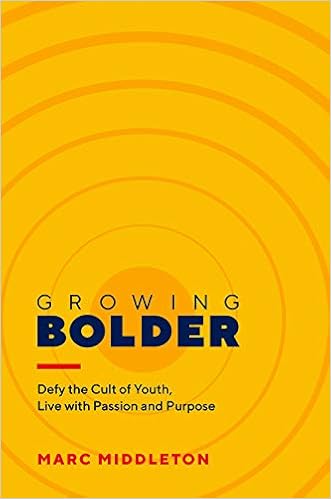
This book was recommended to me by Cody Sype from the Functional Aging Institute when I attended his certification seminar.

I am accustomed to going to seminars, conferences, etc., where books are recommended and I am often cynical, but as a guy who is not getting any younger and is somewhat anxious about aging, this book sparked my interest.

Marc Middleton makes the argument that the “Machine”–the healthcare industrial complex, government, media and culture in general–wants all of us as we age to feel helpless, frail, weak and dependent. The Machine does this because it makes money for them; entire industries are built around this notion and we buy into it because it is so prevalent in our society.

Middleton’s goal is to show us another way. Retiring and aging aren’t about being put out to pasture. On the contrary, our 70s, 80s, 90s and beyond can be the happiest and most meaningful years of our lives. Middleton brings multiple examples of ordinary older Americans doing incredible things. These are not all far-fetched examples; all the individuals are accessible and inspiring.

I can honestly say that this book got me to rethink my attitude about aging. I know to look at the Machine with skepticism. I know that many of us reinforce ageism without even realizing it. I know that unless our society changes its point of view, we will have a big problem on our hands. This demographic is growing; unless we are able to dismantle the Machine, we had better be prepared for a whole sector our economy warehoused in long-term care facilities. Is that what we want?

I am inspired by this book. It has changed my thoughts about aging and given me the courage to rock whatever time I have left!

That Feeling of Being Needed…

cute baby with her dad in the pool

Thought for Shabbat

On Thursday I was at the JCC swimming pool.  At the far end of the pool was a little girl (maybe 12-15 months) being held by her dad.  She was crying (which is why I noticed her) and holding on to her daddy with all her might.  And I had a flashback to my own days as a father of a young child.

I remember those days when my children (the youngest of whom is 19) would hold on to me in the pool.  That firm grip from those little hands and arms reminded me of just how much my kids needed me.  At the same time, it was heartwarming to know that not only did they need me, but I was able to give them exactly what they needed:  a sense of safety and security.  There is nothing in the world like that feeling.

Even though my kids are grown up now, I know that they still need me…but in different ways.  I also recognize that at different times there are others who need me.  There are members of the congregation who depend on me for guidance, and who know that at some time I may need to accompany them through a difficult time.  There are clients of mine at the JCC who depend on me to help them reach their fitness goals in a safe and effective way; others rely on me help keep them active and independent in their older years.  There are also those in society in general who count on me as a fellow citizen to do the right thing, to support the positive endeavors in which we are engaged, and to help them meet their needs.

It feels good to be needed, but it feels even better to be able to provide for those needs.  This is a Jewish value to be sure, but more than that, we know it to be true in our hearts.

Shabbat Shalom!

The “Fitness” of our Memorial Day

My Great-Uncle’s Grave in the US Military Cemetery in Meuse-Argonne, France

I had a conversation a few days ago with a member of the JCC who is from Israel. She asked me what exactly the story is with our Memorial Day; in particular, she wondered how people could say “Happy Memorial Day.” Isn’t it supposed to be sad?

There is a huge difference between how we observe (or don’t) this day in the USA as opposed to Israel. It is much more solemn in Israel, with a moment of silence when Israel comes to a standstill.

Image result for yom hazikaron

No matter what you are doing, you stop and stand at attention in memory of the fallen soldiers and victims of terrorism–even if you are in the middle of a supermarket, even if you are driving your car, even if you are studying. Here, there are the occasional memorial services; Jewish War Veterans often arrange these or they are done town by town. Otherwise, it is barbecues, picnics, opening day at the swimming pool, and, of course, lots of sales at the mall!

What makes for the difference? I don’t know for sure, but in a country as small as Israel, every one knows someone or knows someone who knows someone who was killed in the military. Nearly everyone who lives there has served in the military as well. This close connection to war and what it really means plays an important role in the mind of individuals and in the psyche of the country. It is a time for remembering and reflecting–definitely, not a “Happy Yom Hazikaron,” now lets get the grill fired up!

Here in the US, depending on the circles in which we travel (social, socio-economic, political) we may not know anyone who served in the military–especially after the mandatory draft was dismantled. I have a good friend who serves as a Chaplain in the military, but I would imagine it is a rarity to know someone closely who serves. We may know veterans, but we all know how well we (as a nation) have treated them.

Our notion of Memorial Day is not fit at all. It does not fit at all. This should be a day of really remembering those who gave the ultimate sacrifice for the ideals that we hold so dear. It should also be a time to reflect upon and work for those who have served and currently serve in our armed forces. How well do we take care of them? They risk their lives for us. What are we doing for them?

I never got to meet my Uncle Harry Miller. All I know of him are a few pictures and the letters he sent to my grandmother when she was a teenager during WWI. Some day soon, I hope to visit his grave and say a prayer for him.

In the meantime, I will think about the best ways to honor him and his sacrifice. Maybe not a barbecue or new fitted sheets….

A Meaningful Memorial Day to all!