Bending Over…Sideways

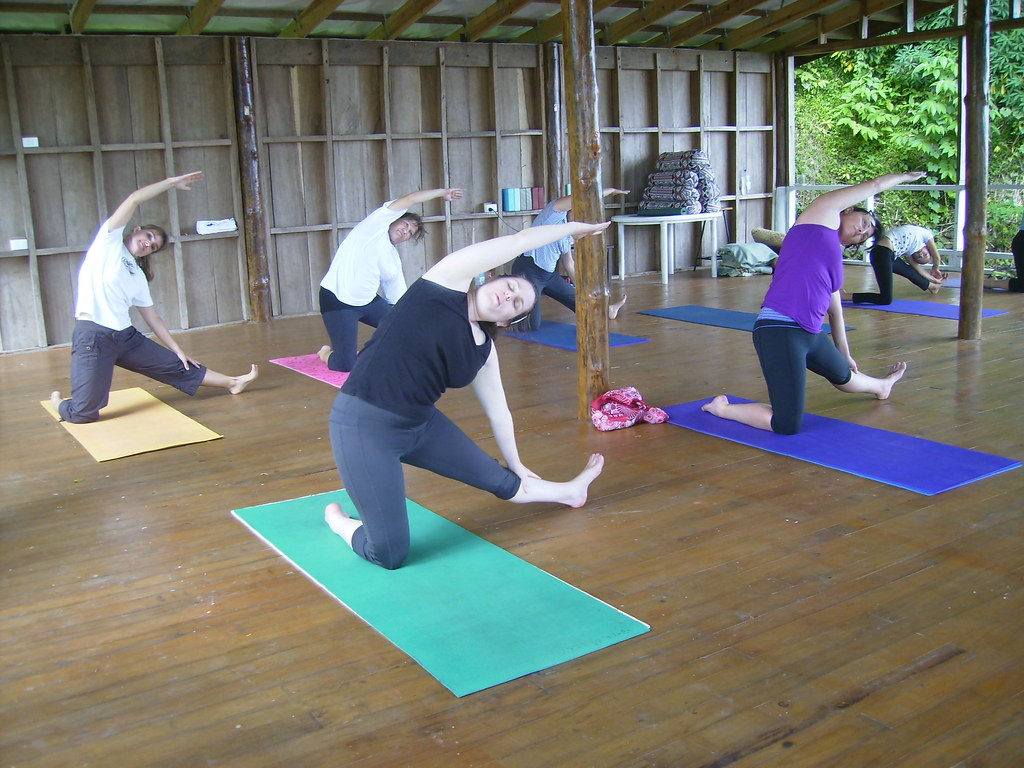
When I was a kid doing exercises in gym class, one of the calisthenics that we always did was side bends–not as dramatic as the yoga pose above, but side bends nonetheless. I liked them because they were not too strenuous, but I was not sure that they served any purpose.

As I studied to become a personal trainer, I learned about the different muscles in the human body. There are those with which most of us are familiar–biceps, hamstrings, calves–but others we may never have heard of before. For me, one of those was the Quadratus Lumborum (called the Q-L for short). It is one of several muscles in the torso and abdomen that serve as stabilizers; their role is to keep maintain, posture, balance, and movement. There are actually two of the Q-L muscles–one on each side of the spine.

The Q-L helps to stabilize the spine, but it also assists with breathing, pelvic alignment, and extension of the lumbar (lower) spine. In terms of movement, it is responsible for bending to the side as well as hip “hiking” or elevating the hip to assist in walking, running, and climbing stairs. The Q-L does a lot of work, so it is important that we care for it properly; included in this is regular stretching–including my old friend the side bend.

There are many ways to do these bends:

  1. Simple Side Bends from side to side, reaching to the floor (weights can be added too).
  2. Single-Arm Side Bends, also known as “I’m a little teapot.” One arm is bent with the hand at the waist while the other reaches down (a single weight can be added here too).
  3. Wide Side Bend/Crunch is more advanced and challenging. With a dumbbell in each hand, form a goal-post position with both arms and lean from side to side; focus on keeping a straight line from elbow to elbow through the shoulders. The torso should do all the work.
  4. Seated Q-L Stretches are especially effective for those who have difficulty with balance. Bend the elbows and place the hands either atop the head, at the shoulders, or at the waist; bend the torso from side to side.
  5. There are also a number of yoga poses that do the same job: Side Angle Pose, Triangle Pose, Gate Pose, and Half-Moon Pose.

The best part about all of these exercise–except for some of the Yoga poses–is that they are relatively easy to do. It is unlikely that a person will break a sweat or start huffing and puffing while stretching the Q-L. Nevertheless, to help maintain stability, balance, and movement, the Q-L Stretch needs to be a part of every older adults’ stretching regimen.

Balance and Longevity

Can you balance on one foot for 10 seconds? Aging adults recognize that as we get older we may experience muscle loss, decreased stamina, and issues with flexibility; balance, however, usually remains unaffected into our fifties and then begins to deteriorate with some rapidity after that. A test of balance that I often use with clients–and this is fairly standard in the fitness world–is a single-leg stance, also known as balancing on one foot. My goals is to get my clients to be able to balance on each foot for 30 seconds; for many of my clients this may never be attainable, but we work our way up as much as we can.

Past research has shown that those who can balance for longer periods of time on one foot are much less likely to experience falls. For older adults, falls can have especially serious consequences as healing takes longer and inactivity takes a greater toll. Falls can also lead to a loss of independence.

The results of a new study published in the British Journal of Sports Medicine suggests that the inability to balance for 10 seconds is linked to nearly double the risk of death from any cause within the next decade. In other words, if you can balance on one foot for 10 seconds you cut your chances of dying in half over then next ten years. A recent article on cnn.com discusses the results. Previous research had linked the inability to balance with fall risk and cognitive decline, but never before with longevity. Of course, the ability to balance may be affected by a number of other health factors; those who failed the test were more likely to be obese, have heart disease, high blood pressure, and type 2 diabetes.

The study does not reach any conclusions about causality. If you practice every day and are able to balance for 10 seconds, does that mean that your longevity will automatically increase? More research will be needed to determine this. More likely, those who are in a normal weight range, have blood pressure and blood sugar under control, and have healthy hearts may engage in more healthy patterns of diet, exercise, and rest. Those who take better care of themselves may therefore be better able to balance on one foot and also live longer. Causality is not yet determined, only linkage.

What does this mean for us? Try the test and see if you are able…or if you are even close; always perform this test near a piece of furniture or kitchen counter, or with someone nearby, rather than in the middle of an empty room in case you fall. If you are unable to pass the test, it may be worthwhile to talk with a medical profession about ways to improve health outcomes. In the meantime, it could not hurt to practice balancing, eat right, exercise, and get plenty of rest; these all contribute to longevity and great enjoyment during those years.