Let’s Move, Everybody!

One of the biggest obstacles facing us at all ages is sedentarism; this is just a fancy word for “not moving.” It is definitely a 21st Century word. For many, the situation got worse since COVID; we used to walk around an office or visit customers, but now a lot of us are just sitting in front of computers. I certainly was more active at the gym when I barely sat down; now I spend about half of my day working with clients virtually sitting on my kiester.

At the recent IDEA & ACSM Health & Fitness Summit, I took a session with Judy Juvance-Heltzel and Stephanie Davis Dierenger (both of University of Akron) entitled “Promoting Life-Long Physical Activity: Strategies for All Ages.” The course was divided into two parts: 1. theory and strategies, and 2. brainstorming and presenting.

We are being encouraged to focus less on the word “fitness” and more on the word “movement.” People are often put off by the word “fitness;” they think that if they are not “fit” then the activity will not be for them. “Movement,” on the other hand, is something that almost all of us do and we should strive to do more. Of course, as trainers, we do not want to focus just on movement; the progression should be from movement to physical activity to exercise to fitness. It is the obligation of fitness professionals to move individuals from one level to the next.

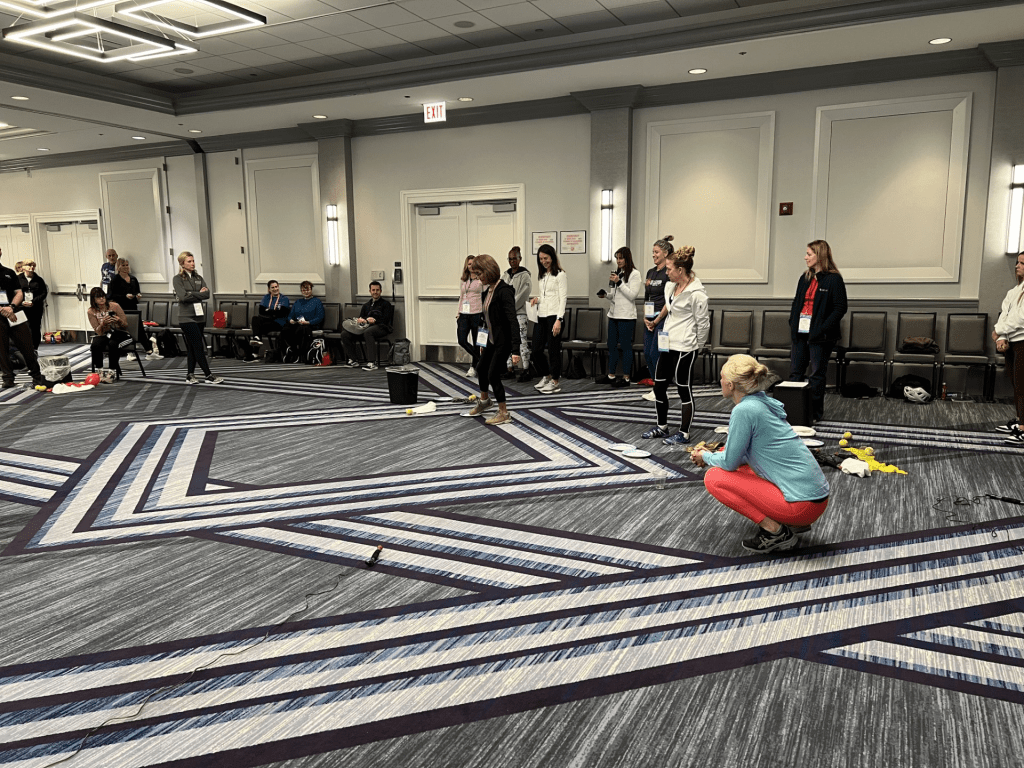
The active part of the program (pictured above) required us to grab a bunch of objects that we can find at home and find ways to make them into “fitness equipment.” Tennis balls to staplers to trash cans to paper plates all became devices to get people moving at home. Why articles that are found at home? Many folks are turned off by the idea of going to a gym or cannot afford it. We were challenged to provide ways for people to move more using what they can find close at hand. It was a real throwback to the early days of the pandemic when very few people had exercise equipment at home and we were working out with canned goods, books, and cans of paint. The solutions worked for people at any age with any level of fitness!

It is not ideal for individuals to exercise only in this kind of ad hoc way, but it can be a start to more frequent movement which will lead to activity, etc. What I liked was that the course got us all thinking creatively. Sedentarism is a serious problem and if the old solutions worked the issue would be solved already. Using a little ingenuity, we can help to bring greater levels of fitness and awareness of activity to those who are mostly just sitting around–from children in front of their screens to older adults in front of the TV.

What have you got at home that you can use to exercise? Here is a hint: can you squat while picking up a full trash can?

Will AI Do Your Exercises for You?

Last week I had the opportunity to participate in the 2024 IDEA & ACSM Health and Fitness Summit in Chicago. For the last several years I have attended this IDEA Personal Trainers’ Institute in Alexandria, VA; this year the event was combined with ACSM and featured over three days of lectures, workshops, classes, and workouts for people in the Fitness Industry.

Like doctors, lawyers, and many other professionals, personal trainers are required by their certifying agencies to engage in continuing education. I try to take one continuing education class on-line each month to meet that requirement. Attending one of these events allows for a high volume of credits, hearing the latest innovations in the field, as well as opportunities to network. I was only able to be there on Friday, but I did attend four sessions. The next few blog posts will be about what I learned.

The plenary session on Friday morning featured Dr. Ted Vickey on the topic: Future of Fitness: A Deep Dive into AI’s Dual Impact on the Business of Fitness. I was curious to hear his remarks because my wife works in “Corporate America,” in a company that is heavily investing in Artificial Intellegence as a way to help employees better serve customers. I know that many people fear AI, but I believe it is just like any other technology; it has the potential for both good and bad. I wondered how this all could be applied to fitness.

Vickey shared some of the ways in which AI can benefit those working in the field and those whom we serve. Although the talk was listed as a “deep dive,” it sort of hung out in the shallows; I am not sure how deep one can go in a 30-40 minute talk! He did give us some sense of where AI might assist us: communicating with clients more effectively, building business more quickly, and even assisting with the programming that we do (the actual exercises, number of reps and sets, weight, etc.) one-on-one or in a group setting. The time saved can potentially permit trainers to take on more clients and/or build business in other ways.

Sadly for my clients, AI will NOT do the exercises for us. It is also unlikely that AI will be able to replace the human interaction that makes working with a trainer so special. It can be a valuable tool, though, that can make the experience of exercise better and enhance the trainer/client relationship.

I do plan to learn more about AI and how I can use it in the work that I do. As Vickey suggested, not all people in the industry will use AI, but those who will survive and thrive will be among those who do. I feel like I have glimpsed the future and it is exciting!

Finally! Exercises for Couch Potatoes!

One of the leading causes of some many of the health issues that we face is being sedentary. The word “sedentary” comes from the same word as “seated,” and refers to the habit of sitting and not moving around. This is a common condition for many who work at jobs where they are tied to a desk or a computer. Others who may have a disability or are more frail simply find it too difficult to keep moving. For many, though, it is just a question of laziness and inertia–a non-moving object simply prefers to remain non-moving. Unfortunately, being a couch potato comes with a price: less favorable health outcomes.

Fitness expert, Dana Santas, recommends four exercises that can be done right on the couch! The first is an elevated Push-Up; rather than doing the exercise face down on the floor, it can be done using a couch. The easiest is off the back of the couch; more difficult is off of the arm of the couch, and most difficult is off of the cushions. Of course, one still needs to pay attention to having the proper form; aim for a plank posture. Next is the Single-Leg Squat (quite challenging!); stand close to the front of the couch and begin to sit down—but before you do, extend one leg forward so that you are only on one leg as you touch the couch. Ideally, one should not fully sit on the couch but rather just tap it with your bottom. This can be modified by starting with a regular squat (using both legs) on the couch which is also called a Sit and Stand. The third exercise is a Seated Pillow Twist. Take a pillow and hold it by the edges out in front of you; twist to the side and tap the pillow on the cushion, then twist to the other side and tap, and repeat. To make it more difficult, you can squeeze another pillow between your knees (knee adduction) while doing the exercise; over time, you can also switch from going side to side with a pillow to something heavier. Finally, there is the Side-Lying Leg Lift. Lie on one side with hips, knees, and ankles stacked one on top of the other; lift the top leg up without rotating the leg/foot toward the ceiling (in other words, make sure your toes are pointing forward) to get a great stretch through the hip flexors. Repeat on the other side.

Of course, there are many other exercises that can be done on couch that Santas does not mention in the article. I have clients who are unable to get up from the floor do some of the following on a couch: Glute Bridges, Dumbbell Chest Presses, Supine Single-Leg Raises, Knee-Ins, “Windshield Wipers,” Supine “Skull Crushers,” and Supine Chest Flys. The possibilities are nearly endless; any exercise that can be done seated or on the floor can usually be done on a couch as well.

So for those who complain that it is too difficult to get to a gym, or to the room downstairs with the exercise equipment, or even to get off the couch (!), you no longer have an excuse. Get moving–even on your favorite sofa–and see the difference it can make!

Aging Doesn’t Have to Mean Steep Physical Decline

As I myself age, I begin to notice how my body is changing; there are certain activities I cannot do as well as I used to. Working with an older population, I often hear the concerns of my clients about their current and future physcial fitness. Will they be able to walk (better) in the future? How will they be able to negotiate stairs? Will carrying bags of groceries into the house from the car be too much? How about picking up a grandchild or beloved pet?

A recent article in Fortune, touched on these concerns. The author, Dr. Zachary M. Gillen, is an expert in Exercise Physiology and is an assistant professor at Mississippi State University. Gillen suggests that one kind of exercise can make the biggest difference for older adults, allowing them to carry out these physical activities without being wiped out at the end of the day. The key: resistance (or weight) training. 

This blog has touched on this idea many times in the past. One of the issues confronted by older adults is sarcopenia–loss of muscle mass. Sarcopenia can lead to other diseases such as Type-2 Diabetes. This happens as a natural part of the aging process, but a steep decline in muscle strength in not necessarily an inevitability. Muscle mass can be maintained and even increased throughout our lives. 

Gillen states that the evidence shows that low muscle strength is a key factor in sarcopenia. The way to combat it is with the proper kinds of weight/resistance exercises. It is important to do these exercises properly and safely, which is why it is a good idea to consult a fitness professional. Sadly, only 13% of adults over the age of 50 do some kind of strength training at least twice weekly; across the fitness world, the recommendation for older adults is 2-3 times per week. Gillen suggests that 6-12 repetitions of each exercise working at 50-85% of one-repetition maximum; this means that if the maximum weight at which you can do an exercise is 20 lbs., you should aim to do 6-12 reps at 10-17 lbs. There should be a 2-3 minute rest between these sets (or longer if needed–especially at the beginning) with 24-48 hours of break between these workouts. Since we should all aim for 150 minutes of moderate exercise each week, the other days should focus on cardio activities.

Gillen ends the article by recommending that older adults take seriously the risks involved in starting a new exercise program. Those with little history of working out can do more harm than good. A fitness professional, like a personal trainer, can help us make sure we avoid steep physical decline–either because of inactivity or injury. If done properly, an exercise program at age 60 or even 90 can help us in the process of healthy aging.

New Study: Improving Fitness Decreases Risk of Prostate Cancer

It has long been known that exercise can contribute to lowering the risks of many diseases including cancer. Even though other factors such as genetics, environment, stress, etc., play a role, on average, those who keep physically fit have better health outcomes.

A new study by the British Journal of Sports Medicine was reported on by nbcnews.com focusing on prostate cancer–a cancer that is diagnosed in 113 of every 100,000 men each year. The study focused on cardiovascular exercise; these are exercises that increase heart and respiratory rates (as opposed to those that are focused on building muscle). Examples of these types of activities are swimming, jogging, dancing, and cycling, as well as many sports activities. It found that no matter what level a man’s fitness, a 3% increase in cardiorespiratory fitness each year for 5 years leads to a 35% decrease in risk for prostate cancer compared to those whose cardiorespiratory fitness decreased 3% each year for 5 years. 

Studies in the past seemed to indicate that more exercise might lead to an increase in prostate cancer, but those studies did not take into account many factors. The most recent testing accounted for factors that might have skewed the results. Interestingly (and vexingly), there is still no certainty as to how these changes in fitness levels affect the occurence (or not) of prostate cancer. More research will be needed. 

In the meantime, it appears that men have yet another reason to improve their cardiovascular fitness levels. As Dr. William Ho, Chief Medical Officer of the Prostate Cancer Foundation (that was not involved in the study) pointed out, the research shows that “no matter what age, no matter where you are in your life or your relative fitness, that if you improve your fitness, even by a relatively small amount, you may significantly decrease your risk of developing prostate cancer.”

Bending Over Backwards for Better Health

We have all heard the expression “to bend over backwards,” which means to put in an extra effort or to be extra flexible on a matter. In the fitness world, there is an exercise called a Back Extension that is the literal physical manifestation of this expression–and it has many benefits for the human body!

The Back Extension is an exercise in which the spine above the waist is extended or leans posteriorly (backwards). Back Extensions can be done many ways. There are machines at most gyms; some move and allow you to add weights, while others are immobile and rely on your body weight as resistance. Without equipment, they can be done lying prone (face-down) on a mat while lifting the head, shoulder, and chest up off the mat; you can lift your legs at the same time for added effect, which is often called a “Superman” or “Superhero.” They can be done in a standing position; some people find it helpful to place their hands on their hips or in the small of the back for stability. For those with balance concerns, it can be done with the buttocks up against a table, counter, or other non-movable object; once in position, lean backwards with arms at the side or crossed across the chest.

What are the benefits of the Back Extension?

  1. Improved posture by strengthening stabilizer muscles – erector spinae, in particular.
  2. Prevention of back pain by lengthening the spine.
  3. Stronger back due to improved flexibility, increased muscle strength, and wider range of motion.
  4. Stronger glutes, hamstrings, upper back and shoulders, and abdominal muscles, which together add up to a stronger core.
  5. The exercise is low-impact, can be done without equipment, and helps to prevent injury.

How often should you do Back Extensions? If you are using weights, recommendations are 3-4 sets of 10-15 reps, twice to four times per week. If you are using just body weight, they can be done in the same quantity every day.

Many times we bend over backwards for others whom we care about. The Back Extension exercise is something that we can do for ourselves to show care for our bodies. 

Fitness Myths that Drive Me Crazy?

There are a lot of things in this world that drive me crazy. Injustice is probably at the top. This is followed by rudeness, disrespect, and belligerence. Apparently, however, according to a recent New York Times article, there are “8 Fitness Myths that Drive Experts Crazy;” and I guess I consider myself (after all these years) a fitness expert. 

Of course, the title of the article engages in a bit of hyperbole to catch the potential readers attention, but the points made in the article are true and provide some good fitness advice.

Here are the myths:

  1. “You should stretch before you work out.” Actually, static stretches (holding a pose) are either ineffective or even harmful before exercise. Rather, one should do dynamic stretches that mimic the kinds of action you will be doing during the upcoming exercise. Static stretches are best for after the workout.
  2. “You need to lift heavy weights to build muscle.” This is especially pertinent to older adults. If you are looking to compete in a bodybuilding contest, by all means go for heavy weights with fewer reps. To build muscle, however, it is possible to do so using lighter weights with more reps.
  3. “Running destroys your knees.” Not true. In fact, it can even protect knees against osteoarthritis. As long as you do not run too fast or increase your distances too quickly, your knees should be okay.
  4. “Walking is enough to keep you fit as you age.” I have blogged a lot about walking; it is a great activity, but for most people it is not sufficient to keep fit. Strength training should also be a part of the program for older adults to combact the loss of muscle mass.
  5. “Modifications are for beginners.” A modification is changing the way an exercise is done to either make it easier or to protect an injury. Some people modify until their strength increases; one could start with a wall push-up then progress to a push-up off a counter and finally progress to a push-up on the floor. For many others, though, a floor push-up would cause injury (or they simply cannot get up from the floor) so modifications are the way to go on an on-going basis.
  6. “Runners and cyclists don’t need to strength-train their lower body.” This does not make me crazy at all. While running and cycling do strengthen the lower body, they are not enough to create significant muscle growth; once again, resistance training as well as exercises like squats and lunges can increase bone density and make the lower body stronger.
  7. “You need 10,000 steps a day to be healthy.” I debunked this one a long time ago. That number came from the company that produced a pedometer and they liked it because it was a nice round number. Research shows that benefits accrue up to 7500 steps/day and that as few as 4000/day reduce the risk of mortality.
  8. “Taking an ice bath after a tough workout improves your recovery.” True or not, you will probably never find me doing this. The theory is that the ice bath will reduce inflammation. As I learned when I studied to become a personal trainer, not all inflammation is bad; inflammation can be useful in helping the body heal and build strength. Jumping in an ice bath can short circuit the natural path. Every once in a while, an ice bath may be okay after a tough workout; saunas, on the other hand, seem to be safer and more effective!

There are many other myths in the fitness world–many with regard to older adults. Here are a few: Older adults should not do power exercises. Older adults should only do seated exercises. Older adults do not need to do exercises with weights. And the list goes on. Before making decisions about your own fitness, do some research or check with a fitness professional near you!

New Year’s Resolution? Grab a Partner

It is that time of the year again. Hanukkah and Christmas are behind us, and in just a few days it will be 2024. I have blogged in the past about New Year’s Resolutions. You can read those posts here, here, here, and here. If you do not want to read all of those posts again, let me give you a summary.

  1. A resolution without a plan is just a resolution. If the goal is: ”I am going to get in shape,” what is the plan? A better resolution is: ”I am going to go to the gym 3 times each week.” The more specific you are the better the chances you will achieve your goal.
  2. Keep it simple. I know some friends who have a whole bunch of resolutions; it is like a grocery shopping list. In Hebrew there is an expression: Tafasta m’rubeh, lo tafasta, which translates as “if you try to grab too much, you grab nothing.” I like the Rule of 3. Choose three things and concentrate on them.
  3. Be realistic. Many of the resolutions that we make we have made before. Are they actually achievable? Can we identify the reasons why we failed? Socrates said, “Know Thyself;” be honest with yourself about what you can and will do and make the plan accordingly. It is better to have small successes that help to build a pattern.

What is the secret sauce to all of these? Grab a partner. Find someone who is willing to be with you on your fitness journey. It can be a spouse/partner, colleague from work, a friend at the gym, etc. Work together to plan goals and how to meet them. Once that is done, hold each other accountable.

Several years ago when I work at a gym, I was in charge of a fitness challenge. We divided into three teams. Not only did individuals win prizes, but the entire team could win if they met certain criteria. We had a very low drop-our rate for the challenge simply because team members looked out for each other, encouraged each other, and did not want to disappoint others in the group. The same dynamic can work one partner or even a small group. Have each other’s backs and watch the results.

The next week is a great opportunity to think about what went well and not-so-well in the past year. A New Year can be a new beginning. To make the most of it, have a plan (keep it simple and realistic), and grab a partner!

Wishing everyone the best in HEALTH and happiness in 2024!

Walking and Type II Diabetes

Readers of this blog know that I have written quite a bit about walking as exercise for older adults. The benefits are many and go beyond simple cardio activity; walking is associated with better health outcomes and disease prevention. Still, older adults wonder if walking is good enough; this was the topic of a post nearly 3 years ago. It is good, but the more intense it is, the greater impact it has on our health.

NBC News recently reported on a study that came out earlier this week in British Journal of Sports Medicine about walking and diabetes. In particular, it dealt with Type II Diabetes; according to the Mayo Clinic, Type II Diabetes is a condition that happens because of a problem in the way the body regulates and uses sugar as a fuel. That sugar also is called glucose. This long-term condition results in too much sugar circulating in the blood. The National Institutes of Health notes that a person is more likely to develop Type II Diabetes if they are not physically active and are overweight or have obesity. Extra weight sometimes causes insulin resistance and is common in people with Type II Diabetes.

The upshot of the new study is that it is now possible to quantify what kind of walking (slower vs faster) can prevent the development of Type II Diabetes. Walking at a pace of 2.5 mph can lower the risk by 15%. The faster the pace, the bigger impact it will have: 3-4 mph lowers the risk by 24% and over 4 mph reduces the risk by 39%. Obviously, the more vigorous the activity, the more it influences our overall health in addition to our chances of getting Type II Diabetes–but speed isn’t everything. Guidelines recommend that adults exercise for 150 minutes per week; so if a person walks vigorously, but only for 30 minutes a week, they are much less likely to make a dent in their chances of developing the disease.

As always, before beginning an exercise regimen, it is important to talk with your physician. Most doctors recommend walking because it requires no equipment (except for supportive shoes) and no instruction. Now there is another reason to like walking: we can help prevent Type II Diabetes.

Exercise before Surgery

Early last week, one of the regular participants in an on-line class that I teach had hip replacement surgery. I teach the class 3 times/week and she is almost always there unless she is traveling. Even in the weeks leading up to the surgery, she has been participating fully with a few modifications.

I checked in with her a few days after surgery to see how she was doing. She told me that the surgery went well–no surprises–and that the recovery had thus far been better than expected. She further explained to me that she had no doubt that all the workouts had prepared her body for a speedier and easier post-surgical experience. I have a friend who had a benign brain tumor removed over 20 years ago; he had a couple of months before the surgery date and he did his best to get in as much exercise as possible. He wanted to give himself the best chance for a successful recovery; there were unrelated complications after surgery and his strength helped keep him alive. He made a full recovery and continues to work out regularly.

These two anecdotal stories illustrate something that medical research has backed up. Study after study shows that the better shape you are in before surgery, the more likely you are to have an easier recovery with positive results. For those who exercise on a regular basis, there is no need to pile on more workouts; those who engage in physical activity regularly are likely to have greater strength and improved cardiovascular capacity to begin with. There is an indication, however, that those approaching surgery may want to shift to more HIIT workouts. HIIT stands for High Intensity Interval Training; it is exactly what it sounds like: periods of intense exercise interspersed with periods of moderate or light exercise. For more info on HIIT workouts you can look at my post from July 2019 and a follow-up from August 2021.

Followers of my blog know that I have undergone a few surgeries over the past years. I have been fortunate to recover to 100% with each one. It is not because of luck alone, but rather because I have prepared my body to be strong and resilient. It goes without saying that if you have been scheduled for surgery, you should talk with your doctor to see what they recommend or discourage before going under the knife (or laser). Hopefully a regular regime of exercise, proper rest, and good nutrition will–like an apple a day–keep the doctor away…but when surgery is called for, the better we go into it, the better we are likely to come out of it.