As the clock ticks down to Rosh Hashanah, there is a lot on my mind. Just like any Shabbat, there are all kinds of preparations that need to be completed: food prepared, Divrei Torah to write, clothes to get ready, etc. In the midst of all those preparations, we can sometimes lose sight of why we are doing all this preparation. If we have a wonderful meal on the table, new clothes, shiny shoes and the house all tidied up, but we have not given serious thought to the hard job of Teshuva–doing atonement–we are not really ready for the holiday. We are lucky to have this coming Shabbat to take a break in the rush to get ready for the spiritual part of the holiday. It is a great time to consider: what have I done well this past year? What needs improvement? What goals did I set last year, and did I achieve them? How will this year be different? None of this is rocket science, but it is easy to forget the “reason for the season.” Shabbat Shalom and Shanah Tovah from my family to yours!
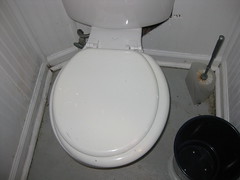
If you’ve ever been “irregular,” you know what a blessing it can be when you finally “go.” What a relief it is. You may even thank God that if finally happened!
In Jewish tradition, there is actually a blessing that one is supposed to say every time one uses the toilet. The blessing, know by its short form Asher Yatzar in Hebrew, is recited by more observant Jews as another way of elevating and sanctifying even the most base and animal-like functions of daily life.
Here is the text of the blessing in Hebrew and English:
Blessed are You, Adonai, our God, King of the universe, who formed man with wisdom and created within him many openings and many hollow spaces. It is obvious and known before Your Seat of Honor that if even one of them would be opened, or if even one of them would be sealed, it would be impossible to survive and to stand before You even for one hour. Blessed are You, Adonai, who heals all flesh and acts wondrously.
This past Shabbat afternoon, I taught a lunch and learn at my congregation, Beth El – The Heights Synagogue, about the mind-body-spirit connection. I referred to this blessing because it is key to understanding the Jewish view of the human body. The blessing is quite biological in its content; there are openings in our bodies that need to stay open, and things that are closed that need to stay closed. Any of us who has ever had something that wouldn’t close (or heal properly) or had something that should be open that isn’t (constipation, for example), knows just how difficult and painful it can be. If it is not eventually resolved, the results can be quite serious.
What is central to the blessing is the idea that if things are not working properly it would be impossible to survive and stand before God. In other words, if we are not healthy we cannot do what it is that God expects of us: clothing the naked, feeding the hungry, supporting the cause of the disadvantaged, pursuing justice, seeking peace, etc. We need our bodies to help make this world a better and more whole place. Our spirits and good thoughts alone won’t cut it; we need to get our hands dirty and put some elbow grease into it.
So it is that every time our body works successfully, an observant Jew thanks God that it is all working…because when it does, we can fulfill our mission in God’s creation.
It seems odd at first to say a blessing after using the bathroom, but upon further reflection, there is something meaningful about reminding ourselves on a (hopefully) “regular” basis to be thankful to God and to get busy with the work of creating a better world. Not only that, it compels us to take care of ourselves (eat right, exercise, get enough sleep, don’t smoke, etc.), so that we can best ensure that we will be able to stand before God and our fellow human beings.
The beginning of Parashat Ki Tetze gives instructions for when an Israelite soldier finds a woman attractive among the captives of the conquest and wishes to take her as a wife. The man is to bring her to his home, trim her nails and cut her hair. She also removes her captive’s garb. These seem to be signs of mourning. The text continues by telling us that she is to mourn her parents for thirty days–presumably because she will never see them again. At first read, this text might appear to be sensitive. The man’s emotions are clear: he is in love and has desire. The verses tell us that he must first take into her feelings; her mourning for what her life was and might have been is real and must be recognized. This seems unusual since the Torah does not often deal with feelings. While we may take some comfort in knowing that the Torah has sensitivity toward the woman’s feelings, we must not forget that it does not change her fate. Her life was not in her control; she became an object rather than a subject in her destiny. Even so, it is instructive that the Torah mentions that when it comes to emotions, we must look beyond what we are feeling alone. There is always another side to the story that deserves validation and respect. Shabbat Shalom!
Parashat Shoftim is perhaps most well known for the verse containing the commandment, Tzedek Tzedek Tirdof, “Justice, justice shall you pursue.” It is popular because it expresses a notion that is at the core of Judaism and Jewish practice.
It is an idea that we can all get behind, but when it comes to putting it into action, it is a little more complicated. First, not everyone agrees on what justice might be in a given case. Second, we have a well-established legal system to which we turn in order to administer affairs of justice. Third, there is a not-so-fine line between pursuing justice and vigilantism.
Despite the “messy” nature of justice, the Torah exhorts us–repeating the word justice–to pursue it. As we are in the month of Elul, it is worth thinking about how we do or do not follow this commandment. We should ask ourselves, “when was the last time I pursued justice?” Can we remember what it was or when it was? If not, it means that we must recommit to the pursuit of justice despite the obstacles.
“Justice, justice shall you pursue,” is not just a platitude. It is at the core of how we must live our lives.
Parashat Re’eh begins with a statement from God given through the prophet Moses. We are told that God has placed before us blessing and curse—and it is plain to see, in Hebrew, “Re’eh.”
There are instructions later in the Parasha that the Israelites, once they enter the Land of Israel, are to place a list of blessings on Mt. Gerizim and list of curses on Mt. Ebal. These two mountains overlook the town of Shechem (Nablus today). Gerizim is to this day covered in greenery, while Ebal is barren and rocky. It is easy to imagine that the Israelites looking at these two mountains would clearly see the difference between blessing and curse, between following the commandments and going after false gods. It is an amazing visual aid.
We are familiar with the phrase, “seeing is believing,” but that is only partially true. Sometimes we cannot accept something until we see it with our own eyes. Other times, our eyes can deceive us; we make judgments about what we see on the surface and miss what is going on behind it.
We know that life is never that simple. Unlike Gerizim and Ebal, life is not black and white (although sometimes it is!). Most of the time there are shades of gray…and other colors too. That is why it is so important to see—really see—in order to do our best to determine what courses of action will lead to blessings and which (God-forbid) will lead to curses.
“When the
moon hits your eye, like a big pizza pie, that’s Amore!” Did you see that full moon last night? It turns out it was about “amore;” today is
Tu B’Av, the 15th Day of the Hebrew month of Av. Tu B’Av is the Jewish cognate of Valentine’s
Day. According to tradition, this date
was the beginning of the grape harvest that ended on Yom Kippur; on both these
dates, the unmarried young women of Jerusalem would go out to the vineyards to
dance. It thus became a day for matchmaking.
Today, the
main way we observe Tu B’Av is that we do not recite Tachanun (the penitential
prayers said at Shacharit and Mincha).
In Israel, it is a day for gifts and romanticism for love partners.
Although the
focus is on love between human beings, Judaism talks a great deal about the love
relationship between the Jewish People and God.
Traditionally, this is how the Song of Songs in interpreted; it is a
book of love poems that highlight the love God has for us, and us for God. We are forever grateful for the love the Lord
has shown us.
As we head
into Shabbat on this Tu B’Av, let’s focus on our romantic partners and appreciate
the ways they have impacted our lives and our hearts. Judaism emphasizes more what we do more than
what we say or think, so use this as an opportunity to show your loved one how
you feel. For those who do not have a
partner, this is a great time to show friends, family and God how grateful we
much we appreciate the relationship.
It is never
too late to say, “I love you,” and it can never be said too often.
Today on the Jewish calendar is Tisha B’Av, the ninth day of the Hebrew month of Av; it is a 25-hour fast that commemorates the destruction of the First and Second Temples in Ancient Jerusalem. Aside from Yom Kippur, it is the only full fast (others just go from sunrise to sunset)…and I’ve got about 6 hours to go.
The goal of the fast (which is the case on Yom Kippur too) is not to lose weight or to suffer greatly, but rather to focus less on the physical and more on the metaphysical. Tisha B’Av causes those who observe it to reflect on the history of the Jewish people: the enemies who have arisen against us from the outside, as well as the enemies from within. Not having to think about eating (which isn’t easy), allows the day to be mostly spiritual, and also gives us a small taste of the suffering of our ancestors.
Interestingly, fasting has been a hot trend in the diet/fitness world the last several years. In particular, a lot of attention has been paid to Intermittent Fasting.
What is Intermittent Fasting? There are several versions. One way to do it is to restrict eating to only certain times of the day (generally an 8-hour period). Others fast one or two days out of the week. Others choose 1-3 days to eat a very restricted calorie count (say around 500 KCals) during the week, and eat normally the rest of the week. The science behind it is that during the fasting periods, the body is required to burn fat in order to maintain its regular functions; in particular, this kind of fasting seems to target belly fat. Other health benefits may include better control of insulin and cholesterol levels.
Why this is appealing to many is that you don’t have to think about calories or only eating certain kinds of food. The process is very simple: eat during certain times and not during others. This can also simplify the dieting process: no need for extensive reading of labels, less meals to plan , etc. Of course, one shouldn’t assume that during non-fasting times root beer floats, corned beef sandwiches and tubs of whipped topping should be the staples of the diet. As always, fruits, vegetables, lean meats, fish and less-processed foods are recommended.
I started doing Intermittent Fasting many years ago not really knowing that it was a “thing.” I noticed that I grazed a LOT after dinner, and it added up to hundreds of calories. I made a rule for myself that I still follow pretty closely: after dinner, no eating! I can drink calorie-free liquids, but that is it. (I do make exceptions for special occasions but don’t go crazy). I found that it helps me control my weight and that my cravings for after-dinner snacks quickly subsided.
There is admittedly a big difference between the kind of religious fasting to which many of us are accustomed (Ramadan, Yom Kippur, etc.), but there is a commonality as well. While one focuses on a physiological goal and the other on a more spiritual goal, both require self-control and self-sacrifice. Both also are means to an end: either greater physical health or greater spiritual awareness.
Readers, I would be interested to know how many of you have tried Intermittent Fasting, or if you currently practice it now. What are the challenges and what are the advantages? What are the results you have seen?
I am a believer–as long as it is done in moderation. Before jumping into Intermittent Fasting, though, do some research and talk to your physician. Be safe and be healthy.
This coming Shabbat morning we begin our reading of the Book of Deuteronomy, the final book of the Torah. Although many biblical scholars assert that this book was written at a much later time, traditionally it is viewed as Moses’ final words (a lot of them) to the Israelites as they were about to cross the Jordan River into the Promised Land. Moses would not be joining them, so he repeats many of the previous laws and clarifies others, much in the way that a parent might remind his/her children before they head off to school, camp, a date, etc.
Deuteronomy plays like a kind of “greatest hits,” bringing us the Shema as well as a second recitation of the Ten Commandments. Ritual regulations are discussed, but there is a particular emphasis on what would be necessary for the people to create a just and peaceful society in their new homeland. There is also a strong sense of Moses’ own personal reflections and emotional state as he reaches the end of his tenure as prophet and leader.
The Book of Deuteronomy comes as a signal that the High Holidays are not that far away. In several weeks we will be at Elul…and we all know what comes after that. We approach a time of reflection—not unlike what I imagine Moses must have done as he approached the end of his life. We wonder how we have done, what it was all about, how we will be remembered.
There are times when I ask myself if I were delivering my final address, what would I say? What have I accomplished? What meaning has there been in my life? How will others remember me? What would I want my descendants to know? The truth is that we write this speech every day through our thoughts, words and actions. As we dive into the Book of Deuteronomy, let us answer those questions…and if we do not like the responses, it is never too late to begin editing our lives.
I am heartbroken by the events in our nation, but particularly by the never-ending stream of mass shootings. It is a nearly daily occurrence and there seems to be no end in sight. I got sick of thoughts and prayers a LONG time ago. When Congress did NOTHING after the Sandy Hook Elementary School massacre, my understanding of what I thought this country stood for was destroyed.
In the Jewish community there has been a lot of talk about security–in general, but especially after the Pittsburgh massacre. Judaism teaches us that we have certain obligations: ritual and ethical (and that these often go hand in hand). Among our obligations are a number of commandments that instruct us to go out of our way to ensure that we prevent unnecessary injury or (God forbid) death. There is a law in the Torah that tells us that when we build a home, a parapet must be put on the roof lest someone on the roof accidentally fall off. Another law tells us that when we dig a pit, it must be marked off or cordoned off lest a person or an animal wander in and be injured. Jewish law over the centuries expanded on this idea, exhorting us to take all necessary steps to prevent bloodshed. We must ask ourselves whether we are taking the necessary precautions to prevent gun violence. (As if the daily news feed does not tell us already).
I know that a lot of folks place the blame for what is happening now on the person who occupies the Oval Office; he certainly has not helped (and many argue that he has made it worse). The truth is that mass shootings in this country predate the Trump Administration; his administration–along with those of previous presidents–bear responsibility for not doing more.
I have been involved in the gun control movement for over 20 years, having served on the board of the Ohio Coalition Against Gun Violence for much of that time. The executive branch is only part of the issue. Congress has it in its power to pass common-sense legislation that would carry out the spirit of Jewish law and the American ethos–namely to do whatever necessary to prevent bloodshed and violence. Congress has failed to do so–even when both houses were controlled by the same party. The NRA is a powerful force in ensuring that this remains the case. It is up to US, the voters, to let our elected officials know that we are a bigger threat than the NRA. The way we do that is by pushing this issue in town hall forums, debates, and in our communications. Facebook and Twitter are not enough. They do not vote NRA shills out of office–only WE can do that.
Of course, there is also an issue in our State Houses and Capitals. Gerrymandering has ensured that in many states there will also be no action on this issue. Ohio is a purple state. It is the swing state personified when it comes to national elections. On the state level, however, it is all red…year after year after year. Gerrymandering has made sure that the State House stays firmly in the control of one party even though the state is evenly split and the majorities should swing back and forth on a regular basis.
The ONLY way I see a change on a national level is by voting those who are in the pocket of the NRA out. On the state level, gerrymandering has to be dealt with. And if you don’t think that the US Supreme Court has contributed to the perpetuation of this problem, think again; there must be a serious examination of what responsibilities should accompany the Second Amendment.
Our work is cut out for us if we want to Make America Livable Again. IMHO, here is where to start:
–Get educated on the issue–especially in your state. What legislation is pending? Who is supporting it? Who is sponsoring? Who is blocking it?
–Support organizations that are helping to raise awareness and support political initiatives to end gun violence. There are dozens, and many websites can direct you to those that will use your donations wisely.
–Do more than send your thoughts and prayers: VOTE!!!
These are not Jewish imperatives, or even American imperatives…it is our human duty and it is literally a matter of life and death.
Today, not only are we about to begin Shabbat, but it is also Rosh Chodesh Av–the first day of the Hebrew month of Av. On the Hebrew calendar, every month begins when there is a new moon in the sky (even if it isn’t visible); it is a lunar calendar (as opposed to the Gregorian calendar which is solar). Even so, the Jewish calendar has a solar correction because the sun and the moon aren’t always lined up; there is a leap month every few years so that Passover always ends up in the spring, Rosh Hashanah in the fall, etc.
Judaism is especially attuned to the cycles of nature. We not only mark the cycles of the moon, but also the various seasons and harvests that accompany them. Prayer times are set by the pattern of sunrises and sunsets.
There is only one major observance that does not line up with any astronomical or natural cycles: Shabbat, the day of rest. It does not reflect anything going on in the cosmos; rather it is based on the biblical story of Creation. Even so, it is an important part (the most important!) of the cycles that make up Jewish life. The mega-cycle of the year on the Jewish calendar causes us to appreciate the world around us, to confront our responsibilities, and find our place in the world. Each holiday asks us to focus on what we need to do in the world. Passover focuses on freedom, Shavuot on responsibility, etc. All the cycles give us context for our lives so that we are not simply running on a treadmill from cradle to grave. The calendar encourages us to live in and appreciate the moment.
I cannot help but see a parallel to the world of physical fitness. Many of us have our regular cycle of upper body days, lower body days, group classes. We may even have a rotation of cardio equipment we use. For those who take this seriously, the cycles and patterns provide a sense of orderliness; they present a plan where it is possible to see progress–to look back on where we have been, where we are, and where we hope to go. These cycles can be quite effective.
In our society we often hear that we should not get “stuck in a rut.” We need to “break the cycle.” There is, however, a flip-side. We can use these patterns to help us organize our lives, set goals and even give our lives a sense of meaning.
On this new moon, I am reflecting on the bad things that happen in our world (that is a theme of the month of Av), and what I can do to prevent them. On this Shabbat (on which we conclude the Book of Numbers), I am thinking about closing one chapter and beginning another. I look to these cycles to help me find my place in the world and what I can do to reflect God’s presence in it.







 Kosher Fitness