One Year after the Pittsburgh Synagogue Massacre

Image result for pittsburgh strong

It has been just over a year on the Gregorian calendar since that terrible morning (October 27, 2018) in Pittsburgh when a gunman entered the Tree of Life Synagogue and murdered 11 innocent people at prayer services. On the Jewish calendar, the Yahrzeit (anniversary of a death) will not be for a few weeks.

I remember where I was when I heard the news. I was in synagogue here in Cleveland Heights when someone brought the terrible tidings. Details were sketchy but we feared it wasn’t good. Once the details emerged our fears were confirmed.

Within days, the Cleveland Jewish Community–along with other communities across the globe–were organizing memorial services. It felt especially close here in Cleveland since Pittsburgh is just a couple of hours away–closer by just a few miles than even Columbus. In this part of the Midwest there is a lot of mobility and nearby Jewish communities have a sense of kinship and overlapping of families. When I was in high school (having grown up in the Detroit area) I even attended a youth group conference that took place at this synagogue. This was not some far away shooting that affected others; it felt personal.

Since then, there is a feeling among many in the American Jewish community that something has dramatically and fundamentally changed. Our sense of belonging in this country has been challenged; an aspect of Jewish history that has been constant is that in nearly every place where Jews have been settled, we have either been expelled or persecuted or worst. I always thought that the USA was different: it is a democracy (still?!) and a nation made up of immigrants, those whose ancestors were brought here against their will, and a small but important minority of Native Americans. This is a place where anyone regardless of their background can become an American–and that is the way I have always felt.

With Pittsburgh something changed. I wonder whether there really is a future for Jews in America or whether what we see going on now is just the beginning of a long, dark path leading to yet another wandering. On the one hand it is unthinkable, but on the other hand Jewish history tells me otherwise.

I am astounded and angry that so little is done in this country to curb gun violence; when nothing was done after the Sandy Hook Elementary School massacre, I realized this country had a problem in its soul. I am incredulous that many political leaders not only do not speak out against xenophobia but actually promote it. The depths to which levels of discourse in the USA have sunk make it hard to imagine much positive change in the short-term…and perhaps even in the longer-term.

I am sad. My heart aches for the Jewish community of Pittsburgh, for the victim’s families, and for our world. I cannot imagine the loss felt in the Steel City.

I am also afraid. I fear that saner voices will not be heard, that the deafening daily distractions will drown them out. I am afraid that things will get worse for the Jewish community in the US (and elsewhere) that has already had to spend millions to upgrade security. Does your house of worship have an armed security guard during prayer services? Mine does….now. How can we focus on feeding the hungry, pursuing justice, seeking peace, educating our youth, looking after the elderly, and caring for the sick when we must divert funds to simply keep ourselves safe and secure?

I will do what I can at the voting booth as well as by contacting my elected officials. I will demand that steps be taken to put this country back on track and make it the place where ALL Americans feel at home. Hopefully my worst fears will not be realized and next year at this time, we will see a new light shining on our great nation–a light of peace, knowledge, justice and love. We must do more than hope…we must act.

Vegetarian at the Bell

Taco Bell

Many of you may recall a couple of months ago that my wife and I tried the Impossible Whopper at Burger King. Overall reviews on that: really good but not necessarily any more healthy than the “regular” stuff. We’d do it again.

I had seen ads for the new vegetarian menu at Taco Bell, so my wife and I have been talking for a while about checking it out.

Before my review, let me share that I am a pescatarian–a vegetarian who eats fish (but not shellfish). When I travel, I usually find vegetarian stuff to eat; this is true even at local restaurants. It is a lot better than it used to be as most people are trying to eat more healthy.

I give you this background to explain the difference between the Taco Bell experience and the Burger King one. At Burger King, it felt like they were trying to replicate the sensation of eating a meat Whopper; a meat substitute was central to that proposition. At Taco Bell, it seems more like their vegetarian menu is just meals without meat. This is not a negative, but just a different expectation; there was no fake ground beef or fake chicken–just meals that contained no meat. I have a feeling I could have accomplished this without an ad campaign to lure me in.

My take on the Taco Bell vegetarian experience? OK. I think the last time I ate there I was in high school (Carter was in the White House), so not a whole lot to compare it to. My wife and I both got one meal; they were OK but not nearly as filling as the Impossible Whopper. I guess I’m supposed to get more than one thing from the menu?

Like the Impossible Whopper, it is nice to know that there are vegetarian options at Taco Bell. Like Burger King, do not think that because it is vegetarian it is any more healthy; although the sour cream is low-fat, this is by no means “health food.” Would I try it again? Perhaps…but not necessarily rushing back.

Struggling with the Creation Story

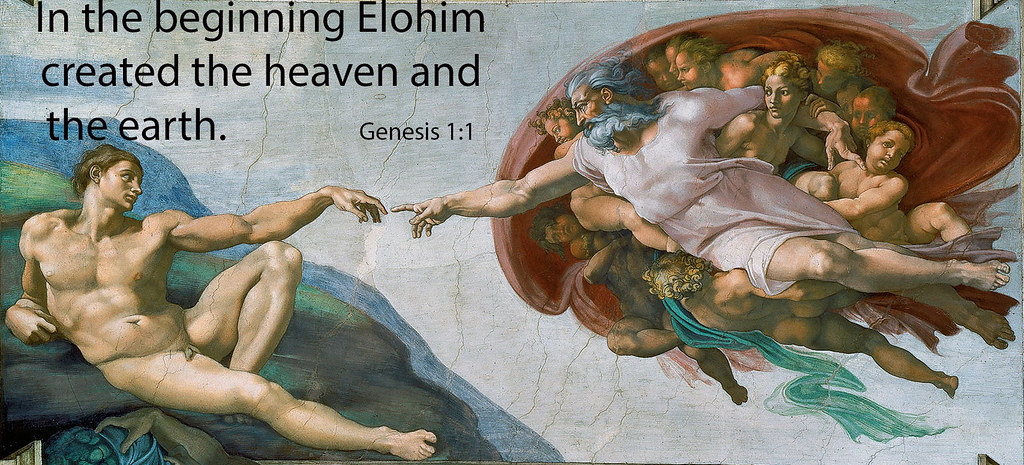
Elohim Creation

Parashat Breisheet–the very first Torah portion–is always a joy to read. The stories of the Creation of the World, the Garden of Eden, and the first generations on the planet are among the most well-known in the world.Despite their popularity, there is a fair amount of discussion/controversy around these early accounts of life in our universe. 

“True believers” take the story literally and accept that the world came into being exactly as described in the Torah.  More progressive readers of the text see Breisheet as a myth created by the ancients to help explain how everything came to exist; those who read it this way find ways to both appreciate the stories and honor their understanding of scientific explanations of the origins of life.

The name Israel (Yisrael in Hebrew) means to struggle with God; we will get to that story in several weeks.  A hallmark of Judaism is that we do strive to understand the nature of God and our universe.  Not everyone agrees on how everything came about; in fact, it is hard to find a topic on which everyone agrees at all!  This is  a tradition that we can fine (literally) “in the beginning.”

Nevertheless, we can all value the accounts in Breisheet.  They are the legends that have been told over and over by generations upon generations in the Jewish and human family.  We may understand that they are not to be taken literally, and at the same time comprehend just how powerful and beautiful the stories are.

Shabbat Shalom!

A Post for National Disabilities Employment Awareness Month 2019 — Rami Ungar The Writer

A repost of a blog post written by my son. Important to remember in the Fitness Community and Jewish Community as well.

As many of you are aware, I am a member of the disabled community, having autism, ADHD, anxiety, and more things than I can name. What many of you might not be aware is that October is National Disability Employment Awareness Month (NDEAM for short) in the United States. And this year’s theme (which I […]

A Post for National Disabilities Employment Awareness Month 2019 — Rami Ungar The Writer

It’s Okay to be Vulnerable

Vulnerable

It is natural for us as human beings to want to feel that we are in control of our own destinies.  We like to plan for the future, set goals and try to achieve them.  Additionally, we may also put up a front to hide our disappointments, pain and embarrassment when those plans do not come to fruition.
No matter how much we think we are in control, the truth is there is so much that is outside of our power.  Natural disasters can affect us.  Economic trends can touch us and our families.  A diagnosis can throw our plans into a tailspin.  We also know that we cannot change other people or control their behavior.  The only person that we can change is ourselves…and we know how difficult that can be.
The holiday of Sukkot in the middle of which we find ourselves is all about vulnerability.  From an historical standpoint, we celebrate the time in the wilderness when we wandered for forty years; we were totally dependent on God’s providence to survive.  We celebrate the harvest time; until it happens, we never know whether it will be a year of bounty or a year of scarcity.  The sukkah (the temporary hut we build at our homes for the week) is open on top so that rain and wind can get in; we cannot control the weather.
Vulnerability is often seen as a negative, but it also has a positive side.  When we are vulnerable we often reach out to others and open ourselves up.  When we lower that mask of infallibility, we connect with others.  Vulnerability teaches us to be humble–not to abase ourselves, but rather to understand our true place in God’s world.
The Yiddish expression is “Man plans and God laughs.”  I don’t know if God laughs, but we know our plans are often sidetracked.  When they are, it is an opportunity for us to regroup, refocus and recommit…and to seek comfort and support in those around us.

Exercise: Ugh or Yay!?

Liverpool Discovers - The Runner

A few blog posts back I wrote about how weight loss is not “one size fits all.” The same is true for exercise as well. I know folks who love to run but cannot stand swimming, and those who love bike riding but hate running. It is very highly individualistic. That is not to say that an “ugh” cannot turn into a “yay.”

At the Mandel JCC where I work, we offer Jump Start Orientations for all our new members. Each new member is entitled to two complimentary sessions with a trainer; one is an orientation to the cardio equipment and stretching equipment while the other focuses on the strength equipment. It is, of course, a clever way to try to get folks to sign up for personal training, but it has a more important role to play. Many people walk into a fitness center and are simply overwhelmed. There is a lot of equipment. There are people who look like they know what they are doing. There is music playing but people have on earphones. Some individuals are sweaty and grunting. It is a lot to take in unless you are used to going to a gym. The JSO helps the new member feel more like an insider; they now know one of the trainers who knows him/her back, and they can walk into the gym and have a mastery of at least some of the equipment.

In the JSOs, I often encounter new members who think they won’t like the elliptical or the stationary bike but once they try it out they decide they really enjoy it. There are also many people (like I used to be) who don’t see themselves as gym-goers or athletes or runners…but, in time, they find they have become “that person;” you know, the one who has to check an extra bag at the airport just for all their athletic gear even when they go on vacation.

A recent article on http://www.nbcnews.com talks to this very point, focusing on running. Running is one of the most difficult individual sports in which to engage; it requires perseverance, special athletic footwear, and endurance. I am not sure how or when I became a runner, but at one point I realized I was. I enjoy biking and swimming (although less so), but running is my thing and I am glad to finally be getting back into it after my foot surgery in April.

The article talks about how there is no one way to approach running. Some people like to run with others, while some like to do it alone. Some prefer a treadmill while others want a track or a trail. Some run the whole time while others walk part of it. The author, Amanda Loudin, notes that it is important to know yourself and what works for you so that you can find a way to run that is feasible and enjoyable.

This, of course, could be said of any sport. Some people like to swim competitively, while others do it for fun. There are those who enjoy a leisurely bike ride to the coffee shop, while others ride 300 miles over three days for charity. There is no “one size fits all,” there is only what fits you.

Don’t give up. Don’t be like the new members at the JCC who at first are intimidated by what they see when they walk into a huge fitness center. Rather, keep an open mind. Know yourself. Don’t try once and declare it a failure. Realize that getting into a sport and a regular routine takes time and commitment. Of course, the rewards–both physically and emotionally/spiritually–are well worth it.

Read the article at: https://www.nbcnews.com/better/lifestyle/how-run-guide-people-who-think-they-can-t-ncna1064311

We Write Our Own Legacies Daily

File:Quill and ink.svg

A Thought for Shabbat

Our Torah portion this week, Ha’azinu, is a poem delivered by Moses to the Israelites as his life is coming to an end.  Up until now in the Book of Deuteronomy, Moses has shared a lot of laws and reminded the people of their history.  Now, as death approaches, he shares final thoughts and warnings.

Moses is fortunate to be able to do this; he knew exactly when his life would be over.  We, on the other, do not know when our last day will be.  Moses was able to consider his words, understanding that they would be part of his legacy.  Do we have that opportunity as well?It is not often (despite what we see in the movies) that we have the chance at the end of our lives to share how we want to be remembered, what we want our descendants to uphold, what values we want passed on. 

Many do write ethical wills while they are in good health, but the most effective way for us to ensure a positive legacy is not through words or documents.  Even though Moses was able to share these thoughts, what we know about him and what we esteem comes from the way he lived his life.  It was not just a poem at the end of his life, but years of sacrifice and leadership that made him so memorable and deserving of emulation.

In our own lives, this is true as well.  We write our metaphorical poems and record our legacies every day of our lives.  Any day could be out last, so let us consider how to act to wisely ensure that the values that matter to us, the love we have shared, and the positive deeds we have performed will remain even after we are gone.

Shabbat Shalom!

Power to the (Older) People

Power to the people

In the world of fitness–as in the world of physics–there is a difference between strength and power.

Muscle strength is the maximum amount of force a muscle can exert against resistance in a single effort. For instance if a person is able to press 135 lbs in a single rep of a bench press, that would be their muscle strength.

Muscle power, on the other hand, is the ability to exert maximal force in as short a time as possible; this could mean accelerating (as in a run), jumping or throwing an object (a ball, a discus, a javelin). Muscle power takes into account speed.

The way a person trains their muscles depends on the outcome they are looking for. Those seeking sports performance often focus on power training since speed is usually a factor in competitive sports. Many others who look to improve muscle tone or who want to be able to carry out activities of daily living may focus on strength training.

The most recent issue of ACE Fitness Journal (Sept. 2019) had a brief article on power training vs strength training for older adults by Shirley Archer, JD, MA. She reports on a study out in Brazil reporting on the benefits of power training in an older population. It showed that subjects in the study who were above the median in maximal power had better survival rates than those below the median; in other words, if you have more muscle power there is a tendency to live longer.

This is exciting news to those of us who work with many older clients. The study can be found in https://journals.lww.com/nsca-scj/pages/default.aspx, vol. 41, issue 1.

The article by Archer notes that there is need for more study and caution. Power training requires more balance and coordination; some seniors may not have the necessary skills to perform power training. Even so, it is interesting to note that this is a promising direction for trainers and clients as we age.

I look forward to more research as I continue to help my older clients live longer, healthier and more independent lives.

Shabbat Shuvah: Recharge

AJ_Batteries001

This coming Shabbat is Shabbat Shuvah, the Sabbath that comes between Rosh Hashanah and Yom Kippur.  Traditionally, it has been considered (along with Shabbat Hagadol before Passover) to be one of the most “important” Shabbatot of the year; it was one of two times during the year when rabbis were required to give a sermon to get the flock in order.
Why is this Shabbat so critical?  In the coming days, we will observe Yom Kippur, the Day of Atonement.  According to our tradition, this is the day on which our sins are forgiven and wiped away…well, at least some of our sins.  Transgressions committed against God could be erased, but those committed against our fellow human beings could not be forgiven until we had made proper atonement for our offenses.  
But can’t this process occur at any time?  Can’t we choose to make things right with God and those around us during the other 364 days of the year?  Yes we can.  Yom Kippur, however, is kind of like marking a fiscal year; it is the day that Judaism recognizes as a time to take care of all that unfinished business.  The fact that it is accompanied by fasting and prayer helps us to focus on our spirits and less on the everyday distractions that often prevent us from being our best selves.
Shabbat Shuvah is the day on which we rest and recharge from Rosh Hashanah to prepare ourselves properly for the task at hand.  We need all our energy–physical and spiritual–to make the changes so that we can be right with our fellow humans and God.  Shabbat Shuvah (with or without a sermon!) is essential for our success.
Wishing all a Shabbat Shalom, and meaningful and productive fast.

When it Comes to Weight Loss, One Size Does Not Fit All

Bathroom Scale

An article that appeared today in the health section of http://www.nbcnews.com highlighted the story of a woman and her husband who embarked on a weight loss journey together. A big part of the article talks about what sparked the change and how the two of them set out to make healthy changes in their lives. Their choices and approach are instructive and are highlighted in the article in a sensible way.

Samantha Cassety, a dietitian and weight-loss expert in NYC whose articles I have referenced in the past, drew some conclusions from this story.

  • Any diet that leaves you feeling deprived has less of a chance of success in the long run. Recognize what you need and make sure you get at least some of it.
  • Having a supportive partner–or someone who is going through the process with you–can bolster chances of sticking to the plan. Joining forces with someone else to get healthy is a powerful thing.
  • In contrast to the top bullet point, identify not only what doesn’t work for you, but what does work for you. The process is highly personal and what is beneficial for one person won’t necessarily be effective for someone else. One size does not fit all.
  • Watch your weight in a way that makes sense. Monitoring is important–whether it is daily, weekly or at some other interval. This is especially helpful in triggering you back to the right path after vacations, holidays, etc., where eating habits may have changed. One size does not fit all, so find what is best for you.
  • Don’t just focus on the numbers; be aware of what comes with healthy habits: increased energy, greater mobility, ability to participate in activities, clothing fitting better, etc.

The main point is really that the process must be specialized to each person. Recognize negative triggers. Understand what you need. Understand your weaknesses and strengths. Find others who will support you or join you in your journey.

The healthy choices we make today, affect the health we have tomorrow.

To read the full article, go to: https://www.nbcnews.com/better/lifestyle/how-woman-lost-80-pounds-visual-cue-sparked-her-weight-ncna1059276