
This week again I am honored to offer some words of Torah in the CJN. Wishing everyone a Shabbat Shalom!
Intermittent Fasting

Today we will skip “Recipe Wednesday” because it is the Fast of Esther; this fast day runs from sunrise to sunset and commemorates the fast that Esther and the Jewish People undertook before her meeting with King Achashverosh.
There has been a lot written about fasting over the last few years, and much of it is promising. Research indicates that intermittent fasting (not a complete fast, but fasting for parts of the day or parts of a week) may not only help with weight loss, but lower insulin levels in diabetics and pre-diabetics. T
I have been following my own form of intermittent fasting for several years now. Once dinner is over–whenever that is–I stop eating. Before I put this “rule” in place, I used to graze all night long to the tune of hundreds of calories. My eating does not take place 24/7 but is now limited to certain times of the day. Note that others have their own systems. I know of some folks who eat from 7-9 am, 12-1 pm and then from 5-8 pm; there is no snacking between those periods.
The attached article from Harvard was published last year and gives a pretty clear summary of the latest findings, as well as what exactly intermittent fasting (IF) is. As I mentioned above, there is more than one model for IF. Do some research and see if this is something that you might want to try yourself.
https://www.health.harvard.edu/blog/intermittent-fasting-surprising-update-2018062914156
In the meantime, wishing those of you who are fasting a Tzom Kal, an easy fast…and a Happy Purim!
Tonight’s Purim Workout
This is the workout that I did this evening. It is based on the Book of Esther, and is annotated to explain the rationale behind each exercise from the story of Purim.
Try it out! It was a very schvitzy experience for all of us.
Purim Workout I – Hamantaschen Buster
Rabbi Michael Ungar
50 minute workout
Tabata: 40 seconds work, 20 seconds rest; each superset completed twice, followed by 90-second rest. Total of six rounds of supersets (plus warm-up and cool-down)
Equipment needed: mats, dumbbells, medicine ball, kettle bell
Achashverosh’s party – to reflect the party we stretched and danced for 1 minute to Hebrew Workout music from Spotify. King Achashverosh threw a party at which he asked his queen, Vashti, to dance. She refused so she was banished and the king searched for a new queen.
Warm-up: Stretch & Dance
Beauty pageant – Not exactly politically-correct, but the king held a pageant to find a new queen. He chose Esther who (unbeknownst to him) was Jewish. The lunges represent the walk down the runway that pageant competitors do; Warrior 3 is like talent competition; floor hip abductions are because Esther managed to get a “leg up” on the competition.
Walking lunges with dumbbells
Warrior 3 (lean forward, balance on one leg, arms forward)
Floor Hip Abductions (on side, raise upper leg – each side 20 seconds)
Mordechai discovers the plot while sitting at the gate – Mordechai overhears a plot to kill the king and reports it to the authorities; he is not rewarded, but his deeds are recorded in the king’s records. Sit-ups because the plot had have caused Mordechai to sit up; single-arm side bends because it looks like you are listening in when you do these; the Russian twist because…well…so many twists to the story.
Sit-ups
Dumbbell Side bends (one arm with dumbbell, other at ear)
Russian twists with weighted ball or kettlebell
Mordechai won’t bow to Haman – Haman, the king’s vizier was a power-hungry guy and no friend to the Jews. He had quite an ego and demanded that everyone bow down to him. The bent-over dumbbell rows represent those who did bow down; the upright rows or presses represent the Jews who would not bow down; the supermans because Mordechai was a super guy!!
Bent-over Dumbbell Rows
Upright Rows or Dumbbell Overhead Presses
Supermans
Haman plans to kill the Jews – Haman was so incensed by Mordechai’s and the Jews’ refusal to bow to him that he convinced the king to allow him to kill all the Jews with the excuse that they were different and not loyal to the ruler. Lots (in Hebrew, Purim) were drawn to determine the day it would happen. To represent his evil plot, this is the most evil superset in the workout; no one was killed in the workout, but it was close!
Burpees
Kettlebell swings
Push-ups
Esther intercedes – Mordechai knew the only way to save the Jews was to have Esther speak to her husband, the King. This would involve her revealing her true identity. It was a gamble, but Mordechai convinced Esther to do it. Her fear and ambivalence are reflected in shrugs; the front raises represent the king raising his scepter (a sign of his allowing her to speak); the hammer curls represent the strength Esther needed to confront the king and challenge Haman.
Dumbbell shrugs
Dumbbell Front Raises
Bicep Hammer Curls
The Jews are victorious – The king could not rescind the decree to have the Jews killed, but allowed the Jews to defend themselves. This prevented their being destroyed; Haman and his sons were hanged and the Jews were, once again, victorious. The squats represent our enemies who were reduced to squat; we crushed our enemies; and the tricep kickbacks? A reminder of the three-cornered hat worn by Haman that is the basis for the three-cornered Hamantaschen pastry we eat on the holiday.
Dumbbell Squats
Dumbbell Skull Crushers
Tricep Kickbacks
The Celebration – After a tough workout, there is no better way to celebrate than to cool down and stretch it out. And that is a workout based on the Book of Esther and the Purim Story!
Stretches
Proteins in a Plant-Based Diet
Many folks who try to cut out animal-based are worried that they won’t get the protein that they need–especially if they like to work out or participate in active sports.
I have been a pescatarian for the last dozen or so years; a pescatarian does not eat meat or poultry, but still eats fish (in my case this excludes shellfish and other crustaceans). When I made the change, I knew that I could not feed my children and myself pasta every night; I had to plan in advance. Putting together a week’s meal plan at one time helped me to make sure there was variety in what we ate, sufficient protein and greens, and prevented me from having to run to the supermarket every day. The biggest challenge was definitely what to do about protein; I am ovo/lacto so cheeses and eggs helped out a lot. Even if you are vegan, though, there are lots of options out there. Here is an article–complete with some recipes–that addresses the issue. It also talks about some of the concerns that have come up in the past around tofu.
Here is the link from NBC News. https://www.nbcnews.com/better/lifestyle/ask-nutritionist-what-are-best-sources-plant-based-protein-ncna982496.
As the article states near the beginning, we don’t have to jump into a completely plant-based diet all at once; even little baby steps make a difference and have health and wellness implications.
Bon Appetit! Voulez-vous de veggies?
The Next Installment from the Cleveland Jewish News
Recipe Wednesday: Healthy Hamantaschen? You bet!
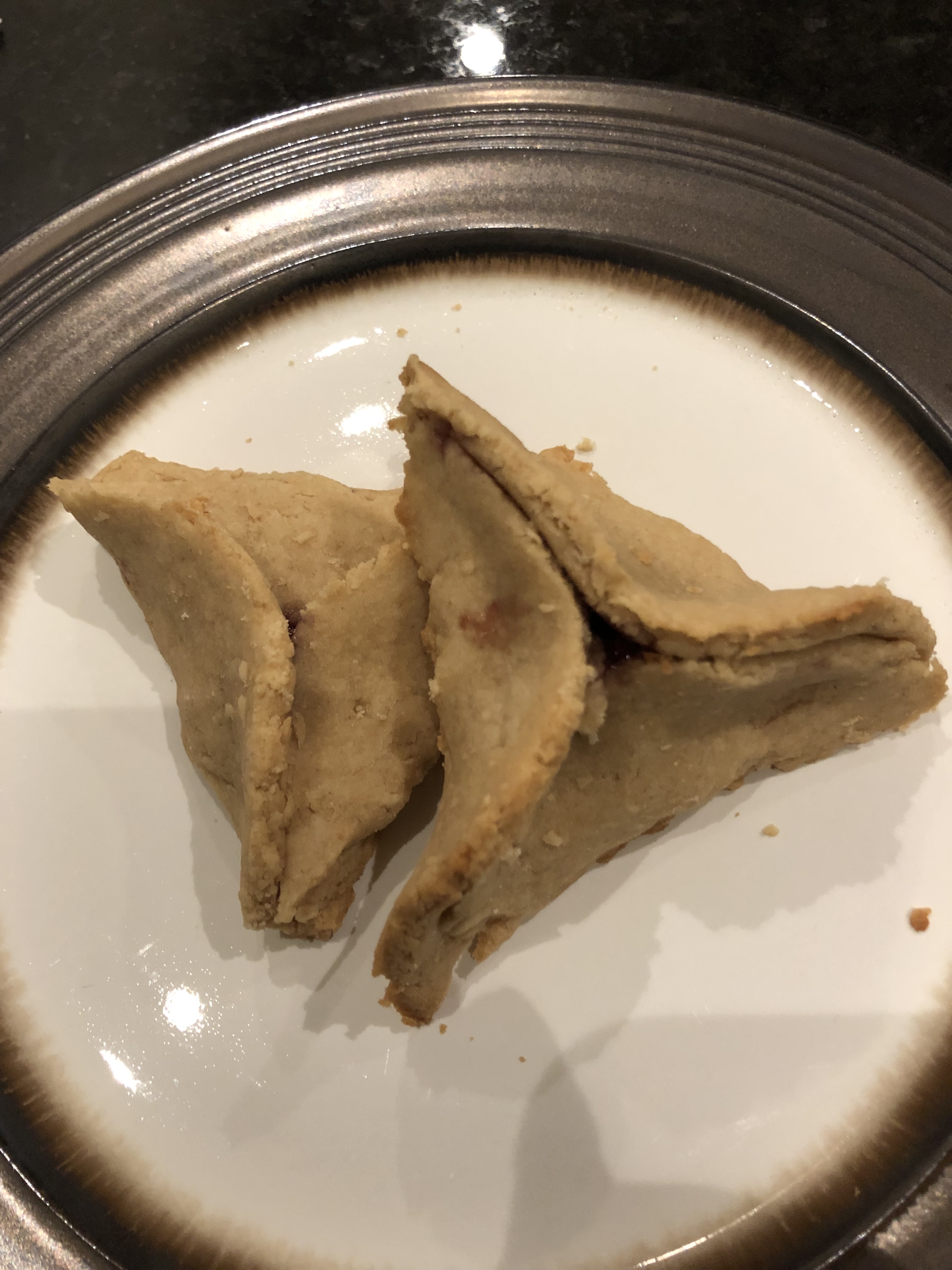
I don’t know about you, but I am powerless against Hamantaschen. It may be my Hungarian Jewish background, but I cannot resist pastries and Hamantaschen are worthy rivals.
Imagine my pleasure/surprise when I found a recipe for Healthy Hamantaschen! I wouldn’t post it here unless I baked it up and tried it myself. I will tell you that the first bite tasted a little out of the ordinary, but several others have said they are actually good. I’ve already eaten more than I care to admit.
The recipe comes from http://www.nowaythatshealthy.com. Here is the link: http://nowaythatshealthy.com/2014/03/healthy-whole-wheat-hamantashen.html.
What makes these healthy are the following substitutions: coconut oil for butter, whole wheat flour for regular all-purpose flour, and honey for sugar.
I prepared them with almond extract (you can also use vanilla extract too), and you can taste it–fine with me! I used whole wheat pastry flour instead of regular whole wheat flour which made the dough a little crumblier than it should have been (due to lower gluten content). I also used a regular jar of store-bought raspberry jam. You can use whatever type of filling you’d like. My step-daughter suggested Nutella!
I will definitely be making this recipe next week for Mishloach Manot. I know they’re still not totally healthy, but it I’ll feel a little less guilty as I celebrate Purim.
Holiday workouts at the Mandel JCC
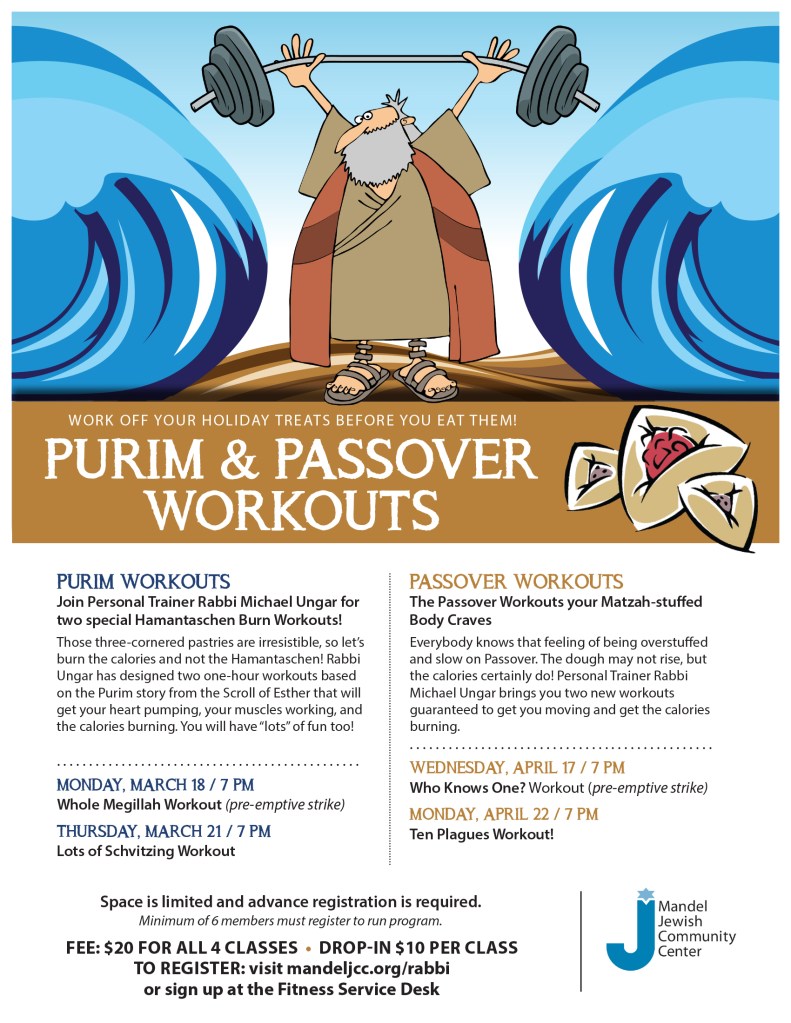
From this week’s Cleveland Jewish News
This is the latest D’var Torah for the CJN; I’ve got two more through the month of March.
Wishing everyone Shabbat Shalom!
Recipe Wednesday
I’ve been making a special effort lately to try recipes that are healthy. I’ve hit a couple of clunkers, but mostly have found some delicious meals and treats that I don’t need to feel too guilty about.
This recipe comes from the website http://www.joyfulhealthyeats.com. I don’t know if I’d use the word “joyful” to describe this particular recipe for Skinny Banana Nut Muffins, but they certainly made me happy! My only substitutions were that I used whole wheat pastry flour (instead of whole wheat all-purpose), and I used pure maple syrup (NOT the fake stuff) instead of honey. They were great!
https://www.joyfulhealthyeats.com/skinny-banana-nut-muffins/
If you’ve got a recipe that is healthy and almost tastes too good to be healthy, please share it with me. Each Wednesday, I will bring you a recipe that I myself have made and tasted.
Next week, healthy Hamantaschen…?
If it doesn’t challenge you, it won’t change you
This morning in spin class as we were pedaling through a particularly difficult “hill,” the instructor said “if it doesn’t challenge you, it won’t change you.” I think this was a nice way of telling us that if we did not have enough resistance on our bikes, we would not get the full benefit of the workout.
Of course, this has applications beyond spinning. As a personal trainer, it is up to me to work with my clients to safely push themselves beyond their comfort zones. Many people come to the gym “knowing” exactly what their capabilities are, i.e., “I can only do 30 pounds on the leg curl,” or “the most can walk around the track is one mile.” In truth, none of us knows what are true capabilities are. How many people do we know who, when faced with adversity, have who shown extraordinary grace and courage? How many times have we surprised ourselves by doing something we never thought possible? How many of us have crossed a finish line in a race marveling that we reached this goal?
Staying in our comforts zones does not allow us to grow or change. If we never look at issues from a different angle, try something new, or connect with people with whom we believe we have little in common, we will find it difficult to move beyond where we are and who we are in this moment.
Staying in our comforts zones is also not a Jewish value. Our tradition places little emphasis on being “comfortable.” The laws in the Torah, the words of the prophets and the teachings of the Sages were all meant to push us to be more than we think possible–as individuals and as a people. We were not meant to stay in Egypt; we were destined to head out into a wilderness, not really knowing what the future would hold. Even the names “Yisrael,” which means to struggle with God, is a hint that we should never feel like we know all the answers, that we have “arrived,” and have no need to change. Our tradition is filled with challenges and this makes us who we are as a people.
The next time we walk into the gym, or into the same drama with family members, or the same dead-end conversations with partners and spouses, we would be wise to remember that if it doesn’t challenge us, it won’t changes us.
Don’t run from the challenge. Embrace it. Change.
 Kosher Fitness