Being Awed

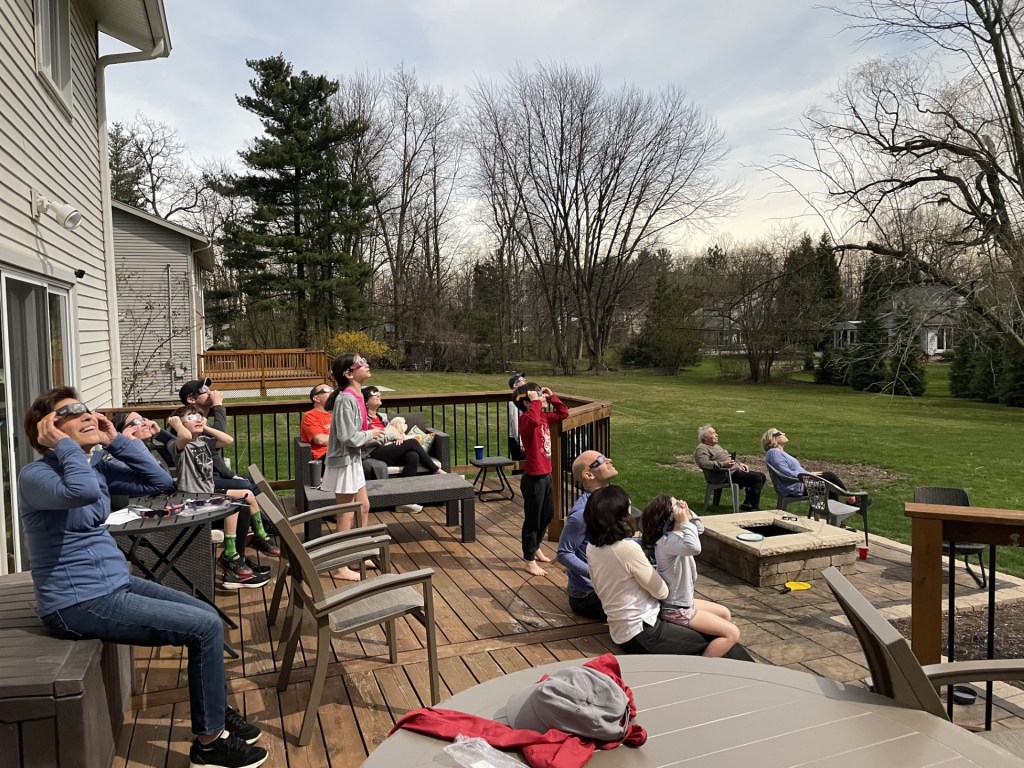
I was fortunate today to share a once-in-a-lifetime event with my family: the solar eclipse of 2024. Living in suburban Cleveland, we were in the path of totality. I knew the experience would be cool, but nothing prepared me for the overwhelming awe of those 3 minutes of totality. Within a half hour of the beginning of the eclipse, it began to cool down (it was an unseasonably warm day); as the totality approached it began to get darker and darker–almost like the moments after sunset. At the moment of totality, we took off our glasses and were treated to the most amazing Ring of Fire. As long as I live, I doubt I will ever forget the sights, sounds, and feelings of those moments. It was chilly. It was quiet. The wind stilled. The moon and sun put on a spectacular show.

Of course, eclipses occur quite rarely–and total eclipses even less. Nevertheless, there are awesome things around us all the time; by “awesome,” I do not mean in the slang use, but rather in the traditional meaning of inspiring awe. Our world is filled with many terrible things, but there are also many amazing things. Watching cardinals hatch in a nest in the small wild hydrangea in front of our house was awesome. Being there for the birth of each of my children was amazing. Having the opportunity to travel and see man-made wonders (the pyramids of Egypt, the skyscrapers of New York City, Machu Picchu, and the magnificent city of Jerusalem) and natural ones (Iguassu Falls, the Grand Canyon, a Resplendant Quetzal in Costa Rica, and huge tortoises in Galapos) has made me appreciate how much there is to inspire awe in our world. While there are many horrible acts committed in the world, there are also acts that humans perform that fill me with wonder: donating blood, adopting children, fighting for justice.

When we recognize the awesomeness in our midst, hopefully we begin to cultivate a practice of gratitude. As I have blogged in the past, developing a sense of thankfulness can result in positive health outcomes–both physically and emotionally. We may not only be thankful to a higher power for the marvels of the natural world, but also to the positive accomplishments of our fellow humans. We can also be better at showing how grateful we are to those around us.

The eclipse had a profound effect on me. I hope that it will inspire me to bring more wonder into the world through my actions, and to better appreciate the awesome things and people around me.

Why Are Rates of Alzheimer’s Disease in the US Dropping?

The most recent issue of AARP Bulletin (March, 2024) has a cover story on Alzheimer’s Disease. It reports that, for the first time in close to 20 years, new drugs are being approved for the treatment of the disease. Not only that, there may soon be better ways to diagnose it–including a simple blood test. The focus among researchers has shifted as well from only looking at the plaque which is found in the brain of those with Alzheimer’s Disease to also looking at neural connections and inflammation. The article is full of information and definitely worth a read.

What I found most compelling was the surprising news that Alzheimer’s Disease diagnoses are actually on the decline. From 2000 to 2016, the rate dropped 30% in the United States according to a 2022 Rand Corporation study! What accounts for this stunning trend?

As noted above, it is NOT because of any new drugs. Instead, researchers believe that the focus placed on heart health over the last 20 years has paid dividends in other areas such as dementia. According to another 2022 study–this one from the University of Minnesota–“41 percent of Alzheimer’s and related dementias were attributed to a dozen modifiable risk factors, of which high blood pressure, obesity and physical inactivity had the most impact.” In other words, we can change our behaviors and lower our odds of getting dementia.

A sidebar in the article pointed out a number of behaviors that can prevent Alzheimer’s Disease.

  1. Don’t smoke! Enough said.
  2. Keep blood pressure and blood sugar at healthy levels. Hypertension and Diabetes increase the risk of memory and thinking problems by 41%.
  3. Get regular exercise. Get moving and lower your risk for all dementias by 28% and Alzheimer’s by 45%.
  4. Eat more healthy foods. A diet limited in red meats, saturated fats, and added sugars that is also high in produce can lower your chances of getting AD and dementia by 48%. Berries and spinach are thought to protect brain cells.
  5. Take a multivitamin. Multivitamins cannot replace a good diet but they have been shown to have a beneficial effect on the brain.
  6. Care for your ears and eyes. A University of Toronto study in 2022 showed that hearing and/or vision loss increase the risk for cognitive problems by 20-50%. Hearing aids and vision care can help.
  7. Be attentive to mental health issues. Stress, depression, anxiety, and loneliness over time can contribute to cognitive decline. Seek help for these conditions.
  8. Get quality, regular sleep. Sleeping is what allows our brains to clear out waste; sleeping problems can prevent that from occurring. Take appropriate steps to improve sleep.

Alzheimer’s Disease and other dementias are frightening–to those who receive the diagnosis and for their loved ones. It is reassuring to see that progress is being made in research for diagnosis and treatment. What is most exciting to me is knowing that our own actions can have a positive impact. It is not just a crapshoot (or even based solely on genetics). We can (up to a point) help prevent cognitive decline as we age!

Working Out with Chronic Conditions

While the gentlemen in this picture look hale and hearty, I am willing to guess that if they are still alive today, they are probably dealing with one or more chronic health conditions. The CDC defines chronic health conditions as those “that last 1 year or more and require ongoing medical attention or limit activities of daily living or both. Chronic diseases such as heart disease, cancer, and diabetes are the leading causes of death and disability in the United States.” At Home Senior Fitness works with clients who are 55 and older, and nearly all of my clients deal with such conditions. How does it affect the way that we train and what results can be expected?

At the 2024 IDEAfit / ACSM Health and Fitness Summit in February, I took a course offered by Dr. Carol Ewing Garber entitled, “Prescribing Exercise to Clients with Chronic Diseases: A Cast Study Workshop.” Garber is Professor of Movement Sciences and Education and Chair of the Department of Biobehavioral Sciences at Teachers College (which is incidentally two blocks from where I attended Seminary in New York). The course looked at different hypothetical cases of individuals of various ages and backgrounds living with different chronic conditions. We worked together to determine the best course of action for training the individual to bring them to greater levels of fitness and health.

Over the years as I have worked with older adults, I have found myself in the same kind of “workshop,” just not in a large hotel with dozens of other people. It is, rather, a one-on-one with myself figuring out what would be most effective and what to avoid. I have had clients come to me with long-time diagnoses like atrial fibrillation (A-fib), dementia, and Parkinson’s Disease. I have also had clients come to me with new diagnoses like epicondylitis and camptocormia (look both of those up!). When we aware of such diagnoses, it is necessary to take into account how not to worsen a condition as well as what exercises might improve it. Many of these conditions I learned about when I was studying to become a personal trainer, but others required me to do research. I have even reached out to a client’s physical therapist on occasion for guidance. These chronic conditions cannot simply be ignored.

Garber’s class was a good reinforcement for me. It reminded me of the importance of understanding where my clients are (not just physically either) so that I can meet them there and then make a difference. If you or someone you loved is diagnosed with a chronic condition, make sure your fitness professional knows about it, knows what it is, and knows how to work with it. Personal trainers can be allies with doctors and therapists in building a better quality of life while living with a long-term condition.

Just for the Women

This is my third report on the IDEA/ACSM Health and Fitness Summit in Chicago at the end of last month. The third session I attended was entitled “Everyday Strength for the Older Female Client;” the instructor was Keli Roberts. I was very interested in this class because approximately half of my clients are older women. Over the years I have learned a lot about the needs of older adults, so I was looking forward to finding out what particular issues women face as they age.

In all honesty, most of the class really applied to older adults of any gender. We talked about different categories of aging: chronological, functional, biological, psychological, and social. Each contributes to the overall picture of a person’s health and fitness, and helps to determine the needs of the client and how best to meet them as a personal trainer. The class was mostly aimed at group or small-group fitness strategies; nevertheless, there was a lot to be learned.

There are a number of issues that relate directly to women. Because women have often been caregivers, it may mean that they did not have the time or opportunity to take care of themselves in the past; the result is that there may not be a history of exercise and other healthy habits. How do we create new patterns of behavior? Women may also be less likely to avail themselves of health services or have access to them in the first place. Some women, then, may not even be aware of the health conditions particular to themselves. All this needs to be taken into account so that an exercise program can be successful.

Older women may experience heart disease, diabetes, obesity, stroke, cancer, anxiety, and other mental health challenges. These are mostly shared with men. Osteoporosis, however, is much more prevalent in women. Osteoporosis a medical condition in which the bones become brittle and fragile from loss of tissue, typically as a result of hormonal changes, or deficiency of calcium or vitamin D. Research has shown that women can benefit from resistance exercises that involve weight bearing and weight lifting. This can be done safely and effectively as long as all the other co-morbidities are taken into account.

I have already put some of my newfound knowledge into practice with my clients and my exercise class. Roberts made me more aware of areas of weakness for women and how to compensate for them. My main takeaway is that while all older adults share much in common when it comes to fitness, women have their own unique sets of circumstances that cannot be ignored. I will definitely be more aware in the future.

Let’s Move, Everybody!

One of the biggest obstacles facing us at all ages is sedentarism; this is just a fancy word for “not moving.” It is definitely a 21st Century word. For many, the situation got worse since COVID; we used to walk around an office or visit customers, but now a lot of us are just sitting in front of computers. I certainly was more active at the gym when I barely sat down; now I spend about half of my day working with clients virtually sitting on my kiester.

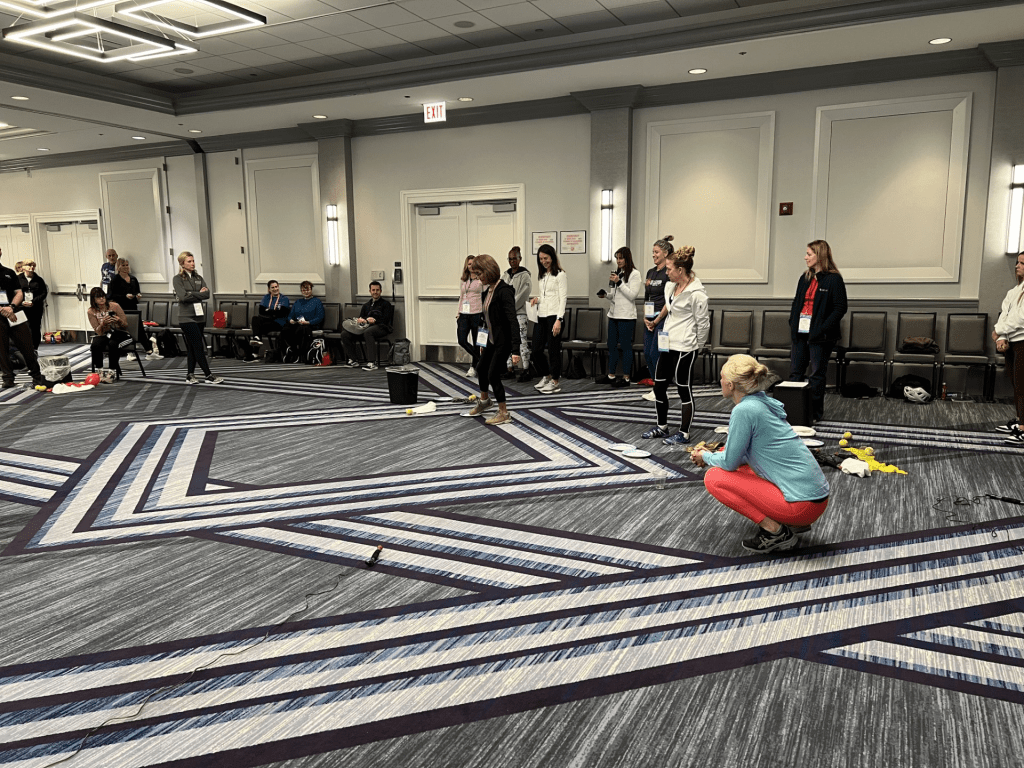
At the recent IDEA & ACSM Health & Fitness Summit, I took a session with Judy Juvance-Heltzel and Stephanie Davis Dierenger (both of University of Akron) entitled “Promoting Life-Long Physical Activity: Strategies for All Ages.” The course was divided into two parts: 1. theory and strategies, and 2. brainstorming and presenting.

We are being encouraged to focus less on the word “fitness” and more on the word “movement.” People are often put off by the word “fitness;” they think that if they are not “fit” then the activity will not be for them. “Movement,” on the other hand, is something that almost all of us do and we should strive to do more. Of course, as trainers, we do not want to focus just on movement; the progression should be from movement to physical activity to exercise to fitness. It is the obligation of fitness professionals to move individuals from one level to the next.

The active part of the program (pictured above) required us to grab a bunch of objects that we can find at home and find ways to make them into “fitness equipment.” Tennis balls to staplers to trash cans to paper plates all became devices to get people moving at home. Why articles that are found at home? Many folks are turned off by the idea of going to a gym or cannot afford it. We were challenged to provide ways for people to move more using what they can find close at hand. It was a real throwback to the early days of the pandemic when very few people had exercise equipment at home and we were working out with canned goods, books, and cans of paint. The solutions worked for people at any age with any level of fitness!

It is not ideal for individuals to exercise only in this kind of ad hoc way, but it can be a start to more frequent movement which will lead to activity, etc. What I liked was that the course got us all thinking creatively. Sedentarism is a serious problem and if the old solutions worked the issue would be solved already. Using a little ingenuity, we can help to bring greater levels of fitness and awareness of activity to those who are mostly just sitting around–from children in front of their screens to older adults in front of the TV.

What have you got at home that you can use to exercise? Here is a hint: can you squat while picking up a full trash can?

Will AI Do Your Exercises for You?

Last week I had the opportunity to participate in the 2024 IDEA & ACSM Health and Fitness Summit in Chicago. For the last several years I have attended this IDEA Personal Trainers’ Institute in Alexandria, VA; this year the event was combined with ACSM and featured over three days of lectures, workshops, classes, and workouts for people in the Fitness Industry.

Like doctors, lawyers, and many other professionals, personal trainers are required by their certifying agencies to engage in continuing education. I try to take one continuing education class on-line each month to meet that requirement. Attending one of these events allows for a high volume of credits, hearing the latest innovations in the field, as well as opportunities to network. I was only able to be there on Friday, but I did attend four sessions. The next few blog posts will be about what I learned.

The plenary session on Friday morning featured Dr. Ted Vickey on the topic: Future of Fitness: A Deep Dive into AI’s Dual Impact on the Business of Fitness. I was curious to hear his remarks because my wife works in “Corporate America,” in a company that is heavily investing in Artificial Intellegence as a way to help employees better serve customers. I know that many people fear AI, but I believe it is just like any other technology; it has the potential for both good and bad. I wondered how this all could be applied to fitness.

Vickey shared some of the ways in which AI can benefit those working in the field and those whom we serve. Although the talk was listed as a “deep dive,” it sort of hung out in the shallows; I am not sure how deep one can go in a 30-40 minute talk! He did give us some sense of where AI might assist us: communicating with clients more effectively, building business more quickly, and even assisting with the programming that we do (the actual exercises, number of reps and sets, weight, etc.) one-on-one or in a group setting. The time saved can potentially permit trainers to take on more clients and/or build business in other ways.

Sadly for my clients, AI will NOT do the exercises for us. It is also unlikely that AI will be able to replace the human interaction that makes working with a trainer so special. It can be a valuable tool, though, that can make the experience of exercise better and enhance the trainer/client relationship.

I do plan to learn more about AI and how I can use it in the work that I do. As Vickey suggested, not all people in the industry will use AI, but those who will survive and thrive will be among those who do. I feel like I have glimpsed the future and it is exciting!

Finally! Exercises for Couch Potatoes!

One of the leading causes of some many of the health issues that we face is being sedentary. The word “sedentary” comes from the same word as “seated,” and refers to the habit of sitting and not moving around. This is a common condition for many who work at jobs where they are tied to a desk or a computer. Others who may have a disability or are more frail simply find it too difficult to keep moving. For many, though, it is just a question of laziness and inertia–a non-moving object simply prefers to remain non-moving. Unfortunately, being a couch potato comes with a price: less favorable health outcomes.

Fitness expert, Dana Santas, recommends four exercises that can be done right on the couch! The first is an elevated Push-Up; rather than doing the exercise face down on the floor, it can be done using a couch. The easiest is off the back of the couch; more difficult is off of the arm of the couch, and most difficult is off of the cushions. Of course, one still needs to pay attention to having the proper form; aim for a plank posture. Next is the Single-Leg Squat (quite challenging!); stand close to the front of the couch and begin to sit down—but before you do, extend one leg forward so that you are only on one leg as you touch the couch. Ideally, one should not fully sit on the couch but rather just tap it with your bottom. This can be modified by starting with a regular squat (using both legs) on the couch which is also called a Sit and Stand. The third exercise is a Seated Pillow Twist. Take a pillow and hold it by the edges out in front of you; twist to the side and tap the pillow on the cushion, then twist to the other side and tap, and repeat. To make it more difficult, you can squeeze another pillow between your knees (knee adduction) while doing the exercise; over time, you can also switch from going side to side with a pillow to something heavier. Finally, there is the Side-Lying Leg Lift. Lie on one side with hips, knees, and ankles stacked one on top of the other; lift the top leg up without rotating the leg/foot toward the ceiling (in other words, make sure your toes are pointing forward) to get a great stretch through the hip flexors. Repeat on the other side.

Of course, there are many other exercises that can be done on couch that Santas does not mention in the article. I have clients who are unable to get up from the floor do some of the following on a couch: Glute Bridges, Dumbbell Chest Presses, Supine Single-Leg Raises, Knee-Ins, “Windshield Wipers,” Supine “Skull Crushers,” and Supine Chest Flys. The possibilities are nearly endless; any exercise that can be done seated or on the floor can usually be done on a couch as well.

So for those who complain that it is too difficult to get to a gym, or to the room downstairs with the exercise equipment, or even to get off the couch (!), you no longer have an excuse. Get moving–even on your favorite sofa–and see the difference it can make!

Aging Doesn’t Have to Mean Steep Physical Decline

As I myself age, I begin to notice how my body is changing; there are certain activities I cannot do as well as I used to. Working with an older population, I often hear the concerns of my clients about their current and future physcial fitness. Will they be able to walk (better) in the future? How will they be able to negotiate stairs? Will carrying bags of groceries into the house from the car be too much? How about picking up a grandchild or beloved pet?

A recent article in Fortune, touched on these concerns. The author, Dr. Zachary M. Gillen, is an expert in Exercise Physiology and is an assistant professor at Mississippi State University. Gillen suggests that one kind of exercise can make the biggest difference for older adults, allowing them to carry out these physical activities without being wiped out at the end of the day. The key: resistance (or weight) training. 

This blog has touched on this idea many times in the past. One of the issues confronted by older adults is sarcopenia–loss of muscle mass. Sarcopenia can lead to other diseases such as Type-2 Diabetes. This happens as a natural part of the aging process, but a steep decline in muscle strength in not necessarily an inevitability. Muscle mass can be maintained and even increased throughout our lives. 

Gillen states that the evidence shows that low muscle strength is a key factor in sarcopenia. The way to combat it is with the proper kinds of weight/resistance exercises. It is important to do these exercises properly and safely, which is why it is a good idea to consult a fitness professional. Sadly, only 13% of adults over the age of 50 do some kind of strength training at least twice weekly; across the fitness world, the recommendation for older adults is 2-3 times per week. Gillen suggests that 6-12 repetitions of each exercise working at 50-85% of one-repetition maximum; this means that if the maximum weight at which you can do an exercise is 20 lbs., you should aim to do 6-12 reps at 10-17 lbs. There should be a 2-3 minute rest between these sets (or longer if needed–especially at the beginning) with 24-48 hours of break between these workouts. Since we should all aim for 150 minutes of moderate exercise each week, the other days should focus on cardio activities.

Gillen ends the article by recommending that older adults take seriously the risks involved in starting a new exercise program. Those with little history of working out can do more harm than good. A fitness professional, like a personal trainer, can help us make sure we avoid steep physical decline–either because of inactivity or injury. If done properly, an exercise program at age 60 or even 90 can help us in the process of healthy aging.

New Study: Improving Fitness Decreases Risk of Prostate Cancer

It has long been known that exercise can contribute to lowering the risks of many diseases including cancer. Even though other factors such as genetics, environment, stress, etc., play a role, on average, those who keep physically fit have better health outcomes.

A new study by the British Journal of Sports Medicine was reported on by nbcnews.com focusing on prostate cancer–a cancer that is diagnosed in 113 of every 100,000 men each year. The study focused on cardiovascular exercise; these are exercises that increase heart and respiratory rates (as opposed to those that are focused on building muscle). Examples of these types of activities are swimming, jogging, dancing, and cycling, as well as many sports activities. It found that no matter what level a man’s fitness, a 3% increase in cardiorespiratory fitness each year for 5 years leads to a 35% decrease in risk for prostate cancer compared to those whose cardiorespiratory fitness decreased 3% each year for 5 years. 

Studies in the past seemed to indicate that more exercise might lead to an increase in prostate cancer, but those studies did not take into account many factors. The most recent testing accounted for factors that might have skewed the results. Interestingly (and vexingly), there is still no certainty as to how these changes in fitness levels affect the occurence (or not) of prostate cancer. More research will be needed. 

In the meantime, it appears that men have yet another reason to improve their cardiovascular fitness levels. As Dr. William Ho, Chief Medical Officer of the Prostate Cancer Foundation (that was not involved in the study) pointed out, the research shows that “no matter what age, no matter where you are in your life or your relative fitness, that if you improve your fitness, even by a relatively small amount, you may significantly decrease your risk of developing prostate cancer.”

Meeting Nutritional Needs as Part of Healthy Aging

What older adult is not interested in healthy aging? We want to be able to avoid disease and disability, maintain good cognitive function, have an active social life, and be engaged in meaningful pursuits. Healthy aging does not just happen; it requires effort.

As we grow older, our nutritional needs are affected by physical changes. Our metabolism slows, we lose muscle mass and bone density, and our organs have to work harder to keep us alive and healthy. In general, older adults require fewer calories on a daily basis, but need more nutrients. Our energy intake declines from the age of 50 and hits its lowest point after 80. At the same time, we may find that our bodies are lacking Vitamin D, Vitamin B12, Calcium, and Sodium. If we can sustain proper levels, we have a better chance at achieving healthy aging.

Vitamin D prevents disease and promotes bone health; a lack of Vitamin D can lead to high blood pressure, cancer, fractures, and falls. Aside from taking supplements, older adults need to be out in the sun more (with sunscreen!), which can be difficult in places where the sun is absent for much of the year. 

Vitamin B12 (as well as B9 or Folate) deficiencies can be caused by a number of things including an unhealthy diet. Shortages can result in tiredness, muscle weakness, vision problems, and psychological problems–among other issues. Higher levels protect against cognitive decline and anemia. 

For older adults, it is more difficult to absorb calcium. This contributes to lower bone density which can lead to osteoporosis and other health issues. 

As for Sodium, we usually think of this as a bad thing (causing hypertension), but too little can be dangerous too. Symptoms can include vomiting, loss of energy, and confusion. In severe cases, seizures, coma, and death can result. 1500 mg/day is recommended–about a third of a teaspoon. To combat the risk of hypertension, proper levels of potassium should be maintained (4.7 g/day).

In addition to these four, it is important to take in proper amounts of fiber, hydration, and other nutrients such as Zinc, Vitamin C, and Vitamin E. Although this all sounds somewhat complicated, most blood tests ordered by physicians before a check-up will ascertain whether you are at the right levels for these vitamins and minerals. If you doctor tells you that there is a deficiency, there are always ways to address them–most of which are easy and painless.

We all want to be healthy agers. Exercise, proper rest, and nutrition are important throughout our lives, but even more so as we get older. Keep tabs on your nutrients to help provide the best life going forward!