
Training Clients with Dementia

September is World Alzheimer’s Month; it is a time to raise awareness about Alzheimer’s disease, promote brain health, and support those affected by the condition. 

As part of my education to become a Personal Trainer, I had to learn about working with “special populations;” this can refer to youth, those with chronic diseases, and those with disabilities. After my certification as a trainer, I studied to become a Functional Aging Specialist. After obtaining that specialization, I was better prepared to work with older adults living with a wide variety of physical and cognitive conditions. I thought I knew all that I needed to know to work with people living with dementia.

Book-learning and seminars, however, are no substitute for hands-on experience. Over the last seven years, I have had the opportunity to work with several clients at various stages of Alzheimer’s Disease or other forms of cognitive decline. It is interesting and challenging work, and I have learned a lot.

There is a question, though, about what the benefit of such an exercise program might be. I have posted about this in the past, but it bears repeating as we work our way through World Alzheimer’s Month. The only non-medical way in which brain health can be improved is through exercise in conjunction with a proper diet and sufficient rest. The heart pumps and circulates nutrient rich blood to all parts of the body; when we exercise (especially cardio) that process speeds up and brings more nourishment to the cells, including those in the brain. Research shows that regular exercise can help to slow the progression of the disease.

There is another aspect though which should not be overlooked. For some of my clients with dementia, the time that I spend with them is an opportunity to engage socially with someone aside from family or caregivers. I always come prepared for a workout especially designed for the client and his/her capabilities; in that respect, they are no different than my other clients. What is different is the way the session may proceed. I usually need to demonstrate exercises several times–even after we just completed a set; this requires patience on my part, but I have gotten accustomed to this and it has changed the way that I cue all my clients for the better.

Related to this is that I must modulate the conversation that I have with my clients with dementia. Ask any of my clients and they will tell you that I love to chat during our sessions; it helps to engage the client and make the session appear to move more quickly–while still getting the same amount of work done. The kinds of questions I may ask clients with Alzheimer’s Disease and the topics we might discuss are different. In most cases, I cannot ask “how was your weekend?” as they may not remember. I can usually ask about things that happened many years ago (those memories are often preserved), but most of the time I focus on the present moment. I may talk about what is going on in my life or the weather or the local sports teams. I like to focus on the present moment and making the most out of it for my client–from an exercise and social standpoint.

World Alzheimer’s Month is a time to reflect on the way that this disease has affected so many individuals and families. It is a time to advocate for more research (rather than cuts in funding). It is also a month in which we can reach out to those around us with dementia and help to make their present moment just a little bit brighter. I am proud of my role as Personal Trainer in helping to make that a reality.

Funding Cuts and Alzheimer’s Disease

Anyone who has been following the news knows that the current US administration has made “government efficiency” one of its goals. While almost everyone agrees that waste should be eliminated wherever possible, many have concerns that in the long run some cuts will do more damage than good. Many point to pauses or cancellation of federal funding for medical research as a clear example of this; these actions are often the result of an over-arching initiative to eliminate all Diversity Equity and Inclusion (DEI) programs at institutions that receive funding for these studies.

CNN recently reported on the effect this is having on research to prevent and treat Alzheimer’s Disease and other forms of dementia. The article talks about one study at UC-Davis entitled: “The Clinical Significance of Incidental White Matter Lesions on MRI Amongst a Diverse Population with Cognitive Complaints (INDEED).” This study has the word “diverse” in its title which triggered an automatic pause in funding; as is apparent from the context, this study does not have to do with issues of merit-based advancement but rather various populations that are affected by Alzheimer’s Disease–which is basically every ethnic group that exists. The funding was eventually restored but a great deal of money was wasted as the study was shut down and then restarted–not exactly government efficiency.

This is just one of many cases affecting research on Alzheimer’s Disease. On paper, these studies seem like easy targets. First, much of the research takes place at research universities; these institutions have been a target of recent anti-DEI efforts. Second, a large number of older adults have Alzheimer’s Disease which means that support and research costs the US government quite a lot; to eliminate would make a positive impact on the “bottom line.” In a related vein, care for those with dementia is approximately 2 to 3 times more costly than for those without it; this makes investment in Alzheimer’s Disease seem to have a lower return on investment.

The key question for me is whether these short-term (and perhaps short-sighted cuts and pauses) will ultimately save money in the long-term or end up costing a lot more later on as research costs rise. Again, everyone agrees that waste should be eliminated where possible, but one has to wonder about the wisdom of these clearly politically-motivated (anti-DEI) measures and whether we are cutting off our noses to spite our faces.

Let your elected representatives know what you think. As we age, these matters will become more important. Let’s not allow our future health and well-being be sacrificed on the altar of political game-playing.

Deep Sleep and Alzheimer’s Disease

One of the issues that older adults face is getting enough quality rest and sleep. Older mens’ sleep is often interrupted in the middle of the night by the need to urinate if they have prostate issues. Many post-menopausal women suffer from insomnia and night-time breathing disorders. Others just have a hard time “shutting off” all the activities of the day. It turns out that lack of quality sleep can affect more than just our level of energy the next day; it can also influence the progression of Alzheimer’s Disease.

ScienceAlert just reported on a study conducted at UC-Berkeley published in BMC Medicine (an on-line journal of medicine) in May. The research showed that subjects in the study who got more deep sleep (defined as non-rapid eye movement slow wave sleep) did better on memory tests the next day than those who did not. The article notes that there is a bit of a chicken-egg issue here; one of the symptoms of Alzheimer’s is sleep problems…and sleep problems may worsen the disease progression. Even so, this appears to be another piece in the puzzle.

Researchers believe that the study and scores of others like it point to this kind of sleep as necessary for allowing the body to get rid of waste products in the brain that accumulate during the day. It remains to be seen what improved sleep over the long-term might do, but in the short-term it appears that more of this kind of sleep can slow the progression of the disease. If, in fact, there is a cause-effect relationship there will be more effective ways to prevent this kind of dementia.

The article also mentions the role of sleep aids (that might actually do more harm than good in this respect). In order to get a better night’s sleep quality, lay off of caffeine later in the day, exercise, limit screen time at night, and take a hot shower. Most of us would like to get on board with that…and now we know it may have the added benefit of preventing dementia.

What Did I Come Into this Room for…and Other Things I Worry About

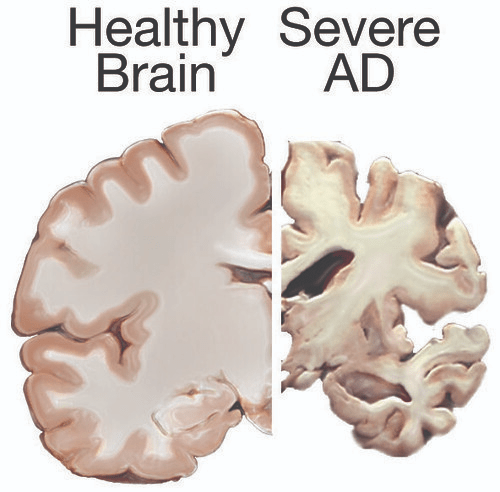
PET scan of an healthy brain compared to a brain at an early stage of Alzheimer's disease.

A short, but informative and helpful, article appeared on CNN.com’s health page today that sparked my interest. Entitled, “Is My Senior Moment the Start of Dementia?,” it explores the difference between milder forms of cognitive impairment such as forgetfulness and more serious forms such as Alzheimer’s Disease. The author, Laurie Archbald-Pannone, is an associate professor of geriatric medicine at the University of Virginia.

As I have grown older, I have accepted that my memory is not what it once was. I have noticed that it seems to be much worse when I am under a lot of stress. I will make what I consider to be stupid mistakes like going to the grocery store to buy one thing and leaving with five things–none of which was the original product I intended to buy. I sometimes cannot remember a name or find the right word to express myself. I got so worried at one point (soon after my move to Cleveland and starting three jobs), that I went to a doctor and asked for a test…man, woman, person, camera, TV…I passed too!

Archbald-Pannone’s salient point is that memory loss becomes a problem when it interferes with one’s ability to do everyday activities. For instance, not remembering the name of someone you know but haven’t seen in a few years is not a problem; forgetting the name of someone you see everyday might be. Not remembering how to get to a restaurant you went to one time is probably not a problem; getting lost on the way to the dry cleaner you’ve gone to for years probably is.

The author points out that mild cognitive impairment is a natural part of aging and is usually not cause for alarm. In any case, it is always a good idea to keep one’s primary care physician apprised of any changes or concerns. Sometimes these changes are, in fact, the beginnings of something more serious.

It bears repeating (at least on my blog) that according to the the Alzheimer’s Disease Foundation’s website there are things we can do to prevent the onset of dementia. Their website lists: proper nutrition, mental activities, certain dietary supplements, and physical activity. The last one, of course, is the one that is most compelling to me. We know that cardiovascular exercise helps the heart, but when the heart is strong it helps the rest of the body. A healthy heart and vascular system is better able to circulate nutrient-rich blood to the cells. The better fed the cells, the healthier they remain. This includes brain cells. It bears repeating: physical activity becomes all the more important as we age.

To read Archbald-Pannone’s article, click here: https://www.cnn.com/2020/09/21/health/what-are-early-signs-of-dementia-wellness-partner/index.html.

And now, I’m off to the store to get some buttermilk…right?