Do You Have a Dream?

martin luther king

As Dr. Martin Luther King, Jr., Day comes to an end, I think about his legacy. He was to me the closest thing that the United States has had to a modern-day prophet. Like the prophets of the biblical tradition, he was not afraid to speak truth to power. Dr. King had powerful dreams and visions. He saw this nation the way it was and dreamed of what it could become–not just for people of color, but for all Americans.

Dr. King reminds me of the biblical character, Joseph. Joseph was a dreamer for sure, but he was more than that. He knew how to interpret dreams (both his and Pharaoh’s) and understood what to do next. He was not just a dreamer, Joseph was a man of action as well. This very well describes Dr. King too. He spoke about his dreams, but he also knew how to organize. He comprehended what it would take for change to come. I am sure that he must have also known that this change might not come in his lifetime, but that the work must be done nevertheless.

On this MLK Jr. Day, we should honor the legacy of this great man, and we should also be aware of just how much of his dreams is unfulfilled. There is a great deal more work to be done to ensure that the United States is a nation of freedom and justice. We must do more than just reflect; we are obliged to consider the ways that we can make his dreams a reality, and then plan our first steps, and the second, and so on.

If this sounds familiar to those of you who have been following my blog, it is because the idea of taking a dream/desire and making it a reality is also a part of our fitness journey. We cannot just dream about becoming more healthy. We must first assess the situation and understand the work that needs to be done. Only then can we set goals and establish a plan to begin the hard work.

May we honor Dr. King’s legacy, not just on this day, but throughout the year–doing our part to make his vision of a more perfect nation more than just a dream.

Take Care of those Joints

Joint Pain

It is no secret to older adults that one of our trouble spots as we age is our joints (the ones inside our bodies!). According to the Centers for Disease Control and Prevention (CDC), over 50% of those age 65 or older have osteoarthritis. Osteoarthritis is a degeneration of joint cartilage and the underlying bone; it causes pain and stiffness, especially in the hip, knee, and thumb joints. Is there anything that can be done to take better care of our joints?

A recent article on http://www.aarp.org, suggests 6 behaviors that are harmful for our joints.

  1. Smoking. Nicotine narrows blood vessels thus prevent blood from reaching the cells that seek its nourishment; this includes the cells in our cartilage. Additionally, smoking can add to brittle bones which raises the likelihood of fractures by 30-40%.
  2. A Physically Inactive Lifestyle. People who are sedentary are more likely to have difficulty maintaining a healthy weight; carrying around extra pounds puts stress and strain on the joints–especially the knees. Consult with a doctor or fitness professional about which exercises are best for joint health, since some movements can exacerbate joint problems.
  3. Overdoing Exercise. This is all about maintaining the proper balance. Currently guidelines suggest 150 minutes (2.5 hours) of exercise each week. This need not be particularly strenuous (and in some cases should not be); as noted in #2, consult a doctor or fitness professional for how to best put together a program for your needs and condition. Avoid being a weekend warrior as well; do not stay inactive the whole week and cram 2.5 hours into the weekend. A mix of cardio and strength training is recommended.
  4. Carrying Too Much. Literally, this could mean moving furniture, carrying a heavy backpack, etc. This should be avoided, but if it cannot, be certain to use proper posture and lifting techniques. Keep the load closer to your body for less stress on the joints.
  5. Eating the Wrong Foods. There are many foods that are “pro-inflammatory.” These include: red meat, fried foods, and sugary foods and drinks. On the flipside, there are foods that are considered anti-inflammatory such as fishes with high levels of fatty acids (salmon and mackerel), leafy greens, as well as some tree nuts; work more of these foods into your diet.
  6. Too much Texting. The more we text the more strain we put on the joints in our arms and hands. There are some ergonomic keyboards that can help, but make sure to take a break if your work/hobby requires a lot of typing. Most smartphones also have a voice to text option so that you can dictate rather than typing some of the type.

As we age, it is more and more important to keep moving. Of course, we rely on our joints to make that a reality. Treat your joints well and they will last longer, keeping older adults more independent.

It’s Not Your Age That’s Slowing Your Metabolism

Metabolism

Older adults are used to hearing that a natural part of the aging process is that our metabolism will slow down; the metabolic rate is the rate at which our bodies burn calories in order to keep our vital systems functioning and allow us to do the things we do on a regular basis. As we age, most of us find that slowly but surely our weight increases; it seems that as our metabolic rate decreases (assuming everything else stays the same, like exercise and diet) the pounds begin to add up. We are just not burning calories at the rate that we used to.

An article in Science, reports that our assumptions are actually incorrect. Our metabolism is not slowing as we get older simply because we are aging, but rather because a number of other factors come together to decrease our levels of activity. Leading a more sedentary lifestyle due to work, home responsibilities, technology–and even the pandemic–is behind those decreasing metabolic rates.

A recent article on http://www.cnn.com, explains the issues and concludes that this research is good news for older adults. If aging is behind our decreasing metabolism, then there is nothing we can do to reverse its effects; we are simply stuck in a downward spiral. What the research shows is that we actually have it in our control to maintain and increase our metabolism as we get older.

The article suggests four main strategies:

  1. Be active throughout the day. Many of us spend hours at a time at a desk (or on a couch) with little movement. Even little bursts of activity throughout the day can raise metabolic rates.
  2. When you exercise, do the right types for maximum metabolic effect. HIIT exercises are recommended because they raise the metabolic rate and keep it elevated even after the workout is over; check out my blog post on HIIT for more info. Additionally, strength training (working with weights and other types of resistance) has a similar effect.
  3. Make sure to get enough protein in your diet and keep hydrated. The simple act of eating increases our metabolic rate because it takes calories for the digestive system to do its job; consuming proteins (especially after a workout) can help to build muscles which cause us to burn more calories. Drinking water–aside from its other positive assets–can raise our metabolic rate too.
  4. Get plenty of rest. Not sleeping enough can lead to a myriad of health problems. Allowing our bodies to adequately refresh and re-energize can help counteract the negative effect of these maladies. It is recommended that adults get at least 7 hours of sleep each night.

Metabolic rate decreases are not a done deal as we age. There is much we can do to counteract the effects of being sedentary, not exercising enough, eating a poor diet, and being overtired. It is all in our power–not part of some process beyond our control. This is good news indeed!

Focus on Behaviors, Not Outcomes

Magnifying Glass

It is that time of the year, and many of us are focusing on our New Year’s Resolutions. I do not have any firm statistics, but I am guessing that not an insignificant number of those resolutions have to do with health/fitness/weight. And (again without firm statistices) my guess is that many of us will be no more successful this year than we were last year.

At a gym where I worked previously, every fall there was a big promotion for a weight loss challenge that would begin in January. The male and female participants who lost the most weight as a percent of their total weight won a prize and bragging rights for the year. One year, I was put “in charge” of the challenge with a couple of other trainers and we decided to shift some of the focus away from weight loss entirely; we knew there could only be two winners, but we wanted everyone to succeed by creating healthy habits. There were two sets of winners: 1. those with the greatest percentage of weight loss, and 2. those who had the greatest number of overall “points.” Points could be earned through weight loss, and also through participating in a fitness class, setting and meeting a fitness goal (like doing a 5K or planking for 60 seconds), or participating in special events like the Indoor Triathlon. We also split into teams, banking on the fact that when we work together in a supportive setting we are more likely to stay motivated. Not surprisingly, attrition during the challenge was quite low; participants really stuck with it because they knew that it was not just about dropping pounds, but also about being accountable to themselves and their teammates–and about building a healthier lifestyle with good habits for the long term.

Unfortunately, most of us do not focus on the permanently changing our lifestyles; we obsess over the number on the scale. I am a firm believer in setting and adhering to simple rules to help make those changes; I even blogged about it. Make a few rules that are do-able, like “no eating after 8 pm,” or “I will go to the gym 3 times each week for 40 minutes,” or “I will take the stairs each day rather than the elevator.” These are all simple, measurable, achievable rules. They are much more concrete than “I will be more healthy,” or even “I will lose 20 pounds.” Neither of those has a plan; they focus on a goal rather than a behavior.

Those who focus on a goal find that it is difficult to stick with it if results do not seem immediately forthcoming. On the other hand, those who focus on the behaviors can be proud of progress on a regular basis. This is much more useful in building a healthier lifestyle.

I have not decided what (if any) New Year’s Resolutions I will make; I am more apt to do this around Rosh Hashanah, the Jewish New Year. In any case, if/when I do I will be certain to focus on what I will do, not where I hope to arrive. It is all about the journey….and eventually we make it to the destination.

What Could Possibly Go Wrong (Part II)

Two Vintage Red Cross Bandage Boxes

In my last blog post, I wrote about ways to keep yourself safe while working out at home–focusing on having a safe and secure workout space.

Preventing injury requires more than just cleaning up a large enough space and getting possible obstacles out of the way. There are factors to take into account both at home, and at they gym to consider. An article in at http://www.aarp.org points out 5 issues to bear in mind when embarking on a fitness journey; these factors are especially relevant for older adults.

  1. Start slowly. With New Year’s Resolutions on the horizon many of us may resolve to start working out more often. Going from 0 to 60 in 3 seconds may be great for a sports car, but our bodies require us to move forward gently–especially if we have been sedentary for a while. Working out for too long, too often, or with weights that are too heavy is a recipe for injury. Muscles need to get used to the new routine; they need to grow and strengthen before we get more intense. Ease into it.
  2. Speaking of going from 0 to 60, every workout should begin with a warm-up. Typically, a before-workout warm-up should involve dynamic stretches or motions; in other words, they should be comprised of actions similar to those you will do as part of the workout, just at a slower, more gentle pace. The goal is to warm up the muscles and get the blood flowing throughout the body. Static stretches can be done after the warm-up, or (as I prefer) after the workout; static stretches are the ones where you hold a certain position for a given amount of time.
  3. Get the right athletic footwear. Shoes are like tires; some work better in different situations, and some only work on certain models. As we age, many of us develop issues with our posture and the rest of our kinetic chain (think of the hip bone connected to the thigh bone…); proper athletic footwear can help us excel, avoid pain, and stave off injuries. Like tires, they also have a mileage limit; if the treads on your shoes are gone, time to get new ones. I recommend going to a shoe store that only sells athletic footwear; their employees are trained and can get you the right fit for whatever quirks your feet might present. Do not let me catch you barefoot or in socks!
  4. Switch it up. Do not do the same exercise day in and day out. First, you will get bored. Second, you may cause injuries due to overuse. It is also important to work all the various muscle groups; varying the workout can help make that happen.
  5. My favorite one: if you are not sure about how to begin, reach out to a fitness professional. Most gyms have personal trainers or other fitness experts who are happy to help; often, an initial session is offered for free so that you can get acquainted with the gym and its equipment. If you prefer to work out online or one-on-one with a trainer at home, there are personal trainers who specialize in these kinds of settings–and you will probably save money not having to pay for a gym membership. A trainer will make sure that you cover most of the points above and will help keep you on track. There’s nothing like a good personal trainer to keep you accountable to your goals.

Of course, injuries do happen. Sometimes there are accidents, and other times we have physical weaknesses of which we are not aware. While there are no guarantees, the points above are certainly excellent guidelines to keeping your workout–at home or at the gym–less likely to cause an injury.

What Could Possibly Go Wrong (at Home)?

Crutches

When I was studying to get my certification as a personal trainer, there was a lot of information about making sure that the workout space was safe. At the gym where I worked, we were pretty conscientious about keeping equipment in working order and either posting a sign that something was broken or removing it from the fitness center altogether. It is all about keeping safe and preventing injuries.

While some gyms are better at this than others, now that so many of us are working out at home, what should we do to make sure our space is in optimal condition to prevent possible injuries? A recent article on CNN.com answers this very question.

The author, Melanie Radzicki McManus outlines several issues of which we should be aware. Some are fairly self-evident, but others often overlooked. Here are the main ideas:

  1. Check the space for potential dangers. This could be electric cords, rugs that move, ceilings that are too low, furniture that is too close together to allow room for proper movement. Make adjustments accordingly.
  2. Wear proper athletic attire. Bare feet (or only wearing socks) is hazardous for a number of reasons. Clothing should fit properly to allow for movement, but not be so big that it is a tripping hazard (like really long pajamas!).
  3. Hire a personal trainer (yes!!!). At home, it is often harder to know if form is correct, if the weights are too heavy or not heavy enough. It is also easy to overtrain by not allowing muscle groups to recover. A fitness professional can help avoiding those pitfalls and there are many excellent ones who have mastered the art of virtual training, or who may come to your home.
  4. Remember what comes before and after the workout. Warming up the muscles before, and cooling down and stretching afterwards are important to preventing injury. Just because it is a home workout does not mean this can be skipped.
  5. Prepare for the unlikely event that you do get injured. If someone else is at home, this is less of a problem, but for those who are alone it is helpful to have a cellphone nearby in case an emergency call needs to be made.
  6. Get outside. A home workout can also take place in nature–as long as the factors above are taken into consideration. Brisk walking, bike riding, yoga, etc., in the great outdoors is wonderful exercise and exhilirating. Remember the sunscreen!

Despite the ongoing surges and lulls in the pandemic, people are getting out a little more. Even so, it looks like gyms may be the among the last places to see a real comeback. If the choice is made to stay at home, remember to keep it safe. There will be no fitness professionals to remove faulty equipment or help with the proper form; there may also not be someone there to see if you are injured. Take the proper steps and enjoy great workouts at home!

The Secret to Living Longer?

Birthday Cake

A recent article in the Idea Fitness website shares a summary of research done by Dan Buettner, Author of The Blue Zones: Lessons for Living Longer From the People Who’ve Lived the Longest (2008). Blue zones are areas where people live much longer than the rest of the planet such as Sardinia (Italy), Okinawa (Japan), Nicoya (Costa Rica), and the Seventh-Day Adventist Community in Loma Linda, CA.

Buettner sought common demoninators which might help to explain why folks living in these places lived longer. The article on Idea Fitness features a summary by Canadian journalist, Matthew Kadey. Here are the common factors in the Blue Zones that Buettner studied.

  1. Each place had a prodominantly plant-based diet; that diet was not the same in each zone, but it was still plant based.
  2. Daily life was filled with physical activity. Whether it was shepherding, pounding grain, farming or exercise, this was a common attribute of each place.
  3. While the “purpose” varied in each Blue Zone, inhabitants had a strong sense of purpose in their lives. Whether it was commitment to community, fulfillment at work, etc., people in these areas in general had a strong reason to live.
  4. Social interaction was prevalent. Each of these communities had many opportunities for people to gather in social settings; there was a strong sense of interconnectedness.

What can we draw from these results? Kadey suggests that we can learn and adapt from Buettner’s findings ways to lengthen our days. We can switch to a more plant-based diet, keep ourselves physically active, find meaning/purpose in our lives, and take advantage of or create opportunities to have social interactions. Combining all of these appears to be a key feature of the Blue Zones.

Of course, not only do these factors seem to contribute to a long life, but to a healthy, meaningful one as well! Let’s make our own Blue Zones.

Overcoming the Odds

Hanukkah menorah

When most people think about the holiday of Hanukkah (today is the 5th day out of 8), they think about the miracle of the oil that lasted for eight days even though there was only enough for one. What oil, where, and when remains a mystery to a lot of people.

The story of the oil that is the basis for lighting a Hanukkah menorah is found in the Talmud and is considered a legend rather than historically verifiable fact. The story of the miracle was meant to help bring God into the picture, when from a historical standpoint the holiday celebrates an event in which God may not be readily apparent. At its heart Hanukkah is about a military victory.

Over 2000 years ago, there was a strong Hellenizing (Greek) influence in the Jewish world and the Land of Israel. There was a great deal of assimilation to the point that a statue of a Greek god was placed in the Holy Temple in Jerusalem. This was too much for traditionalists who formed an army–the Maccabees; they fought the Assyrian Greeks and defeated them, even though the Maccabees were outnumbered and outpowered. This allowed the followers of the Jews to purify and rededicate the Temple; they also rooted out the Greek influence that had become so prevalent. The original Temple built by Solomon was dedicated over an eight-day celebration, which is why Hanukkah (which means dedication) was also an eight-day festival; the story of the oil is just icing on the cake really.

What does all of this have to do with fitness? After all, this is a fitness blog. Although Hanukkah is really about religious freedom and autonomy, it is also about our ability to overcome great odds when we set our minds to it. This is true in fitness as well. When I was 40, I never would have thought about running a half-marathon, but when I was 51 I did it. Of course, it took a lot of training, but it also took a change in my way of thinking. I began to consider not my limitations, but rather about the possibilities. I cannot help but think that the Maccabees did the same thing; they could have looked at the overwhelming forces of the opposing army and simply given up, but instead they fought with valor and tenacity until they were victorious. Jews today owe our existence to their grit and determination.

Hanukkah is a known as a festival of miracles. The miracle of the oil is a legend; what seems miraculous is the way in which the Maccabees overcame the odds. We are no less capable today of creating miracles in our own lives–whether it has to do with our education, our relationships, or fitness. We can overcome the obstacles (most of which we put in front of ourselves) and make miracles happen.

6 Month Kidney-versary

Today I have a lot for which to be thankful. I have been blessed in so many ways: an amazing wife, incredible kids, excellent friends, a fulfilling career, a wonderful community, and good health.

I am also grateful that this past year I was able to successfully give the “gift of life” by donating my left kidney to someone with advanced kidney disease. I have worked hard over the last couple of decades to eat right, exercise, get plenty of rest, and practice other forms of self-care. It has paid off. I have always said that one of the best motivations for being physically active and eating right is in order to be healthy enough to help those around you–sort of like the message of the air masks that fall during an unlikely cabin depressurization; I have helped myself first, and then assisted others around me. This has been the focus of my career as a rabbi and now as a personal trainer as well. I never imagined, though, that I would be able to donate an organ (at least, while I was alive)–especially at the age of 58–but all those years of watching what I eat and going to the gym helped make it possible–not only for me, but for the two people and their loved ones who benefited from my donation.

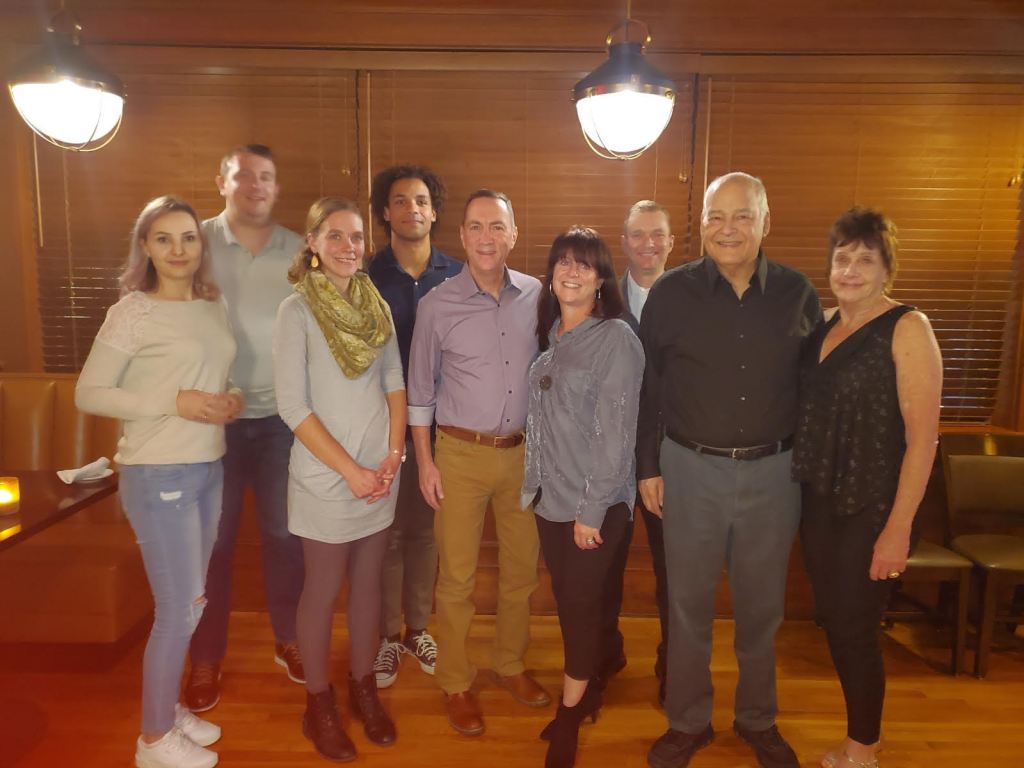
A couple of weeks ago we had a 6-month Kidney-versary dinner here in Cleveland (pictured above). It was great to get the three donors and three recipients and their spouses together. It was even better to see everyone doing so well. I hope that we will continue to get-together as we are able to give thanks for the miracles of modern medicine that make it all possible–along with the outstanding doctors, nurses, and other caregivers. We are now all tied together by a very special bond.

For the first time this year, I feel like I am truly thankful not only for what I have, but for what I am able to give. I look forward to more opportunities to continue on this path…but I do plan to keep my other kidney!

Wishing everyone a happy and healthy Thanksgiving!

The Most Wonderful Time of the Year?

Thanksgiving Dinner

Andy Williams sang, “It’s the most wonderful time of the year….” The holiday season ushered in by Thanksgiving is wonderful in so many ways: family gatherings, festive meals, joyous music, and fun family traditions. It is for many, though, the most difficult time of the year.

The holidays season puts a lot of stress on us. The continued emphasis on consumerism around Christmas and Hanukkah is not only stressful as we try to get the perfect gifts, but it also puts pressure on our financial situation. There is also the potential conflict that arises in families–you know that crazy uncle who always brings up politics! We may also be worried about meeting year-end goals. It is just a very intense time of the year.

I have blogged in the past about how to try to approach the holidays–and Thanksgiving, in particular–in a more healthy way. Last year, we had the added issue of families preparing smaller feasts given the isolation and reduced gatherings necessitated by COVID-19; for many, that is less of an concern this time around. For most people, this final part of the secular year becomes a battle against overeating; it is exacerbated by an extra busy schedule which might make finding time to exercise and get enough sleep challenging.

There are two key factors that I keep in mind as the holidays near.

1. Plan, plan, plan. Typically, my wife and I plan our menus out a week in advance. We know what we are going to have for each meal, create the shopping list accordingly, and thus avoid (mostly) purchasing foods that are less healthful. I plan as well for those days when I know there will be a lot of food around (Thanksgiving, Hanukkah, football games, holiday parties, etc.) so that I eat moderately the rest of the day; at the “event,” I do my best to drink lots of water and set simple rules for myself like “fill the plate one time only” or “skip the sides and save for dessert,” so that I do not gorge myself. As an aside, try to limit alcohol intake as it is dehydrating and often lessens our resolve to follow our rules. I also take a look at my week and day in advance to figure out when I will be able to work out; I am a personal trainer and I also teach fitness classes so this is a little easier for me, but there are days when I have to simply block out the time to make it happen. This time of the year calls for planning.

2. Be kind and forgiving to yourself (and others). It is almost inevitable that we will have a “bad” day. We may go into that holiday party with the best of intentions, totally prepared and planful, only to take one look at the baked salami, pecan pie, and spinach/artichoke dip and it’s all over. It happens to almost every one of us, including me. I do not beat myself up over it; I do not consider myself a failure. I am only human. Instead, I get back on track the very next morning. In the long run, one bad day is not going to ruin our health. What will be harmful is getting upset at ourselves, giving up, and turning one bad day into a bad week, month, or year. Recognize that there are times when we come up short; that is OK, and we just look forward. Be kind to yourself.

Finally, remember that this time of the year is not about obsessing about our eating habits and exercise. This should be a concern (not obsession) all year round. Take into consideration the special circumstances of the holiday season, but do not get overwhelmed. After all, with the gatherings, music, tradition, and treats–no matter what holiday(s) you celebrate or do not–it is really a most wonderful time of the year!