Mental Health and Exercise

DSC_8612

A lot has been discussed in the past several days since the mass shootings in Gilroy, El Paso and Dayton regarding mental health.

I am always bothered when mental health gets dragged gratuitously into discussions about gun violence. Mental illness occurs all over the world, and yet we still have a terrible record in the United States when it comes to gun violence and mass shootings. Additionally, the same elected officials who focus on the role of mental illness in our violent culture are often the same ones who have worked to provided greater access to mental health services. (End of that sermon).

As a personal trainer and a rabbi, I am by no means an expert in mental health. I do have some background in pastoral counseling, but I also know when the issue at hand is beyond my training and capabilities; then I refer to a professional. I have also dealt with mental health issues in my family–who hasn’t? A lifetime of living tells me that there are no easy answers, that you cannot just “get over it.” Depression, anxiety, panic disorders, etc., are real and they can be debilitating. The good news is that most mental illnesses are treatable, and success rates are highest with early intervention–which is why it is so important for all of us to work toward de-stigmatizing mental illness.

My own fitness journey really intensified about 11 years ago after my mother passed away. It was not that long after my divorce and after the end of an engagement that did not lead to marriage. I was not at my best. For several years, I had periods when I would go to the gym more regularly and others when I would not. After my mom passed away, a fellow mourner at synagogue services gave me some advice (I have mentioned this in a previous post): “take good care of yourself, this will be harder than you think.” I resolved from that moment to take good care of myself; I made visits to the gym a regular thing and was more careful with my diet. Those decisions–along with the support of family and friends–made a difference. Mourning for a parent was harder than I thought it would be, and taking care of myself was an important part of getting through it. I have stuck with it ever since and it has helped me through emotionally trying times.

Anecdotal evidence aside, there is a firm basis in science for the effect that exercise can have on our mental health. We know about the benefits to our cardio-vascular system, brain health, and musculo-skeletal system, but we do not often talk about what it does for our mental well-being. There are several good articles out there on this topic, and google will be your friend if you want more info.

A few points worth mentioning. Exercising releases chemicals in our bodies that create a greater sense of well-being–in particular, endorphins. The latest research also indicates that increased blood flow, nutrients, and oxygen to the brain as a result of exercise can aid in neurogenesis (the creation of new neurons) in the hippocampus–the part of the brain that helps regulate memory and emotions. For more on this topic, go to: https://www.psychologytoday.com/us/blog/what-works-and-why/201803/how-your-mental-health-reaps-the-benefits-exercise.

Additionally, depending on the exercise we are doing, we can develop greater capacity for mind calming (running, swimming, yoga). Small group classes can help build a supportive community. A personal trainer can create a plan to help us reach our physical fitness goals; many of my clients talk about the emotional well-being they feel as a result of the experience as well.

Exercise will not solve the mental health care crisis in our nation. Exercise will also not put an end to violence and mass murder in our society. Exercise is, however, one piece of the puzzle–not just to improving physical health, but mental health as well.

The world we live in is difficult–harder than we think. The advice I pass along: take good care of yourself. Exercise is one way to do that.
I Try Not to Get Political on this Blog, but…

Black and White Candle

I am heartbroken by the events in our nation, but particularly by the never-ending stream of mass shootings. It is a nearly daily occurrence and there seems to be no end in sight. I got sick of thoughts and prayers a LONG time ago. When Congress did NOTHING after the Sandy Hook Elementary School massacre, my understanding of what I thought this country stood for was destroyed.

In the Jewish community there has been a lot of talk about security–in general, but especially after the Pittsburgh massacre. Judaism teaches us that we have certain obligations: ritual and ethical (and that these often go hand in hand). Among our obligations are a number of commandments that instruct us to go out of our way to ensure that we prevent unnecessary injury or (God forbid) death. There is a law in the Torah that tells us that when we build a home, a parapet must be put on the roof lest someone on the roof accidentally fall off. Another law tells us that when we dig a pit, it must be marked off or cordoned off lest a person or an animal wander in and be injured. Jewish law over the centuries expanded on this idea, exhorting us to take all necessary steps to prevent bloodshed. We must ask ourselves whether we are taking the necessary precautions to prevent gun violence. (As if the daily news feed does not tell us already).

I know that a lot of folks place the blame for what is happening now on the person who occupies the Oval Office; he certainly has not helped (and many argue that he has made it worse). The truth is that mass shootings in this country predate the Trump Administration; his administration–along with those of previous presidents–bear responsibility for not doing more.

I have been involved in the gun control movement for over 20 years, having served on the board of the Ohio Coalition Against Gun Violence for much of that time. The executive branch is only part of the issue. Congress has it in its power to pass common-sense legislation that would carry out the spirit of Jewish law and the American ethos–namely to do whatever necessary to prevent bloodshed and violence. Congress has failed to do so–even when both houses were controlled by the same party. The NRA is a powerful force in ensuring that this remains the case. It is up to US, the voters, to let our elected officials know that we are a bigger threat than the NRA. The way we do that is by pushing this issue in town hall forums, debates, and in our communications. Facebook and Twitter are not enough. They do not vote NRA shills out of office–only WE can do that.

Of course, there is also an issue in our State Houses and Capitals. Gerrymandering has ensured that in many states there will also be no action on this issue. Ohio is a purple state. It is the swing state personified when it comes to national elections. On the state level, however, it is all red…year after year after year. Gerrymandering has made sure that the State House stays firmly in the control of one party even though the state is evenly split and the majorities should swing back and forth on a regular basis.

The ONLY way I see a change on a national level is by voting those who are in the pocket of the NRA out. On the state level, gerrymandering has to be dealt with. And if you don’t think that the US Supreme Court has contributed to the perpetuation of this problem, think again; there must be a serious examination of what responsibilities should accompany the Second Amendment.

Our work is cut out for us if we want to Make America Livable Again. IMHO, here is where to start:

–Get educated on the issue–especially in your state. What legislation is pending? Who is supporting it? Who is sponsoring? Who is blocking it?

–Support organizations that are helping to raise awareness and support political initiatives to end gun violence. There are dozens, and many websites can direct you to those that will use your donations wisely.

–Do more than send your thoughts and prayers: VOTE!!!

These are not Jewish imperatives, or even American imperatives…it is our human duty and it is literally a matter of life and death.

The Cycles in our World and in our Lives

MDR_eclipse_140415_Phases

Today, not only are we about to begin Shabbat, but it is also Rosh Chodesh Av–the first day of the Hebrew month of Av. On the Hebrew calendar, every month begins when there is a new moon in the sky (even if it isn’t visible); it is a lunar calendar (as opposed to the Gregorian calendar which is solar). Even so, the Jewish calendar has a solar correction because the sun and the moon aren’t always lined up; there is a leap month every few years so that Passover always ends up in the spring, Rosh Hashanah in the fall, etc.

Judaism is especially attuned to the cycles of nature. We not only mark the cycles of the moon, but also the various seasons and harvests that accompany them. Prayer times are set by the pattern of sunrises and sunsets.

There is only one major observance that does not line up with any astronomical or natural cycles: Shabbat, the day of rest. It does not reflect anything going on in the cosmos; rather it is based on the biblical story of Creation. Even so, it is an important part (the most important!) of the cycles that make up Jewish life. The mega-cycle of the year on the Jewish calendar causes us to appreciate the world around us, to confront our responsibilities, and find our place in the world. Each holiday asks us to focus on what we need to do in the world. Passover focuses on freedom, Shavuot on responsibility, etc. All the cycles give us context for our lives so that we are not simply running on a treadmill from cradle to grave. The calendar encourages us to live in and appreciate the moment.

I cannot help but see a parallel to the world of physical fitness. Many of us have our regular cycle of upper body days, lower body days, group classes. We may even have a rotation of cardio equipment we use. For those who take this seriously, the cycles and patterns provide a sense of orderliness; they present a plan where it is possible to see progress–to look back on where we have been, where we are, and where we hope to go. These cycles can be quite effective.

In our society we often hear that we should not get “stuck in a rut.” We need to “break the cycle.” There is, however, a flip-side. We can use these patterns to help us organize our lives, set goals and even give our lives a sense of meaning.

On this new moon, I am reflecting on the bad things that happen in our world (that is a theme of the month of Av), and what I can do to prevent them. On this Shabbat (on which we conclude the Book of Numbers), I am thinking about closing one chapter and beginning another. I look to these cycles to help me find my place in the world and what I can do to reflect God’s presence in it.

One Year Later

time piece

It’s hard to believe, but an entire year has passed since I moved to Cleveland. What a year it has been.

After ten years of being together, Michele and I are finally in the same city and under the same roof. This could, of course, have gone badly, but it has been wonderful from day one. We have learned a lot from and about each other. I imagine this is a never-ending process.

It has been a year of pleasant surprises…and others less pleasant. We have had our share of health-related issues in the last 12 months, but thank God we are doing fine now. We have traveled to some pretty exciting places: Columbus, Omaha, Chicago and Alaska! Lots of exciting plans for the future. Both of us have had unexpected opportunities and disappointments professionally. Through it all, we have been at each others’ sides.

My good friend, Rev. Tim Ahrens, is somewhat of an expert on the topic of transitions. He recommended a book that taught me a lot; one of the main points was that there cannot be any beginning without an ending. I think in previous parts of my life, there were new phases of my life that I tried to begin without really having ended the previous one. Although there were some issues (emotionally and otherwise) that I needed to work through, I think that my time in Columbus really did come to an end and wasn’t followed by a period of lingering. I jumped right into my new life: a new city (Cleveland has WAY surpassed my expectations), a new home (one that my wife and I have created together), and new employment.

I am thoroughly enjoying my work at Beth El – The Heights Synagogue; it is a small, independent minyan in Cleveland Heights–traditional and egalitarian. The shule has an interesting history and is not without its challenges, but it is very rare to find a place that embodies the kind of “pitch in and get things done” attitude that you find at BE-THS. This is a place that does not necessarily NEED a rabbi; there are plenty of members (some of whom are rabbis) who know how to give a drash, read Torah, etc. It is a shule that WANTS a rabbi and I am fortunate to have become connected with a really wonderful bunch of people. Did I mention we like to sing?

Work at the JCC has been most interesting. Although I passed my ACE certification to become a personal trainer in May of 2018, I did not start as a trainer at the JCC until mid-August and then did not train a member one-on-one until October. It is one thing to pass the exam and quite another to be able to translate the knowledge into action. I made my share of mistakes (more to come, I’m sure), but I have not hurt anyone. On the contrary, I am gratified to see the progress that many of my clients are making–especially some of my older adults who are seeing increased strength, agility and confidence. I have worked on a few projects (the Weight Loss Challenge–my team won!) and have several more in process now. I really like my colleagues who make it fun to come to work. I have been told by veteran trainers that it takes two years to really learn the “business” and to build a full roster of clients; I am pleased with my progress but I know there is a lot more hard work to come.

My take-aways from this last year:

  1. It is true that you cannot start something new without ending the old thing. I am glad to have had the circumstances in place to make the transition the right way.
  2. Transitions are difficult, and it helps to be kind to yourself. I am tough on myself and I am impatient. I am in the process of re-inventing myself after 26 years in the same role. Rome will not be built in a day, so I should not beat myself up when I have a setback.
  3. Humility is a virtue. I went from working as a congregational rabbi–a field in which I excelled and had a lot of experience–to being a personal trainer–a field in which I a newbie. It is good to be reminded that I have a lot to learn.
  4. Through the tough times of transition, there is nothing like the love of family to get you through it all. My kids have been so supportive–each in their own way. My siblings in Michigan have stayed close as always. My wife’s family has made me feel at home; it is a real treat to have family so close by and to be able to watch nieces and a nephew grow up in the neighborhood. And, of course, how very fortunate I am to have an amazing partner by my side. My wife is everything and more than I could have ever hoped for. She reminds me every day that good things come to those who wait, and some times nice guys finish first.

Today I celebrate a major milestone. Tomorrow…back to work and learning and loving. Thanks to all of you for joining me on my Kosher Fitness journey.

Is it Time to Re-Think Wearing a Yarmulke in Public?

Yarmulke

Last night, I had an experience that has never happened to me before, and I’m just not sure what to make of it.

Ever since I became observant in the mid-1980s, I have worn a Yarmulke/Kipah/Head-covering pretty much wherever I go. I have worn it out in public all over the US, in Canada, Costa Rica, Poland, Belarus, Cuba and Israel. I am a personal trainer and I wear my Kipah when I work out, when I train and when I teach a class (I have one I only use when I work out).

Pretty much the only time I don’t wear one is when I go to a non-kosher restaurant. This is based on an old concept: Marit Ayin, which is Hebrew for “the way something looks.” I do eat out in non-kosher restaurants where I can get dairy or vegetarian meals, but wearing a Kipah inside might lead someone to think the restaurant is kosher. Someone walking by might see a person with a Yarmulke and assume the restaurant is something it is not because of “the way something looks.”

Sometimes–especially when I’m on vacation–I may wear a baseball cap because I want to travel incognito. Sometimes, truthfully, I may not even cover my head, but that is rare.

So here is what happened last night. My wife and I went with some friends to an outdoor concert in Cleveland. I was not wearing a baseball cap–although I had meant to. I wore my Kipah and really did not think that much about it. Our seats were on a kind of aisle and toward the end of the concert an older man came by and said hello to me and told me how much he likes the Jews. I don’t remember exactly what he said, but I am not unfamiliar with this kind of attention; people who say “Shalom”–it doesn’t bother me. Then he said this: “I made a lot of money with the Jews.” I was dumbfounded and I said something like, “I’m not even sure what to say about that.” I think he was sincere about his statement, like he thought he was speaking my language. He then made his way back to his seat.

What had been a very delightful evening got weird real fast. My wife mentioned that she actually thought she had met this guy before and back then he had asked if she was Jewish. This was in front of a hardware store. He made a similar statement to her. I am guessing he just doesn’t get how offensive a comment like that is, and I didn’t have the words to express that myself at the time.

The whole thing got me thinking about just how vulnerable it has begun to feel wearing a Kipah in public. On the east side of Cleveland there is a huge Jewish community–many of whose members are quite religious–so seeing a Kipah is not unusual. But many in the community stick to themselves; I, on the other hand, get out a little bit more. Today I did a prison visit in Marion, Ohio, and wore the my Kipah…but thought about it at the gas station as I was refilling my car in a small town.

Chants of “send them back,” may not be directed at me and the Jewish people (yet), but there is something going on in our country that I have never experienced before…and it is unsettling. Last night, I realized just how vulnerable I could be making myself. In this case, this was an old man who just didn’t know any better. To those who are real anti-Semites, though, I identify myself as an easy target.

For now, I will continue to wear my Kipah. I will be vigilant, though, and consider and re-consider as the days ahead unfold. It just saddens me. I have always felt at home in the US, but that home seems to have changed quite a lot…

The High Priest’s Grandson and Your Workout

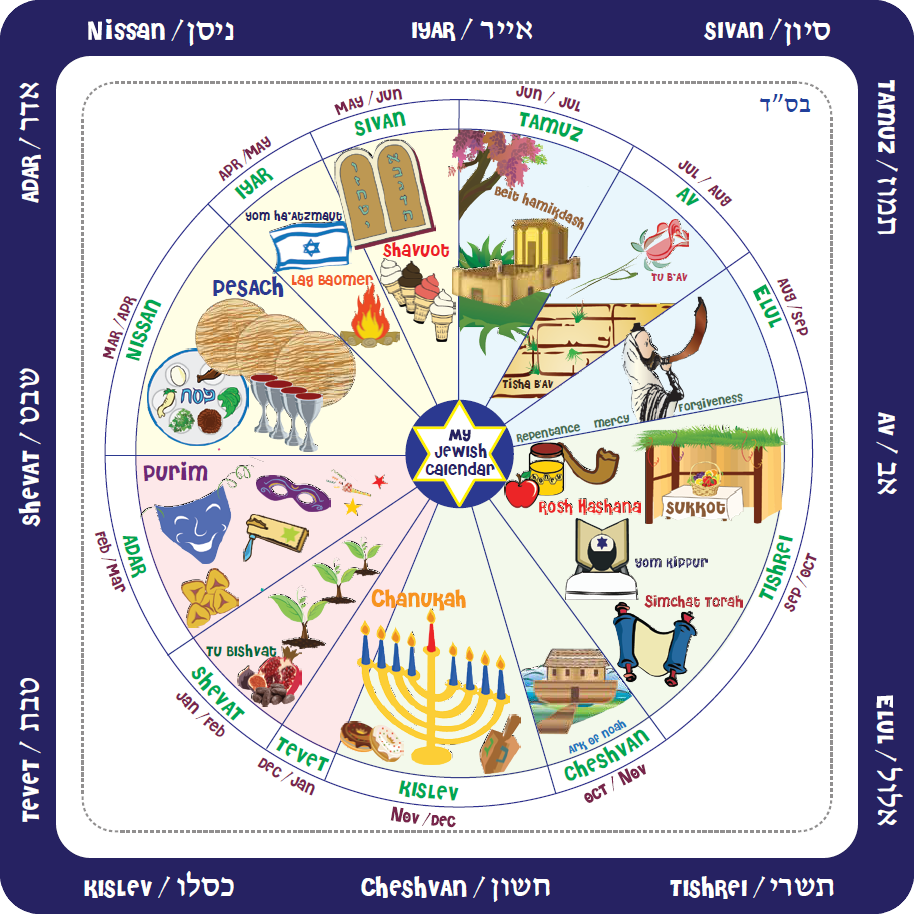
Jewish-calendar-plate

Thought for Shabbat

The end of this week’s Torah portion, Pinchas, outlines the offerings to brought to the Tabernacle and later to the Temple.  It begins with the daily offerings, the weekly Shabbat offerings, and is then followed by the various festivals.

It is noteworthy that there was an offering presented by the priests every morning and every afternoon.  Sacrifices were seen by the ancients as a way to connect with God; during a sacrifice, the boundary between life and death was crossed and that mysterious and powerful act was thought to bring God’s presence nearer.  The Torah legislates that this does not happen only at special occasions or even just weekly, but rather every single day.

As a personal trainer, I can relate to this.  In ancient times, the goal of sacrifice was to draw near to God.  This could not be done in a haphazard way; it had to be done on a regular basis if there was any hope of achieving this aim.  The same is true for almost any goal we set for ourselves.  Whether in business, education or physical fitness, we need a regular program to help us get where we want to be.

I tell my clients that it is good that they see me on a (mostly) regular basis, but once or twice weekly may not be enough to lose the weight, tone up, build strength and endurance, etc.  The effort needs to be daily, lest we miss a day…and another…and another.  

Parashat Pinchas reminds us that this approach is valid not just in our earthly pursuits, but in our quest for the Divine as well.

Shabbat Shalom!

More News on Dementia and Lifestyle

Image result for factors to prevent dementia

Well, it’s not really “news” since it is simply reconfirming what we already have seen in recent research.

There are studies recently shared at Alzheimer’s Association International Conference last week that show that there are five factors that have been shown to significantly reduce the risk of developing dementia later in life.

Both studies pointed to:

  1. A healthy diet
  2. At least 150 minutes a week of moderate to vigorous physical activity
  3. Light to moderate drinking (alcohol)
  4. No smoking
  5. Engaging in mentally stimulating activity

Engaging in all five decreased risk of Alzheimer’s by 60% compared to those who only had one healthy behavior. Those who added only one of the habits above saw their risk lowered by 22%!

It is becoming more and more clear every day that the decisions we make about our lifestyles at every point in our lives have implications downstream. There is no point at which we are “too late” to add healthy behaviors, and when we do add them the impact is noticeable.

For the full article in http://www.cnn.com, click here: https://www.cnn.com/2019/07/14/health/dementia-risk-lifestyle-study/index.html

Judaism teaches us that we are to pursue life. This means we cannot simply wait around and see what is in store for us health-wise. We must at every moment, make healthy decisions; not only will we sense the difference now, but in the years ahead as well.

Losing Weight: It’s All About the Math

Numbers

Those of you who follow my blog know that for the last few months I have been “struggling” to take off the weight that I put on during my mostly sedentary recovery from foot surgery.

Newsflash: going on a week-long Alaska cruise does NOT help the cause. Luckily, I only put on two pounds during the vacation, but it could have been worse.

When I returned home, I had the latest issue of ACE Fitness Magazine weighting for me. Much of the issue was devoted to discussions about nutrition and weight loss. There were articles about the latest trends in dieting (Keto, for example), the debate about whether eggs are good for us or not, as well as the latest research on the role of carbs.

The issues are usually not clear cut. Keto, for instance, is an effective method for dieting IF you can actually stay on the diet. The food choices are so limited that it is estimated that 50% of folks who try it do not last long enough to see results. It is also not recommended for older adults since the lack of protein in the Keto diet can contribute to loss of muscle mass–a serious issue as we age.

As was the case in many articles in ACE Fitness Magazine, the conclusion is that “more research is needed.”

So what do we know? A simple truth: weight loss is achieved when we burn more calories than we put into our bodies. It is a simple question of mathematics. If we eat 3000 calories worth of food but only burn off 2500 each day, we will put on weight (approximately one pound/week). On the flip-side if we burn 3000 calories per day and only eat 2500, we will lose about a pound a week. Simple math.

How does this effect me in my weight loss journey? I have started using the My Fitness Pal app again; I stopped on the vacation. This app (there are others out there) allows me to calculate how many calories I am ingesting, how many I am burning through exercise and activities of daily living, and suggests a proper calorie intake per day to achieve my goals. I have to be super-diligent to make sure I enter in the info in order to actually have this work. The app works on one simple principle as well: math. The numbers don’t and won’t lie.

We should all feel free to try different diet plans, but there are certain underlying truths:

  1. Eat less processed foods.
  2. Increase consumption of vegetables and fruits.
  3. Eat fats and carbs in moderation; try to switch out saturated fats for unsaturated fats.
  4. Burn more calories than you consume through eating.

I will keep you posted on my journey. The fact that yesterday was a Jewish fast day (17th of Tammuz) did help the cause, but I know there is a lot more work ahead to get me back to where I was pre-surgery.

Good thing I always did well in math class!

Back from Alaska renewed?

Alaska-0021

I write this Thought for Shabbat from the airport in Houston on my way back from a wonderful vacation with Michele. 


We had the good fortune to travel to Alaska for a tour/cruise. It was a beautiful trip with great memories. 

We went primarily to see the majesty of nature before it is altered beyond recognition by global climate change; unfortunately, so much damage has already been done and we saw and experienced it first hand. It renewed in me the need to act in ways that are sustainable and even help to reverse the damage that has been done. 

Princess Cruises’ motto is “come back new.”  I certainly feel refreshed, but I think I’m still me. What is new, is an appreciation of the enormity and beauty of God’s Creation—and the obligation that each of us has to “till it and tend it.”


Shabbat Shalom!

Korach and Leadership

ORT-21 Tochka

Parashat Korach is considered by many to be the most revolting Torah portion there is.  (See what I did there?)  It is about the rebellion of Korach, Datan and Aviram against the leadership of Moses and Aaron as the Israelites began their wanderings in the wilderness on their way to the Promised Land.

At first read, the case brought by Korach and his followers seems like a legitimate challenge.  They want to know who put Moses and Aaron above everyone else; after all, are not all the Israelites holy?  Traditional commentaries have noted that their complaint was really a cover for a power grab.  Whereas Moses felt a responsibility to God and the people, it appears that the rebels were more interested in elevating themselves.  These are two very different views of leadership, and ultimately God makes it clear which one is preferable; Korach and his followers were swallowed whole into the earth.

On this post-Independence Day Shabbat, we reflect upon the history of our nation.  Like at Passover, we recognize the value of the freedoms that we sometimes take for granted.  We also consider those whose leadership—like Moses’—brought us through many challenging times.  It has been the sacrifices of members of our Armed Forces that have helped to ensure our freedoms, but it has also been the service of duly elected officials that have labored on behalf of the people.  Likewise, each of us has a responsibility to hold our officials to the standards set by our Constitution and our history; that is part of what we do to preserve this grand democratic experiment.  Let us be wary, though, that we do so for the right reasons—not for a power grab, but rather to benefit all those with whom we share this great country.