Overcoming the Odds

Hanukkah menorah

When most people think about the holiday of Hanukkah (today is the 5th day out of 8), they think about the miracle of the oil that lasted for eight days even though there was only enough for one. What oil, where, and when remains a mystery to a lot of people.

The story of the oil that is the basis for lighting a Hanukkah menorah is found in the Talmud and is considered a legend rather than historically verifiable fact. The story of the miracle was meant to help bring God into the picture, when from a historical standpoint the holiday celebrates an event in which God may not be readily apparent. At its heart Hanukkah is about a military victory.

Over 2000 years ago, there was a strong Hellenizing (Greek) influence in the Jewish world and the Land of Israel. There was a great deal of assimilation to the point that a statue of a Greek god was placed in the Holy Temple in Jerusalem. This was too much for traditionalists who formed an army–the Maccabees; they fought the Assyrian Greeks and defeated them, even though the Maccabees were outnumbered and outpowered. This allowed the followers of the Jews to purify and rededicate the Temple; they also rooted out the Greek influence that had become so prevalent. The original Temple built by Solomon was dedicated over an eight-day celebration, which is why Hanukkah (which means dedication) was also an eight-day festival; the story of the oil is just icing on the cake really.

What does all of this have to do with fitness? After all, this is a fitness blog. Although Hanukkah is really about religious freedom and autonomy, it is also about our ability to overcome great odds when we set our minds to it. This is true in fitness as well. When I was 40, I never would have thought about running a half-marathon, but when I was 51 I did it. Of course, it took a lot of training, but it also took a change in my way of thinking. I began to consider not my limitations, but rather about the possibilities. I cannot help but think that the Maccabees did the same thing; they could have looked at the overwhelming forces of the opposing army and simply given up, but instead they fought with valor and tenacity until they were victorious. Jews today owe our existence to their grit and determination.

Hanukkah is a known as a festival of miracles. The miracle of the oil is a legend; what seems miraculous is the way in which the Maccabees overcame the odds. We are no less capable today of creating miracles in our own lives–whether it has to do with our education, our relationships, or fitness. We can overcome the obstacles (most of which we put in front of ourselves) and make miracles happen.
6 Month Kidney-versary

Today I have a lot for which to be thankful. I have been blessed in so many ways: an amazing wife, incredible kids, excellent friends, a fulfilling career, a wonderful community, and good health.

I am also grateful that this past year I was able to successfully give the “gift of life” by donating my left kidney to someone with advanced kidney disease. I have worked hard over the last couple of decades to eat right, exercise, get plenty of rest, and practice other forms of self-care. It has paid off. I have always said that one of the best motivations for being physically active and eating right is in order to be healthy enough to help those around you–sort of like the message of the air masks that fall during an unlikely cabin depressurization; I have helped myself first, and then assisted others around me. This has been the focus of my career as a rabbi and now as a personal trainer as well. I never imagined, though, that I would be able to donate an organ (at least, while I was alive)–especially at the age of 58–but all those years of watching what I eat and going to the gym helped make it possible–not only for me, but for the two people and their loved ones who benefited from my donation.

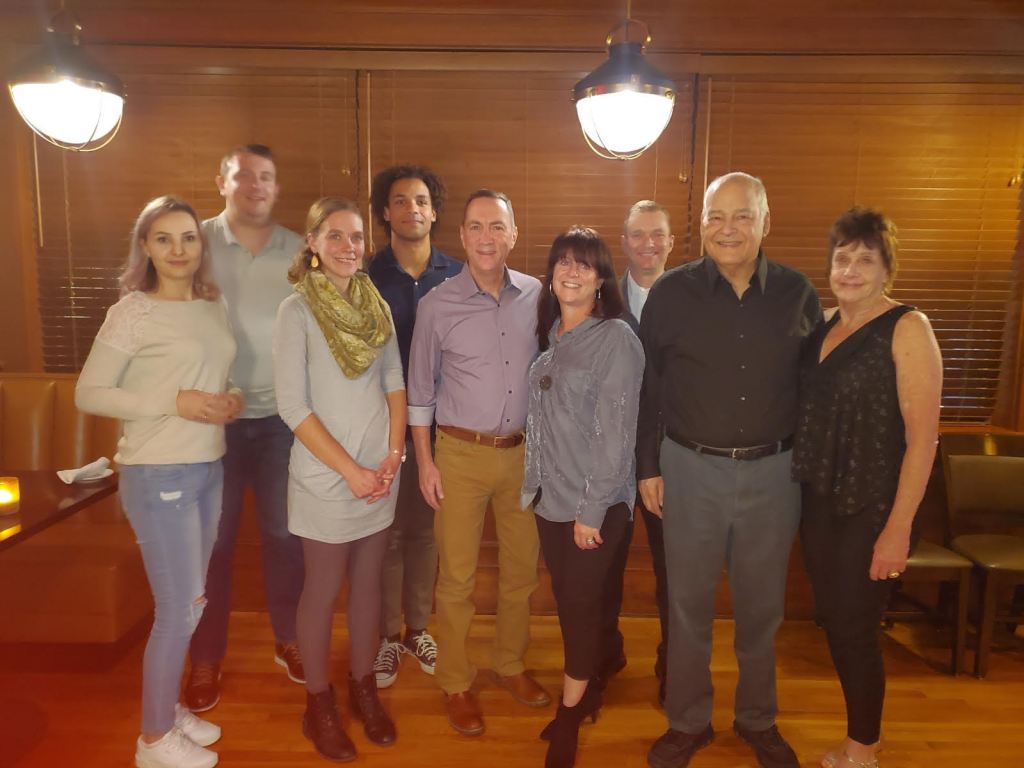
A couple of weeks ago we had a 6-month Kidney-versary dinner here in Cleveland (pictured above). It was great to get the three donors and three recipients and their spouses together. It was even better to see everyone doing so well. I hope that we will continue to get-together as we are able to give thanks for the miracles of modern medicine that make it all possible–along with the outstanding doctors, nurses, and other caregivers. We are now all tied together by a very special bond.

For the first time this year, I feel like I am truly thankful not only for what I have, but for what I am able to give. I look forward to more opportunities to continue on this path…but I do plan to keep my other kidney!

Wishing everyone a happy and healthy Thanksgiving!

One Year as a Self-Employed Trainer

Champagne

Today marks one year since I left my position as a trainer at the local JCC. I had worked there for over two years and it was the first position I got after my certification. I am grateful for the friendships and experience that I got, and that management was willing to take a risk in hiring an “old guy” like me. Being new to the Cleveland area, it was a great way to connect with the local Jewish community as well.

In late summer 2020, though, I decided that I wanted to branch out and try training privately. It was certainly slow at first, but the pandemic actually helped. Many folks felt uncomfortable/unsafe going into fitness facitilies and either wanted to train virtually or one-on-one at their home. Within a few months it was apparent that I was onto something; there was a need for someone who worked exclusively with older adults, understood their particular needs, was affordable, and convenient. I knew it was a big leap to go out on my own, but I also knew that, as they say in Yiddish, “you can’t dance at two weddings.” In other words, it is difficult if not impossible to grow a new business while still employed somewhere else. If I wanted to At Home Senior Fitness to thrive, I would need to give it my full attention. November 15 was my last day at the JCC and I have not looked back.

I am really happy to report that I have a full book of clients. I am working with a great group of older adults and am gratified to see the progress they are making. I have clients from as far west as the Bay Area in California and as far east as Ashkelon in Israel. I am training virtually, in-home (within 5 miles of my home), and leading a regular fitness class on-line three times/week. My clients range in age from 58 to 93. Some are quite agile and active; others are recovering from strokes and other serious health conditions. A hallmark of At Home Senior Fitness is that the program is never “one size fits all;” each client has a fitness plan designed especially for them that will keep them safe, injury-free, and working toward their goals.

The biggest news is that I was recently tapped by a local publication for older adults to be their “expert” on fitness. I will be a regular contributor with a column appearing in each issue. This is really exciting and a great opportunity to expose many seniors to the idea of keeping fit as we age. I will share more details as I am able.

I look forward to what the next year will bring. Stayed tuned for more exciting announcements about what is planned for 2022.

Finally, a big thank you to my clients and to all those who have supported me on this journey (especially my patient wife!). You all give me a reason to be up and at ’em each day!

This $h!t Really Works!

Waimaku Falls

This is the view that greeted us last week after a one-hour uphill hike at the Haleakela National Park on Maui in Hawaii: the Waimaku Falls. Of course, this picture does not do it justice; there are actually three separate falls cascading 400 feet into a clear cool pool that empties (eventually) into the Pacific Ocean. This was not an easy hike; there were lots of steps, stones to climb up, and a few slippery spots. The views were magnificent and part of the hike passes under a giant banyan tree, while another section traverses a bamboo forest. Simply breathtaking and unforgettable!

As a personal trainer working with older adults, I have noted that my clients have different motivations for why they choose to exercise, and why with a personal trainer. One of the key reasons is that they want to be able to remain active and do the things they enjoy for as long as they can. A significant number enjoy traveling (whether on vacation or to see family), and they want to be able to get up and go…instead of just sitting on a couch. Not all of my clients would be able to climb up to Waimaku Falls, but a good many would. Earlier in the week we saw a fair number of older adults climbing to the top of Diamond Head in Honolulu. It was impressive. A regular (and supervised) exercise routine can help make this a possibility.

This past May, I had a pretty major operation. The trip to Hawaii was planned before I knew this surgery would take place. My regular fitness routine helped with my recovery and made it possible for me to do these two hikes without really thinking too much about it–aside from sunscreen and water. Additionally, I was able to snorkel, walk long distances, and even take surfing lessons! I hope that I never take for granted that the work I put into keeping myself fit makes all of these adventures possible. I do appreciate that it allows me to be able to keep up with my pre-K and elementary-aged nieces and nephew. I am proud that I rarely have to ask: am I up to it at age 58?

More adventures are planned for the future (God-willing). There are more reefs to snorkel, More mountains to climb. More journeys to begin. I sometimes have wondered whether the exercise and proper nutrition are worth the trouble, but after these last couple of weeks in Hawaii, I have concluded: this $h!t really works!

Put Your Money Where Your Mouth (and Your Values) Are

Money Roll - $100 Dollar Bills

Just a couple of weeks ago, I gave a “sermon” on the evening of Yom Kippur about aligning our actions with our words and values.

I focused on a time-management tool with which many of us are familiar; take a piece of paper and divide it into 2 rows and 2 columns. At the top of one column put “Important” and at the top of the other put “Not Important.” In front of one row put “Urgent” and in front of the other put “Not Urgent.” The exercise is to review an entire week and categorize each activity on the grid: laundry, grocery shopping, watching Netflix, exercising, working, studying, etc., and attach a time component to it, ie., how many hours were spent doing each activity. Finally, do the math. How much time was spent on activities that are not important? How much on stuff that is not urgent? Ideally, anything that is not urgent and not important should grab the least amount of our attention, time, and energy; conversely, we should focus on those things which are important and urgent. How well does this line up in reality?

This is not just a question of time. It is also a question of our finances. How much money do we spend on things that are not important or do not line up with our values? A recent FaceBook post by Amanda Malcolm-Brown addressed this very issue. She relates it to our health and fitness. How many of us complain about the high cost of gym membership or personal training, but are willing to drop a lot of money to go to a pro football game? Why will we spend a fortune at a fancy restaurant, but balk at spending a little extra at the supermarket for foods that are healthier for us? Malcolm-Brown notes that what really counts are our actions–not our thoughts or intentions. This is, of course, a statement that aligns with Jewish values and is at the core of the High Holidays and the Kol Nidre (Yom Kippur eve) service.

Here we are in the last quarter of 2021 (or the beginning of the Hebrew year 5782); what can we do now to ensure that our actions (and money) help us to reach our goals? Perhaps a good start is to take a piece of paper, divide it into four quadrants….

Weights? We Don’t Need No Stinkin’ Weights!

Pushups

As the pandemic wears on, more and more people who used to be regular gym-goers are realizing that it has been 18 months since they have stepped foot in a fitness center. Some have found other ways to keep fit, but many have simply stopped working out altogether. It is a sad reality, and one whose end is not necessarily in sight.

One of the issue stopping people from working out at home is that they lack the equipment found in gyms. I have been working virtually with clients (first for a local gym, and then in my own business “At Home Senior Fitness”) since the earliest days of the shutdowns in 2020. By now, many of my clients have at least a couple of dumbbells or perhaps some resistance tubes. Even so, I am able to put together workouts for clients that use body weight alone. This is especially helpful when clients are traveling and cannot bring equipment with them.

Is a body weight workout effective? The answer is a definitive yes. To paraphrase the classic film The Treasure of the Sierra Madre, “Weights? We don’t need no stinkin’ weights!”

Of course, there are certain principles that should be followed. As in workouts using weights/resistance, the best results occur when there is a pattern of progression. In other words, either increase the weight being used, decrease the rest period between sets, increase the number of reps and sets, etc. In a body weight fitness regime increasing the weight does not figure in, so it involves getting more creative. There are many ways to make the workout more challenging: single limb exercises, changing the angle, increasing tempo, introducing hybrid exercises, etc.

It should go without saying that this applies to resistance training, but it is also the case in cardio workouts. Treadmill, ellipticals, and stair climbers were created to replicate already existing body movements. Instead of a treadmill, one can walk or run on a street or trail; speed can be varied and (depending on where you live) so can incline. Running or jogging can replace ellipticals, although the impact on joints is much greater. Bicycle riding can replace a stationary bike, and one can simply climb stairs! We have become so accustomed to thinking that we have to go to the gym, but it is possible to be fit–and even “ripped”–without using equipment.

Finally, a body weight workout regime requires a lot of creativity. Every piece of equipment in a gym is designed to work a certain muscle or muscle group; these muscles can be exercised without that equipment as well, but it may take a fitness professional to help adapt them. Finally, a personal trainer can help to ensure that a body weight workout is not only effective and safe, but also fun!

Weights are great, but their absence should not be a reason for avoiding a workout. The good Lord gave us all bodies, and we can use them creatively to keep ourselves fit and healthy.

All The Promises We Have Made

Promise?

This evening as the sun sets, Jewish people around the world will gather in synagogues (and around laptops/tablets/cellphones) to begin the holiest day on the Hebrew calendar, Yom Kippur.

The day begins with a rather unusual ritual–but one that is filled with great power and emotion. The Kol Nidre prayer is recited as the sun sets and is actually not a prayer at all. It is a legal proceeding requiring three witness; usually each of them will hold a Torah Scroll taken from the Holy Ark to symbolize the importance of the goings on. Kol Nidre literally translates as “All Vows,” but can also mean “All Oaths,” or “All Promises.” The proceedings take just a few minutes (the legal formula is recited aloud from the prayer book three times in a row), but they have great impact. The aim of Kol Nidre is to pre-emptively nullify any promises we might make during the coming year that we are not able to keep; in some communities, the formula in Hebrew is slightly different and it asks for forgiveness and nullification after the fact for last year’s vows.

What a strange way to begin the holiest night of the year! It does, however, make sense upon deeper reflection. The 24 hours of Yom Kippur will be spent in prayer and reflection; it is a full day to consider our actions in the past and what we hope to accomplish going forward. It is like making New Year’s Resolutions but with more serious implications. We pre-emptively ask God to forgive us for making promises (to ourselves and to God) on this occasion that we may not be able to fulfill; promises to others do not get a free pass–we must make good on them.

What is the point of making such vows in the first place if we can just have them annulled? It is like making a promise with your fingers crossed behind your back! The Rabbis who put this service together stressed that we should really avoid making vows altogether; there is a whole section of the Talmud on this topic. Kol Nidre reminds us that if we are going to do it, we better be serious about it; better not to promise at all and over-deliver than to promise and not deliver.

This, of course, has implications not only for our spiritual life but for our physical well-being too. We often promise ourselves to go to the gym, or eat more healthy foods, or drink less alcohol, etc., but make little progress. Kol Nidre teaches us to be more realistic. If we are going to make a promise, we should be serious about it; this involves not just deciding on it at the spur of the moment. It means knowing ourselves and what makes us tick. It also means having a plan to accomplish our goals, including opportunities for little victories that will further motivate us.

I find this approach comforting. Kol Nidre recognizes human nature. We often make the same mistakes over and over again; this service urges us to be kind to ourselves and be realistic about what we can and cannot accomplish–spiritually and otherwise. We do not have to be perfect. When it comes to our fitness, in particular, it is better to start small rather than make huge commitments only to burn out soon afterwards. It is also important to find ways to be accountable for our actions. What roadblocks have we met in the past and how can we overcome them this time? What can we do to set ourselves up for success? Who can help us reach our goals? What will success look like?

As we begin Yom Kippur, I wish all those who observe a meaningful fast. May the promise of the coming year include promises kept for our spiritual and our physical well-being.

An Accounting of our Health

Shofar and Candlesticks

Rosh Hashanah, the Jewish New Year, begins this coming Monday evening at sunset. It ushers in a period known as the Ten Days of Repentance that ends with Yom Kippur, the holiest day of the year.

Unlike the frivolity and celebration of the secular New Year, this ten-day period is more serious. It is ideally spent in prayer and reflection. Traditionally, Jews review the last year in what is called in Hebrew, Cheshbon HaNefesh, literally an “Accounting of the Soul.” We look at the “asset column” of the positive things we did in the last 12 months; and then we look at the “debit column” of things that did not quite work out well, where we could have done better. Hopefully the good outweighs the bad, but no matter how the ledger sheet balances out, our attention turns to how we can do better in the coming year.

As a rabbi and personal trainer, I see an intersection between the “Accounting of the Soul” and an “Accounting of our Health.” Of course, there is spiritual health, but none of that is possible unless we take care of the body in which our spirit resides. Additionally, Judaism teaches that in the final analysis we are judged not by our thoughts/beliefs, but rather by what we do. “Doing” requires a body that is well enough to act. We can have all the best intentions to make our lives and the world around us a better place, but ultimately we have to find a way to move past intentions into action. This requires our body to be healthy.

The connection between body and spirit is well established in Judaism. At this time of the year, we would be wise to not only consider spiritual matters; we should also commit to living in a way that allows our bodies to bring blessing and holiness to others. An “Accounting of our Health” should be part and parcel of this holy season.

Best wishes to all those who celebrate Rosh Hashanah for a happy, healthy, and fit 5782!

Not Going Back to the Gym?

Chicago-approved exit sign

The New York Times ran an article at the beginning of the year that addressed the changes that had occurred in the fitness industry–in particular with fitness facilities–since the onset of the COVID-19 pandemic. It focused on individuals who decided to forego the gym and were willing to pay thousands of dollars for personalized workouts. The examples in the article were somewhat extreme, but they point to a significant trend that has been addressed in later publications as well.

Gyms are having a tough go of it. During the time when gyms were shut down, people invested in equipment to use at home; some spent heavily on products like Mirror, Peloton, weights, mats, etc. I have an elliptical in my home now too! The spending spree continued when gyms re-opened but much of the public was reticent to re-enter them. I work with some clients who have nothing more than a pair of 2-pound dumbbells, but I also have clients with an array of weights, exercise balls, resistance tubes, and cardio equipment such as recumbent bikes and treadmills. With so much invested at home, why return to the gym…and start paying those monthly fees?

Still, there was something that was missing. For many people, it is hard to stay motivated at home. There are those that worry that they may not be using the right equipment or using it correctly. Enter people like me, entrepreneurs who have stepped into the personalized virtual and in-person training domain. I started my business just under a year ago and left the gym where I worked a few months later; my schedule is almost completely full and the inquiries continue on a regular basis.

What I offer is more convenient, less costly, and no less effective. There is no monthly gym membership to pay in addition to my personal training fee; I have much lower overhead and can pass those savings along to my clients. There is no commute–either I come to the client’s home or we Zoom–which is an extra bonus for older adults. There is also no worry about whether the guy coughing on the next treadmill over has been vaccinated or not.

This business model is one that I imagined before the pandemic arrived; the events of the last 18 months only accelerated the demand for it. Offering a niche service–training only older adults–has put me in even higher demand. The next step is finding ever more innovative ways to meet seniors in the virtual and “real” world to help bring fitness to an often-overlooked demographic knowing that many senior adults will never go back to the gym. I am proud of the work that I am doing–and, more importantly, of the results my clients are seeing.

Not going back to the gym? You are part of a growing trend. The next question is: what are you doing to keep yourself fit and healthy as the pandemic drags on…and in the years beyond it?

Decrepit No More

Decrepit in the Rain

It was late 2020 when I got a call from a woman responding to an advertisement I had placed in the Cleveland Jewish News for my personal training business. She told me that primarily she was calling about her husband; he was in his mid-70s and in her words “decrepit.” Could I help?

I met with them, and after making all the proper arrangements began training with him 3 times per week for 30 minutes at their home. This was before vaccinations were happening so we were all masked up and training outside on the back deck when possible. I do not know if I would have used the word “decrepit,” but there were a lot of issues: balance, stamina, strength, and flexibility. I created a program specific to his needs and abilities and stuck with the plan.

It was tough going at first, but it was clear that progress was being made. It was proof to him and his wife–and to me–that we are capable of making positive changes in our levels of fitness at any age. It also demonstrated that the definition of “too far gone” needs to be rethought. Things for my client were looking great!

Unfortunately, he had a serious stroke a few months ago. I was worried that all of the progress would go down the tubes. On the contrary, the work we had been doing together helped prepare him to be successful at the inpatient rehab facility where he was for several weeks. He was their star student! Imagine my surprise when I started working with him again and he looked even better than before the stroke; of course, there was (and still is) a lot of work to be done to maintain and increase strength and mobility, but without a doubt between rehab and our workouts he was making a comeback.

Yesterday at his first workout of the week we commented on how he no longer looks or feels decrepit. It took about 8 months–and a stroke intervened–but this guy is proof that a supervised fitness program for older adults can be the difference between independence and decrepitude.

I know this is only one example, but I see progress with all of my clients. Word needs to get out so that older adults can begin to think differently about themselves and their fitness. As we age, we need be decrepit no more.