
The Mental Work of Working through Physical Recovery

It has been one week since my foot surgery and hopefully only another three until I can walk again.
The physical recovery has not been as difficult as dealing with emotional issues that come along with an injury/illness. The first few days after surgery were not that tough; the block on my lower leg meant that I did not feel anything below the knee–especially pain. Once that wore off, I began to feel the discomfort. I really wanted to avoid taking pain meds since I don’t like the side effects, so I’ve been icing and trying to take it easy with several doses of acetaminophen daily. Today I wanted to go to morning minyan (prayer services); I got up, showered, got dressed, but was in too much discomfort to go. Big bummer.

The past several days have been difficult since I am so accustomed to doing a lot of the work to prepare for Passover. For those unfamiliar, imagine two Thanksgiving Dinners two nights in a row, but having to start with all new ingredients. In the past, I did a huge amount of the work and my wife pitched in with some sides and desserts. We were so excited to be doing all the preparation for the Seders together this year, but it ended up being all her. I tried to help where I could, but I felt kind of useless.

That feeling was made worse when I started receiving all the emails from the gym that all my clients were being cancelled for the entire month. That is a tough situation for anyone, but when you are just starting out in the industry and trying to build your client base, it feels devastating (even if the real effect may be much less). Since I don’t know what my recovery will be like and whether I will ever be back to where I was nine months ago before the pain began, there is an added level of anxiety. Will I be able to get back to training as quickly as I want? Will I have restrictions? Can I be successful at this new endeavor in my life? All questions swirling in my head.

It is always nice to have an objective party to discuss these issues with, and I did that today. I have in my mind that these four weeks are just a total write-off, but I can use this time productively. I will spend the week studying and hopefully obtaining my Functional Aging Specialization. Getting ready for that basically requires me to sit on my butt and read…I think I can do that this week. I also have to take things one at a time; I think we can all sometimes get into a downward spiral and follow a rabbit hole into the worst-case scenarios. I have to stop myself and let things unfold as they do without getting ahead of myself.

What has surprised me is just how much this recovery from surgery is emotional as well as physical. I have to deal with not working out, which is my usual stress reliever. I have to consider the possibility that my body may not fully recover. I have to face the fact that I am aging; this doesn’t mean that I’m all washed up, but rather that I have to change my approach. Hopefully, that awareness will make me a better Personal Trainer in the long run–especially as I train those in my peer group.

Wishing everyone a Happy Passover, belated Happy Easter, and all the best in whatever you celebrate. I also celebrate the process of healing–physically and emotionally. But it is hard work!
Another reason why Seniors should be Weight Training

In all my courses, we have been taught that working out–and especially weight training–is good for individuals at any age. Current trends are aimed at getting the 50+ crowd to understand the importance of resistance work along with cardio exercise.

I am currently recovering from foot surgery and will be unable to walk for four weeks. I have a scooter and crutches; they are tools, but they cannot perform all the functions necessary to get around. Thank goodness I have been working on building muscle strength over the years. I have found that I can balance on one foot for a while (thanks yoga!), push and pull myself up, hop around my car to get to the scooter in the trunk. It is the difference between having some independence and none at all.

This is an argument that should be made to seniors. Weight training isn’t necessarily about have a killer beach body; we need the strength to help us navigate the Activities of Daily Living. And when we do find ourselves with an injury, hopefully the hard work of resistance training we have put in will allow us to compensate for our deficits (in the long- or short-term).

As someone who has never had to rely on devices to help me ambulate, I have learned a lot in the last few days. I get why we have extra-wide handicap spaces. I get why we have ramps. The ADA has gone a long way to making public places accessible. If, however, we lack the basic strength to make use of these accommodations, what is the use?

We are never too old to lift weights. Muscle degradation does not need to be in our future. Seniors: get off of those treadmills a few times a week and get to the dumbbells! You’ll be glad you did.

Learning from our Challenges, and Applying it to the Work We Do

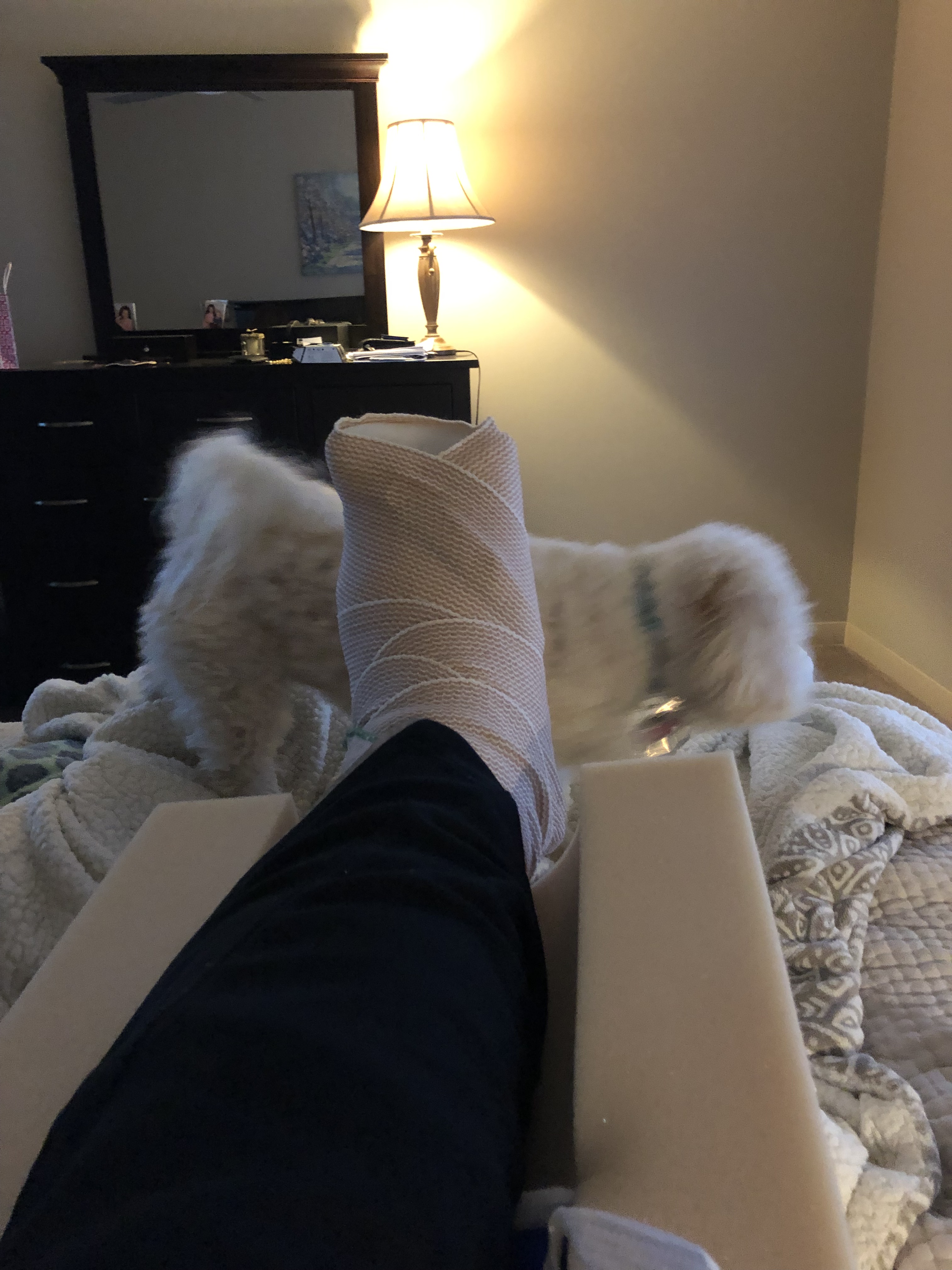
The dog trying taking care of me

I am used to being very active–at the gym every day except for Shabbat training and working out. For the last 8 years or so I’ve been a runner: 3 half-marathons, more 5k races than I can count, several obstacle course races. So the thought of having to not WALK for four weeks is killing me!

I started having heel pain (most likely Plantar Fasciitis) back in late September when I was training for the Columbus 1/2 Marathon; it was a few weeks before the race so I couldn’t quit. Besides, it didn’t hurt when I ran…only afterwards. I finished the race (with my personal best time) but within a few days I knew I had a problem. I went to my podiatrist and we went through the usual conservative steps: new orthotics, stretching exercises, cutting down on the running. I even had a boot to wear at night that was supposed to flex my foot, but that was more annoying than the foot pain. Finally, I spent the last 5 weeks in a boot that went up to my knee. Unfortunately, while it improved at first, when I tried to walk for one hour without the boot, the pain was back.

Yesterday was surgery: stretching the Achilles Tendon was part 1, thinning out the plantar fascia was the part 2. Today I got my knee scooter so I can begin to get around again. Still, it is unclear how much or whether I’ll be able to train for the next month. I’ll need clearance from my doctor before I can go back to being on the Fitness Center Floor.

I am being forced to take a break–for a while at least. It makes me nervous. I rely on my workouts to ease stress, keep in shape, and for the social element as well. Training also helps to pay the mortgage. If I am unable to train, perhaps I will see if I can work at the Welcome Desk so I still feel a part of things.

Here is my real concern. All along I’ve told my doctor that I just want to be able to run again. We all have met people who tell us “I used to be a runner until….” I’ve also met folks who have said, “I was told I would never _____ again, but I did not give up.” I’d like to think I will be in the second category, but I hope I don’t have to make the choice.

When I am “fully recovered,” I hope I’ll understand what this all means. In the meantime, I now have a greater understanding and empathy for my clients who have had injuries or surgeries that have limited their ability to do the things they are accustomed to doing. When we talk about “Activities of Daily Living,” I now have a better sense of what that means.

When I am met with challenges, I always try to learn from them and then apply them to the work that I do–as a rabbi and as a personal trainer. This time will be no different. I will keep you posted on my progress.

WSJ: Forget the Hotshot Trainer with the Six-Pack, Boomers Want Mature Fitness Coaches

This is the title of an article that appeared yesterday (April 8, 2019) in the Wall Street Journal. The article by Hilary Potkewitz notes that seniors are going to the gym in record numbers; at the same time the demand for trainers in their 50s and 60s is going up. The article contains some statistics as well as a lot of anecdotes about this trend.

I know that many of my clients are on the “senior side” of things, and part of what attracted them to meas a Personal Trainer is that I am 50+. I understand what an aging body feels like. I know that the vast majority of seniors are not as interested in what their bodies will look like at the beach or pool this summer as they are about their ability to carry out the activities of daily living (not that a killer bod wouldn’t be appreciated!).

On a pretty regular basis clients tell me about past injuries, aches, deficits in strength, etc., and in many cases I can relate because I have been there. Hernia surgery, check! Achilles tendinitis, check! Plantar fasciitis, check! Not only can I relate, but my recovery experiences help me to understand what exercises are effective and which aren’t.

This is not to say that a younger trainer might not be a good listener and even know how to do corrective exercises; there are many out there who are better than I at that. What it does say is that there is a kind of kinship of fellow travelers as we age and we think about our fitness, our jobs, our families, and our goals.

Of course, this is all good news for me and for the fitness industry. Fitness is not just the domain of the “hotshot trainer with the six-pack;” those of us with a little wear and tear have just as much to give…often with a dose of well-earned wisdom!

Functional Aging Specialization


At the end of last week, I had the opportunity to attend the IDEA Fitness Conference East in Alexandria, VA. In particular, I went to participate in the pre-conference training to receive Functional Aging Specialist Certification presented by Cody Sipe, PhD.

I had never been to a Personal Trainers Conference before and was not sure what to expect. The Conference East is the smallest of their gatherings so it was a more intimate crowd. My workshop on Thursday had between 50 and 60 people–ranging in age from 20s to 60s. I was afraid I might be the oldest one there (at almost 56) and the one who is newest to the industry; luckily, neither was the case. I actually felt that I fit in…which is a good feeling.

The focus of the day was to prepare us to pass the certification exam to become Functional Aging Specialists. What is a Functional Aging Specialist? The approach, which seems somewhat intuitive (but really isn’t) is to train seniors (50+, but more likely 65+) not by simply having them do cardio and strength training that simply works different muscle groups. Instead, the approach is individualized to each client based on their specific needs and wants. Needs: assessment can reveal where there are deficits like difficulties with balance, sarcopenia, poor reactivity, etc. We train with a program that specifically addresses the deficits. Wants: listening to the client can reveal what they would like to be able to do–be able to complete a 5k run, participate in a travel adventure that will require hiking, being able to get up the stairs without pooping out, etc. Again, we can train using a program that will help them to reach those goals.

The next few weeks will be filled with studying so that I can pass the exam. I know that this can be a great niche for me in a sector of the fitness world that is growing at a very fast pace.

Additionally, research shows that many seniors do not want to train with a shredded 20-year-old; they want to work with mature trainers who understand themselves how our bodies change as we age. More on that topic later this week.

Itโ€™s not just weโ€™re eating, but what weโ€™re not eating.

This global study of diet shows that we are at risk not from eating unhealthy foods alone. It is that at the same time we are not eating healthy foods. The reasons are numerous, and this article explains the global and regional implications.

https://www.cnn.com/2019/04/03/health/diet-global-deaths-study/index.html

When a Trainer needs a Trainer

Last week I went to Columbus and signed up for a training session with my long-time personal trainer. It had been 8 months since my move, and frankly I was a little nervous. I’ve had some health setbacks and was worried that I had atrophied while I was gone.

It was a tough workout but I made it through. What it made me realize–which is kind of like a “duh”–is that there really is a benefit to working with a trainer. Of course, as a personal trainer myself, I see the results in my clients. So many of them are reaching their fitness goals, have greater stamina, improved balance, and have taken control of their health. Sometimes it takes a trainer–not a doctor or family member or friend–to push you beyond what you think is your capability. As I said in a recent blog post: “If it doesn’t challenge you, it won’t change you.”

I left Columbus knowing that I may not need to hire a personal trainer, but that it makes sense for me to ask one of my fellow trainers (which I did) if we could work out together. We had a short 20 minute session today. He told me that he pushed himself because I was there, and I certainly went beyond my usual. It felt great!

I know this sounds self-serving, but if you feel like you are in a rut, not getting the results you want, and that you are continually playing out the same fitness drama…seek professional help. I did. You can too! ๐Ÿ™‚ Personal Trainers make a difference.

What a Vegetarian Wants…at Passover

Not this…well, at least not only this.

Passover is not that far away and if you, like me, are planning your menus for the week–and in particular for the Seders–you may be wondering if there are ways to feed your vegetarian guests (or self) that will be satisfying and delicious.

Unfortunately, most web searches turn up recipes that look great but are not necessarily healthy (fried) or that contain little or no protein. Some of them contain dairy products which would traditionally not be served at a meal where meat is being consumed. While others feast on chicken, brisket or salmon, vegetarians often get short shrift. At best it might be a vegetable dish, and at worst: “here Morrie, have some more Karpas!” Just vegetables won’t cut it. Plan ahead now.

Admittedly, finding Kosher for Passover plant-based protein sources is not easy. During the rest of the year, vegetarians often depend on legumes (peanuts, beans, etc.) for their protein, but many Ashkenazi Jews (those of Central and Eastern European descent) do not eat legumes on Passover.

Image result for legumes

Several years ago, the Rabbinical Assembly (the organization of the rabbis of the Conservative Movement) put out a Teshuva (responsum) saying that it is okay for Ashkenazi Jews to eat legumes (called Kitniyot in Hebrew); still there are many who avoid them. To read the responsum, click here:
https://www.rabbinicalassembly.org/sites/default/files/assets/public/halakhah/teshuvot/2011-2020/Golinkin-Kitniyot.pdf. Note that there are also opinions in the Conservative Movement that do not permit Kitniyot.

If you are eating Kitniyot (and so might your guests) many of your problems are solved. Most recipes that are used during the year can be converted to Passover recipes; ask your local rabbi for assistance on this if you are not familiar with the rules.

For those who still do not eat Kitniyot, creativity is called for. Luckily, most authorities (even the most traditional) allow quinoa which is a good source of protein; tree nuts are also allowed. In the coming weeks as Passover approaches, I will share some recipes that I have used and are appropriate to serve to guests at a Passover Seder: fancy, protein-filled, and not too difficult to prepare.

Until then, make sure to ask your guests what their requirements are for Passover so that no one goes home hungry…which is, of course, one of the worst sins you can commit! ๐Ÿ™‚

Simple Rules for Fitness

Several years ago an associate recommended to me the book, Simple Rules: How to Thrive in a Complex World by Donald N. Sull and Kathleen M. Eisenhardt. Although the book is really directed at the business world, it has applications far beyond that field.

The argument made by Sull and Eisenhardt is that often we seek complex solutions to problems (or we don’t seek them, but they end up being the solution we go with) when simple rules can serve just as well. The process involves getting down to the roots of the problem–understanding what is truly at work–and then applying a consistent set of rules that correspond to the values/qualities/outcomes we seek.

For example, if someone is looking for a person to fill a position at a company, s/he may receive hundreds of applications. That person may put together a team to go through the applications to find candidates who might fit. Those applicants can then be re-reviewed, etc. The Simple Rules philosophy would have him/her set very limited criteria (just a handful or less) and eliminate all those who do not fit from the get go. This cuts down on the amount of work and speeds up the process, while leaving little room for subjectivity. This is, of course, not a perfect approach…but we do not live in a perfect world. We live in a complex world, and sometimes the best approach is to simplify.

What does this have to do with fitness? Often when individuals seek to improve their fitness they come up with plans that are too complicated; they become more trouble than they are worth. Take a diet plan, for instance; counting calories, weighing portions, keeping track of calories burned in exercise might be too much for some people–especially those starting out. It is intimidating and overwhelming. The Simple Rules approach would say “come up with a few behaviors to change that are simple;” base them on an honest assessment of where you think your weaknesses are. Examples could be: it’s ok to fill my plate, but no seconds; eat out only once per week; no “grazing” after dinner; or no calories from drinks. These are not complicated and don’t require overthinking. Choose a few and change the behavior.

When I started to get more serious about my own fitness, the Simple Rules philosophy was central to my initiative. I started by committing to seeing a personal trainer for an hour each week, doing cardio at least 4 times a week for 30 minutes, and not eating after dinner (except for very special occasions). The results were easy to see and I could sense the progress. Over time, I have changed the rules, but always kept them to a few, and simple enough that I don’t need a paragraph to express it.

What do you think? Simple Rules…too simple or simply a wonderful idea? At the very least, I think it’s worth a try for those who find diet and exercise to be too overwhelming/complicated/intimidating.