It has been a distressing week in the news—more than the usual. Between the tariffs/trade wars with China, the growing tensions between the US and Iran, and the most recent passage of the strictest reproductive rights legislation since before Roe v. Wade, there is a lot about which we should be concerned—no matter our political leanings.
Often, I feel like there are forces at work in the world much larger than I, and I wonder what power I have to influence these processes for good. Frequently, we sense that there is not a whole lot that we can do. As we say in modern parlance, “it is what it is.”
Of course, “it is what it is,” is not really a Jewish value. Our tradition has never taught us to just accept things the way they are—not even the very teachings of the Torah. Everything is up for interpretation, and it is possible to come up with more than one way of looking at a problem and its possible solutions. In contrast, to “it is what it is,” Judaism’s focus has been more on looking at “what is” and imagining how to make it “what ought to be.” This is why we have such a fine tradition of kvetching (complaining); it is not just kvetching for its own sake, but rather to stir us to action. We cannot just sit and stew about the state of our community, our nation, or our world. We must find ways—big and small—to make God’s creation closer to the image that the Divine intended.
What can we do—as individuals and as a community—to make a world filled with peace, justice, prosperity and love? I don’t know for sure, but surrendering to hopelessness is certainly not the solution.
CNN reported on the new global guidelines from the World Health Organization (WHO) about preventing dementia.
The guidelines reinforce what many of us in the Fitness Industry and who have an interest in brain biology already know. Many of the gimmicks that are advertised to help stave off dementia are just that–gimmicks that are not proven to really work.
For some time now, experts in brain biology have been able to cite only one factor that is known to reduce the chances of developing dementia: cardio exercise. But wait, what does the heart have to do with the brain (sounds like a country music song)? It’s actually not that complicated; the more blood that we get pumping throughout our bodies (which is what cardio exercise does), the more blood that flows to the brain; the more blood to the brain, the healthier it is!
What the WHO guidelines add is that there are now a few other factors that also can contribute to preventing dementia: “regular physical exercise, not using tobacco, drinking less alcohol, maintaining healthy blood pressure and eating a healthy diet — particularly a Mediterranean one. “
Just one more reason to head to the gym…or outside…or to that piece of cardio equipment in the basement. Not only is it good for your heart, it is good for your brain too!
A article in the most recent AARP Bulletin (May 2019, Vol. 60, No. 4, pg. 4) highlights something that those in the Fitness Industry have been saying for years…and now there is even more research behind it.
The study began in 1995 as a joint venture between AARP (American Association of Retired Persons) and the NIH (National Institutes of Health), and tracked the exercise habits of more than 315,000 people ages 50-71. It showed that even if a person has been inactive most of their lives, getting into regular exercise can add years to our lives and quality to those years as well.
The research shows that: “those ages 40-61 who begin exercising after years of physical inactivity can still extend their longevity. They had a 32 to 35 percent lower risk of mortality. The odds of death from cancer and heart disease also decreased. Compared with those who never exercised during the multiyear study, those who exercised their entire lives had a 29 to 36 percent lower risk of death.”
This is good news indeed–especially for fitness professionals who face the skepticism of those who have never been physically active during most of their lives. Of course, the real challenge is changing that behavior in the first place. Those who have felt that exercise or taking proper care of themselves was not a priority earlier in their lives are not necessarily going to “see the light.” Usually it takes a “wake-up call” or “Aha moment” to change the way they act. It should be comforting for them to know that not all is lost; even in their later years, they can have a significant impact on the quantity and quality of years in their lives.
As for change, Judaism has always taught that we are capable of change. Most religious traditions have a similar viewpoint. This is why there is a strong emphasis in the faith community on redemption in its many forms; there is a sense that we can always improve ourselves, and as a result, the world around us. We are not stuck with “it is what it is.” We have the potential to make “it what it ought to be.”
It is that time of the year when we in the Midwest are aware that there may be time when we will either get a notice on our phone, on TV, or hear the siren and we know that we will have to head to a safe area due to severe weather. It is a part of living in this part of the country, and it seems a small price to pay to avoid volcanoes, earthquakes and hurricanes.
This week, many Israelis were forced to seek shelter over and over but for a different reason; the threat was not severe weather but rather missiles launched from Gaza. Although this happened far away, I have many Facebook friends who live in Israel for whom this was a frightening reality. I do not know how one ever can get used to the mad dash to the shelters on a regular basis—sometimes after a long stretch of quiet.
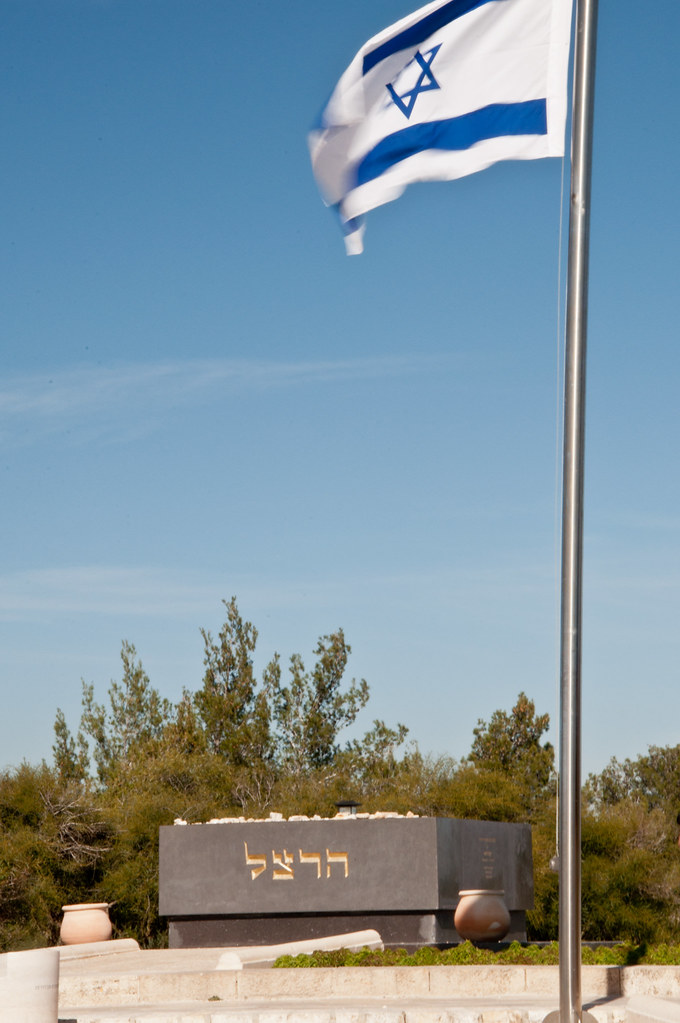
And then, yesterday (after Israeli Memorial Day on Wednesday), the celebrations began for Yom Ha’atzma’ut. Having been in Israel on Independence Day several times, I know how much fun it can be. It is a day to reflect on the many accomplishments of the Jewish State as well as the sacrifices that made it all possible.
How Israelis are able to regulate their emotions from fear of missiles to the elation of the reality of Eretz Yisrael under Jewish sovereignty again after nearly 2000 years? It takes a certain kind of special to do it, I guess.
This Shabbat let us give thanks for the many blessings that the State of Israel has brought. Let us also pray and work for the peace and well-being of all of Israel’s inhabitants. Next year, may there be no reason to fear…only reasons to celebrate!
Over the last several weeks I have been using crutches or a knee-scooter; I am not allowed to bear weight on my left leg until next week.
It has been a challenge, but thank goodness, only a temporary one. I must admit that while I am proud that the USA has the Americans with Disabilities Act (ADA), I really did not understand what a difference it makes.
This is surprising since since my son, Rami Ungar, works on a US Defense Dept. Installation in the Equal Employment Opportunity office and part of his responsibilities is to ensure that workers on the base who need accommodations due to a disability receive what they need. The ADA is a big deal for those with disabilities–and for society in general.
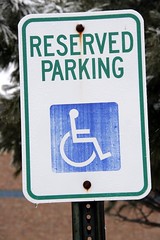
In the short time that I have been “disabled,” I have been frustrated by the following: how difficult it is to navigate in many stores, how far disabled parking spaces are from entrances, how few parking spaces there actually are, and how ramps are sometimes so steep that it is difficult to ascend and dangerous to descend. I won’t even get into the poor shape of many sidewalks and parking lots, or the people who say that my scooter “looks like fun;” I have not been honest with them about where I’d like to put that scooter. (I must admit that I have thought about adding some modifications a la Wiley Coyote…that would be fun!)
I remember in High School doing experiential exercises where we were blindfolded or had to navigate in a wheelchair. For most of the participants in these experiments, it was fun. There was a lot of laughing. It didn’t really hit the mark in terms of showing us just how challenging a disability can be; it may be fun for a few minutes, but try doing it day after day for several weeks…or even for the rest of your life.
My point? Do not for one moment feel that those with disabilities get some kind of special treatment or perks. There is nothing fun about a disability–although it has the potential to “build character.” The accommodations put in place by the ADA do not give the differently-abled an advantage; all it does is help to level the playing field. I’m proud that the USA has this act and look forward to a day when those with disabilities will find that the barriers to their full participation in society no longer exist.
Surgery was just over three weeks ago. I have one more week of non-weight-bearing, and three more weeks wearing the boot.
This means that next week I can get back to training others at the JCC. Last night I taught a small group class, but could not participate–it was a weird feeling.
Since I began my fitness journey I have had a few surgeries: Bunionectomy, double-hernia correction, emergency appendectomy (this past January) and now the surgery on my foot.
What I have learned from my past experiences:
Listen to your doctor…but also listen to your body. Doctors set guidelines for how we should “ease” back into our fitness routine, but that does not work for everyone. I have seen people have the same surgery performed by the same doctor for the same condition; one was back to work in 2 days, the other was out for 3 weeks. We all respond differently; some have surgery that is 100% successful, while others experience less success. So while a doctor may tell us that we should be able to do something (run, lift weights, etc.) we must listen to our body too. If we feel that we are nowhere near the progress we and/or the doctor expected, we must be sure to communicate with him/her.
Go slow. I do not expect to be running long distances for a while (even a mile). I will start with walking on the track, then little by little adding a couple of laps on the track (1/12 of a mile) each time. When I had my hernia surgery, I had completed a half-marathon 10 days earlier; I was in tip-top shape. I tried to hop back into running with both feet and it was big mistake. I actually pushed myself too hard and too quickly, setting me back further and causing greater pain. It was about a year until I felt full recovered. This does not mean that we shouldn’t push ourselves (see point 1), but caution is our ally.
Try to have some goals and a plan about how to get there. This is true with any kind of fitness plan, but all the more so after an enforced break. Before heading back to the gym, have a plan of how frequently and for what duration it makes sense to be doing which exercises (what weight, how many reps, how many sets, cardio or resistance). Putting it on paper gives perspective; does it look like too much, or not enough?
Don’t get impatient or give up hope. I remember after my hernia surgery thinking that I was washed up and would never recover. The reality is that I did my best work after that surgery; easily beat my half-marathon time, ran obstacle course races, won to 5ks, and became a personal trainer. Keeping a positive outlook and knowing that we are on a journey (that isn’t necessarily linear) helps our sense of progress.
Do some research. I’ve been poking around the internet and found several good articles on recovery after surgery. They all contain several common themes. Best of all, they help to set appropriate expectations. The more we set appropriate expectations, the less likely we are to be disappointed. The less we are disappointed, the more positive we are. The more positive we are, the more progress we make.
I will keep you posted on my recovery with insights I develop through the process. Let’s see how the 5 points above really play out.
My weekly musings that I share each week with Beth El – The Heights Synagogue…and now with you too!
This Shabbat is the first of many that is not a “special” Shabbat. The last two weeks were Passover, before that Shabbat Hagadol, and before that Hachodesh, Parah, etc.
Nevertheless, this Shabbat is significant to us today because it falls between two important dates on the Hebrew calendar: Yom Hashoah (Holocaust Remembrance) and Yom Hazikaron/Ha’atzma’ut (Israel Memorial Day and Independence Day—that are observed one day after the other). Their proximity on the calendar is coincidental; it is just the way it worked out in modern times. The 27th of Nissan was chosen by the Knesset in the early 1950s as the result of negotiations, putting it somewhere on the Jewish calendar between the day that the Warsaw Ghetto Uprising began and the day that the Nazis declared that the Ghetto had been completely liquidated. Yom Ha’atzma’ut, of course, was set on the anniversary of the establishment of the state, with Yom Hazikaron set the day before.
It always seemed to me that it was more than a coincidence that these two observances are so close to each other. Just as Yom Ha’atzma’ut follows Yom Hashoah, the establishment of the State of Israel followed the Holocaust. This understanding is somewhat simplistic, though.
Modern Zionism had been working on creating a Jewish State beginning in the 19th Century. Settlement and support of this venture began soon afterward and grew during the first part of the 20th Century. Many historians believe that Israel would have come into being eventually, but that the Holocaust (and the resultant world sympathy for the Jews displaced as result) sped up the process.
Each of these observances stands independently; one is not a result of the other even though they are somewhat connected. This Shabbat as we stand between these two dates, let us reflect one of the worst episodes in our history…as well as one of the most glorious. The path we follow on the calendar remind us of Passover’s message of redemption—even when it seems most unlikely.
This article, by Samantha Cassety, was featured on http://www.NBCNews.com. It is a pretty thorough explanation of how we can and cannot affect our metabolisms…and just what metabolism is in the first place.
The conclusion is something that those in the Fitness industry have been saying for years: regular exercise is good for us but may not necessarily help us lose weight; our diet is most important to dropping those pounds. On our journeys to weight loss and fitness, we need to assess our approach: we have little control over how many calories our bodies will burn, but we have total control over how many we will put in our bodies!
Readers may recall that I attended the IDEA Personal Fitness Conference – East at the beginning of April in Alexandria, VA. My main reason for going was to do the all-day training for the Functional Aging Specialist Certification. It was a great training (and I got CEC for it), but still needed to take three on-line exams in order to be certified.
I hoped that I would be able to pass all three by the end of April, but wasn’t sure if I could pull it off. Being laid up after foot surgery left me with more time on my hands so I decided to be productive. Many hours of reading and watching videos and I passed the last exam today! With four hours left in April!
As I blogged about earlier, FAI is in the forefront of fostering better practices and research in the realm of fitness for older adults. The focus is less on building muscle strength and more on working to keep older adults able to do the things they want and need to do. In other words, we address the wants and needs of our clients in order to keep them functional and independent. There is a greater emphasis on building muscle power (which helps with getting out of a chair or going up the stairs) as well as improving balance and reactivity time.
This will be very interesting for me since this is such a diverse population. Every senior presents with a different fitness and health history; there are 60-year-olds who cannot walk without assistance, and there are 80-year-olds running marathons. This kind of training requires more intense planning and specialization based on getting to know the client really well.
I will keep you posted on how this part of my “business” progresses. In the meantime, I look forward to a little celebration of my accomplishment!
The Israelites Eat the Passover, illustration from the 1728 Figures de la Bible; illustrated by Gerard Hoet (1648–1733)
Passover and fitness in the same sentence! Is that even possible? Most of us who observe the Passover holiday think of it as two nights of Thanksgiving Dinner-sized meals followed by carbs, carbs and more carbs. It is possible to eat healthy during Passover, but that’s not my focus here.
The Passover holiday commemorates the departure of the Hebrews from Egyptian slavery as told in the Book of Exodus. The events described would have taken place thousands of years ago. The Haggadah–the book that contains the service for the Passover Feast (called a Seder) held on the first two nights–tells us that each of us should see ourselves as if we personally went out from Egypt. This is a tall order; many, if not most, of us have never experienced discrimination or oppression–let alone slavery. It is a challenge to try to put ourselves in the story.
The holiday is not just about the historical exodus from Egypt, though; the underlying theme is about redemption–the idea that where we are now is not where we need to be forever. The Hebrews’ situation seemed hopeless and yet, with God’s power, they were able to make their way to freedom; not only that, Egypt–the most powerful empire on the planet–was brought to its knees in the process. This sets a paradigm for us in the world and in our personal lives. The world we live in, with all of its problems, need not remain as it is; we can make it better–redeem it as it were. On a personal level, who we are today does not define who we will be tomorrow; we are always capable of becoming more and better than we are now.
Which brings me to Fitness and Passover…
Many folks look at their own personal fitness and say, “well, this is how I am.” “I’ll always be fat.” “I can never get in shape.” This outlook becomes even more rigid as we age. All the research on fitness, however, points in the opposite direction. Embarking on an exercise and/or diet program at any age is beneficial; we are always capable of improving our health. The prevailing notion was always that as we age there are certain functions that we must inevitably lose; study after study shows that we can maintain and even improve our muscle mass, cardiovascular health, endurance and reaction time–or at the very least slow the progression of their weakening. We all know individuals who were sick and frail who, after a period of rehab, were back to “normal” or even stronger than before their illness or injury. We know that we can transcend the situation in which we find ourselves; we can get better. The lessons of Passover echo this idea; they teach us that we are always capable of redemption. Although there are chronic diseases and conditions like cancer that we may not be able to overcome, we still have greater control over our fitness destiny than we may have thought in the past.
Another connection has to do with the idea of freedom which underpins the Passover story. The Hebrews were not liberated from Egypt simply so they could run around in the wilderness without a care in the world; the exodus had a purpose. The Israelites were forced to serve Pharaoh, which meant that they could not serve God. How could they focus on their connection to the divine when every day was a struggle to stay alive? The purpose of the Hebrews’ liberation was to allow them to serve God and follow the Lord’s commandments that they would receive soon afterwards at Mt. Sinai. The Israelites were made free in order to serve; it sounds oxymoronic, but it is a profound idea.
Likewise, watching what we eat, exercising, and taking care of ourselves is for most of us not an end unto itself. We take care of ourselves so that we are able to do the things we want to do longer, more efficiently and more easily. We build strength and endurance in order to carry out the tasks of our lives. What are those tasks? Certainly much of our lives are taken up with grocery shopping, paying the bills, working, studying, folding fitted sheets (!), etc., and we need to be healthy enough to do that–but most of us look for a deeper purpose to our existence. If, in fact, one of our duties as human beings is to partner with God and our fellow humans in making the world a better place (redeeming it), we cannot do so if we are frail, weak, tired and out of shape. Ideally, we maintain and strengthen our bodies–which are vessels given to us by God–to be able to carry out our mission in the world (however you define that for yourself).
The work of redemption is not easy. It is slow, laborious and often frustrating–kind of like some of our workouts. Jewish tradition teaches us that it is not our obligation to finish the work, but neither are we at liberty to excuse ourselves from the work of redemption. One of the ways that we can ensure that we are up to the task is to prepare ourselves spiritually AND physically. We are capable of changing the world for the better…but not if we don’t first change ourselves for the better–in spirit and in body.
Chag Sameach! Best wishes for a happy and fit Passover holiday!